Foreword from our delegated safeguarding partners
Looking back on 2025-26
This has been a year of continued collaboration, challenge and progress for the Devon SCP. Across Devon, partners have worked together with a shared commitment to improving the lives of children, young people and families. Safeguarding is everyone’s responsibility, and the best outcomes are achieved when services work together.
National and local change has given us an opportunity to reflect on what is working well, where progress has been made, and where improvement is still needed. Through quality assurance, learning reviews, workforce development, scrutiny and engagement with children, young people and practitioners, we have strengthened our understanding of the difference partnership working makes. We have also challenged ourselves to look beyond activity and focus more clearly on impact, outcomes and children’s lived experiences.
One of the strengths of the partnership is the willingness of partners to work openly and constructively together. Whether responding to emerging safeguarding risks, developing new strategies, learning from reviews, supporting national reform programmes or improving frontline practice, partners have consistently demonstrated a shared commitment to learning, improvement and innovation. The Department for Education Effectiveness Review provided valuable external reflection on our progress and highlighted both the strengths of our arrangements and opportunities to continue maturing as a partnership.
Looking ahead, we know services remain under pressure and the challenges facing children and families are increasingly complex. Even so, we remain ambitious for Devon’s children. We will keep focusing on impact, listening to children and families, supporting the workforce and ensuring partnership activity improves outcomes for those who need help and protection.
Most importantly, none of this work would be possible without the dedication, professionalism and compassion of practitioners, volunteers, community groups, schools and partner agencies across Devon. Every day, people across our county work tirelessly to support children, young people and families, often in challenging circumstances. On behalf of the Devon Safeguarding Children Partnership, we would like to offer our sincere thanks to everyone who has contributed to this work during the past year. Your commitment, expertise and willingness to work together continue to make a real difference to the lives of children and young people across Devon.
- Julian Wooster (Chair) – Director of Children’s Services, Devon County Council
- Roy Linden – Chief Superintendent South Devon BCU Commander, Devon & Cornwall Police
- Su Smart – Director of Allied Health Professionals and Nursing (Statutory Partnerships) NHS Cornwall, Isles of Scilly and Devon
- Helen Casson – Devon Schools Leadership Service, and Chief Executive Officer for the Wave Multi-Agency Academy Trust
Executive summary
During 2025–26, Devon SCP continued to strengthen its multi-agency safeguarding arrangements, with a clear focus on learning, assurance, partnership working and improving outcomes for children and families. The partnership has made progress in areas such as governance, education engagement, quality assurance, use of data, child exploitation, neglect, workforce development and hearing the voice of children and young people.
However, the report also recognises that improvement is not complete. The partnership needs to do more to evidence impact, understand the profile of children experiencing the poorest outcomes, strengthen the use of data to identify disproportionality, and ensure children and families from all communities are visible in safeguarding work. This includes improving our understanding of how ethnicity, culture, Gypsy, Roma and Traveller heritage, poverty, deprivation, housing insecurity, SEND, care experience and rurality may affect children’s experiences of risk, access to support and outcomes.
The coming year will also be shaped by significant change, including Working Together 2026, the Families First Partnership Programme and preparing for Local Government Reorganisation. In this context, maintaining workforce stability, strong inter-agency relationships and effective local safeguarding arrangements will be critical. Safeguarding works best when professionals know each other, trust each other, share information well and are able to challenge constructively on behalf of children.
Introduction
The Devon Safeguarding Children Partnership (Devon SCP) was established under the safeguarding partnership arrangements introduced through Working Together to Safeguard Children 2018 and continues to operate in line with the requirements set out in Working Together to Safeguard Children 2023. The partnership brings together safeguarding partners and relevant agencies to work collectively to safeguard and promote the welfare of children and young people across Devon.
This report covers the period 1 April 2025 to 31 March 2026 and fulfils the statutory requirement for safeguarding partners to publish an annual report setting out how local safeguarding arrangements have been exercised and the difference they have made. Annual reports are an important part of partnership accountability, providing transparency to children, families, practitioners, partner organisations and government departments on the effectiveness of local safeguarding arrangements.
Devon SCP’s Multi-Agency Safeguarding Arrangements, which set out how partners work together to safeguard children, commission and publish Child Safeguarding Practice Reviews, and provide independent scrutiny, were reviewed and republished in line with statutory requirements. These arrangements continue to provide the framework through which partners identify priorities, respond to emerging risks and drive improvement.
This report follows the Department for Education’s annual report template. It sets out the partnership’s priorities, achievements and areas for continued development, showing how partners have worked together to strengthen safeguarding arrangements and improve outcomes for children, young people and families across Devon.
Section 1: Area profile and context
Local Context and Demographics
Devon has a population of 842,313 people, including 148,164 children and young people under the age of 18. Of these, around 42,960 are aged under five and 124,300 are aged between 5 and 19. Devon includes large urban areas, market towns, rural villages, coastal and farming communities, and military families. While this diversity is a strength, Devon’s geography can create challenges for children, families and professionals in accessing services and support.
Key demographic information
- The majority of Devon’s population is White (96.4%), although Exeter has a more diverse population than other districts.
- 6.2% of primary school pupils and 5.9% of secondary school pupils have a first language other than English.
- Around 23% of children live in relative poverty.
- More than 15,000 households are on the housing register, reflecting ongoing housing pressures across the county.
- 20.5% of primary-aged pupils and 23.0% of secondary-aged pupils are eligible for free school meals.
- 21.9% of children have identified Special Educational Needs and Disabilities (SEND), and the proportion of children with Education, Health and Care Plans (EHCPs) continues to rise.
- Around 35% of residents live in areas at high risk of social exclusion due to transport challenges, which can make it harder for some families to access services and support.
Health and wellbeing
Compared with national averages, Devon has:
- Lower rates of infant mortality.
- Lower rates of under-18 conception.
- Lower levels of obesity among children in Reception year.
- Higher rates of alcohol-related hospital admissions among young people.
- Higher rates of hospital admissions for children’s mental health concerns.
- Strong engagement with universal early years services, including 63% breastfeeding prevalence at 6 to 8 weeks, 86% attendance at health visitor appointments and high uptake of funded early years provision.
Demand for support and safeguarding services
During 2025/26:
- 2,254 Early Help assessments were completed.
- 5,546 referrals were made to Children’s Social Care, a 3% reduction from the previous year.
- The referral rate was 374.3 per 10,000 children, lower than both Devon’s statistical neighbours and the national average.
- 1,571 Section 47 child protection enquiries were undertaken, representing a 39% reduction from the previous year.
- There were 813 children looked after, a small decrease from 849 in March 2025 and part of a continuing downward trend over the previous three years.
Children subject to Child Protection Plans – as at 31 March 2026:
- 385 children were supported through a Child Protection Plan, a reduction of 33% compared with March 2025.
- The Child Protection Plan rate was 26 per 10,000 children, lower than both statistical neighbours (36) and the national rate (41).
- The main categories of abuse were:
- Neglect – 48%
- Emotional abuse – 43%
- Physical abuse – 5%
- Sexual abuse – 4%
What This Means for Devon
Many indicators compare favourably with regional and national averages, and most children and young people in Devon are thriving. However, some families continue to experience significant challenges linked to poverty, housing pressures, SEND, poor mental health, rurality, transport barriers and social isolation.
These factors can affect access to services, education, employment, digital inclusion, health and wellbeing, and may increase vulnerability for some children and families. The partnership is particularly mindful that children living in rural and coastal communities, children with SEND, children living in poverty, those experiencing housing insecurity, and children who are less visible to services may face additional barriers to achieving positive outcomes.
Although Devon is less ethnically diverse than many areas nationally, it remains important to understand and respond to the experiences of children and families from minority ethnic communities, including Gypsy, Roma and Traveller communities and children whose first language is not English. Small population sizes can make disproportionality more difficult to identify, but should not prevent the partnership from seeking to understand whether some groups experience different outcomes or access to support.
The partnership will continue to strengthen its use of data, audits, reviews and lived experience to better understand vulnerability, identify children experiencing the poorest outcomes, and ensure support is available at the earliest opportunity. Particular attention will be given to understanding the impact of poverty, housing insecurity, SEND, rurality and inequality on children’s lives and whether some groups are under-represented, over-represented or less well served by current safeguarding arrangements.
Recent Inspections and Findings
Inspections and reviews during 2025–26 provided valuable insight into safeguarding arrangements across Devon. They helped the Partnership understand where progress has been made, where strengths can be built on, and where further improvement is needed. The findings have informed partnership priorities, scrutiny activity and improvement planning throughout the year.
Children’s Services – Ofsted’s Inspection of Local Authority Children’s Services (ILACS), carried out between September 2024 and January 2025, identified that further improvements were needed to improve outcomes for children in Devon. The findings have continued to shape improvement activity across Children’s Services and have remained a key focus for the Partnership throughout 2025/26. Subsequent Ofsted monitoring visits recognised several positive developments, including stronger leadership, a more stable workforce, improved support for care-experienced young people, better engagement with children and families, and strengthened responses to children experiencing harm and domestic abuse. However, areas for further development remain, including the quality of planning and risk assessments, support and accommodation for care leavers, and evidencing the impact of services and interventions on children’s lives.
Devon & Cornwall Police – The HMICFRS PEEL Inspection in January 2026, recognised improvements in areas such as call handling, offender management and partnership working. However, both Investigating Crime and Safeguarding Children and Adults at Risk of Harm were graded Inadequate, with inspectors identifying concerns relating to the quality of investigations, risk assessment, domestic abuse responses and the management of safeguarding information. These findings are particularly relevant to Devon SCP priorities, including domestic abuse, neglect, child sexual abuse, exploitation and vulnerable adolescents. The inspection reinforces the importance of effective multi-agency safeguarding arrangements, clear information sharing, professional challenge and continuous improvement across the partnership.
Health Services – Inspections of Children and Family Health Devon (CFHD) and services provided by Torbay and South Devon NHS Foundation Trust provided positive assurance regarding safeguarding practice within health services. Inspectors recognised compassionate care, effective partnership working, strong safeguarding arrangements and positive experiences reported by children, young people and families. The inspections also highlighted opportunities to strengthen workforce development, address capacity pressures and ensure services remain accessible and responsive to children with complex vulnerabilities.
What This Means for Devon – taken together, these inspections present a consistent picture. Across Devon there is evidence of committed practitioners, effective partnership working and improving services in many areas. However, they also highlight common themes that require continued partnership focus, including:
- Identifying vulnerability and risk earlier.
- Workforce capacity, stability and development.
- The quality of assessments, planning and oversight.
- Effective information sharing and multi-agency decision-making.
- Robust responses to domestic abuse, neglect and exploitation.
- Showing the impact of services and interventions on children’s outcomes.
- Making sure children at greatest risk receive timely, coordinated and effective support.
These themes will continue to inform Devon SCP’s strategic priorities, quality assurance activity, workforce development programme and scrutiny arrangements as partners work together to improve outcomes for children and families across Devon.
Safeguarding Partnerships and Collaboration
Implementation of Working Together to Safeguard Children 2023
Embedding Change and Strengthening Partnership Working
During 2025–26, Devon Safeguarding Children Partnership focused on embedding the changes introduced through Working Together to Safeguard Children. With the new arrangements implemented in December 2024, attention turned to making sure they were understood, used in practice and making a difference for children and families.
Over the year, we made good progress in several key areas:
- Stronger leadership and accountability – We continued to strengthen safeguarding leadership across the partnership through our Lead Safeguarding Partner (LSP) and Delegated Safeguarding Partner (DSP) arrangements. This included the appointment of an Education Lead Safeguarding Partner and Education Delegated Safeguarding Partner, recognising the vital role education plays in safeguarding children and ensuring education has a strong voice in both strategic and operational decision-making. We also continued to review and refine our safeguarding arrangements to ensure they remain effective, transparent and meet statutory requirements. Alongside this, Devon worked closely with safeguarding partners across Cornwall, Plymouth and Torbay to promote greater consistency in safeguarding approaches, policies and assessment processes. A key piece of work has been the development of a shared Levels of Need Framework, helping professionals across the Peninsula develop a more consistent understanding of need, risk and intervention.
- Bringing more voices into safeguarding – Throughout the year we continued to involve a wide range of partners in our work. This included schools, early years and childcare providers, voluntary and community organisations, and wider community groups. Our Education Advisory Group, locality forums, practitioner forums and VCSE networks provided valuable opportunities to share learning, discuss emerging issues and ensure that our safeguarding arrangements are informed by the experiences of practitioners, children, young people and families.
- Strengthening scrutiny and assurance – We strengthened scrutiny and assurance through the appointment of two independent scrutineers, a revised scrutiny programme, and an independent Effectiveness Review undertaken by the Department for Education. Combined with performance data, audits, reviews and partner feedback, this gave us a clearer understanding of what is working well, where improvement is needed, and how effectively our safeguarding arrangements are improving outcomes for children and families.
- Developing a learning culture – Supporting learning and continuous improvement remained a key priority. We reviewed and updated a range of multi-agency policies, procedures and training. Workforce development activity helped practitioners understand their safeguarding responsibilities, apply learning from reviews and inspections, and respond to the changing needs of children and young people. Following a request from Lead Safeguarding Partners across the Peninsula, significant progress was also made towards establishing a Peninsula-wide Workforce Development Team.
- Improving understanding of need and risk – The partnership continued to strengthen its understanding of local need and risk by bringing together learning from audits, safeguarding data, local and national reviews, and the Joint Strategic Needs Assessment (JSNA). This information has helped shape safeguarding priorities, service planning and commissioning decisions.
- Oversight of child protection and family support – The partnership maintained strong oversight of child protection and early help services throughout the year. This was informed by learning from Ofsted monitoring visits, the Children’s Services Improvement Partnership Board, Child Safeguarding Practice Reviews, Serious Incident Notifications and a range of multi-agency quality assurance activity.
- Working together across the wider system – We continued to work closely with police, probation, prisons, health services and other partners, strengthening multi-agency collaboration and a shared understanding of each agency’s role in safeguarding. We further developed our relationships with voluntary, community and faith sector partners, helping to build stronger links between statutory and community-based services to promote a more coordinated response to safeguarding concerns for children, young people and families across Devon.
- Learning from child deaths and serious safeguarding incidents – Robust child death review arrangements remained in place throughout the year. The Child Death Overview Panel (CDOP) continued to identify opportunities for learning and prevention through the review of child deaths across the region. Devon SCP also considered learning from Rapid Reviews, Child Safeguarding Practice Reviews (CSPRs) and Serious Incident Notifications, helping partners better understand where practice was effective and where improvements were needed. This learning has influenced workforce development, safeguarding policies, quality assurance activity and service improvement, contributing to stronger safeguarding arrangements and more effective support for children and families.
Other highlights from 2025-26
Notable achievements this reporting period included:
- Further strengthening multi-agency safeguarding arrangements through improved information sharing, partnership working and joint learning.
- Delivering a programme of audits, reviews and assurance activity focused on key safeguarding priorities, including neglect, domestic abuse, child sexual abuse, harmful sexual behaviour, exploitation and hearing the voice of the child.
- Completing an independent Effectiveness Review, which provided assurance about the effectiveness of local safeguarding arrangements and identified areas for future development.
- Using learning from inspections, reviews and audits to support the development and early implementation of the Families First Partnership Programme. This work is helping partners develop a shared approach to family help, early intervention and multi-agency working. The strong collaboration and engagement shown by partners was recognised by the Department for Education and highlighted the strength of Devon’s partnership approach.
Overall, 2025–26 was a year of embedding, learning and improvement. The partnership moved beyond implementing new arrangements and focused on understanding their impact, strengthening collaboration and keeping services centred on better outcomes for children, young people and families across Devon.
Section 2: Outlining Requirements Set Out in Statutory Guidance
Working Together to Safeguard Children 2023
This document sets out the statutory arrangements for safeguarding children in England. Under the Children Act 2004 (as amended by the Children and Social Work Act 2017), the three statutory safeguarding partners are:
- The Local Authority
- An Integrated Care Board (ICB) for an area which falls within the Local Authority area
- The Chief Officer of Police for an area which falls within the Local Authority area
The Devon Safeguarding Children Partnership (Devon SCP) operates in accordance with the requirements of Working Together to Safeguard Children and is responsible for ensuring there are effective multi-agency safeguarding arrangements in place across the county. These arrangements provide the framework through which partners work together to identify need, assess risk, safeguard children and improve outcomes.
Leadership, Governance and Accountability
Devon SCP’s safeguarding arrangements are led by Devon County Council, NHS Devon Integrated Care Board, Devon & Cornwall Police and strategic education partners. Through the Lead Safeguarding Partner (LSP) and Delegated Safeguarding Partner (DSP) arrangements, they provide joint leadership, accountability and oversight of safeguarding across Devon, sharing equal responsibility for improving outcomes for children and young people.
Lead Safeguarding Partners provide strategic leadership, accountability and assurance for the partnership. They are responsible for:
- Setting the strategic direction and priorities of the partnership.
- Ensuring effective multi-agency safeguarding arrangements are in place.
- Holding partner agencies to account for their safeguarding responsibilities.
- Approving key partnership documents, including the annual report, budget and safeguarding arrangements.
- Receiving assurance regarding the effectiveness of safeguarding practice and outcomes for children.
Delegated Safeguarding Partners oversee the operational delivery of the safeguarding arrangements on behalf of the safeguarding partners. Their responsibilities include:
- Monitoring the effectiveness of multi-agency safeguarding practice.
- Overseeing local procedures, thresholds and pathways.
- Promoting effective information sharing and partnership working.
- Supporting workforce development and learning.
- Ensuring that the voices of children, young people and families inform partnership activity.
The work of Devon SCP is supported through a governance framework comprising the Executive Group, delegated partner arrangements, priority and thematic groups, quality assurance activity, child safeguarding practice review processes, and independent scrutiny arrangements.
Partnership Working and System Leadership
Devon SCP provides the strategic safeguarding framework through which agencies work together to safeguard children and young people. The partnership brings together representatives from statutory agencies, education, early years, health providers, the voluntary and community sector, faith organisations and other relevant partners.
The partnership works across organisational boundaries to develop shared policies, procedures, learning and practice standards. Devon SCP also works collaboratively with safeguarding partners across Cornwall, Plymouth and Torbay to support greater consistency in safeguarding practice and approaches across the Peninsula where appropriate. It’s role includes identifying local safeguarding priorities, overseeing multi-agency improvement activity, promoting learning and ensuring safeguarding arrangements respond to local need, national policy and emerging risks.
Scrutiny, Assurance and Learning
These are central components of Devon SCP’s safeguarding arrangements and support the partnership in fulfilling its statutory responsibilities under Working Together to Safeguard Children 2023.
Independent Scrutiny provides external challenge, support and assurance to the safeguarding partners regarding the effectiveness of local safeguarding arrangements. The Independent Scrutineer works across the partnership to promote transparency, accountability and continuous learning, reporting findings directly to the safeguarding partners.
The partnership maintains a multi-agency assurance framework which brings together information from a range of sources, including:
- Performance and partnership data.
- Multi-agency audits.
- Child Safeguarding Practice Reviews and Rapid Reviews.
- Inspection findings.
- Practitioner and partner feedback.
- Feedback from children, young people and families.
- Thematic reviews and assurance activity.
These arrangements enable the partnership to monitor the effectiveness of safeguarding practice, identify emerging themes and risks, and oversee areas requiring further attention or development.
Governance and accountability are supported through the Devon SCP Executive Group, Delegated Safeguarding Partners, priority and thematic groups, quality assurance arrangements, and child safeguarding practice review processes. Together, these provide oversight of priorities, monitor partnership activity, and support escalation of risks and issues where needed.
Learning from reviews, audits, inspections and other assurance activity is shared across the partnership to support continuous improvement and inform future priorities, policy development, workforce development and safeguarding practice.
This framework helps ensure that safeguarding partners and relevant agencies remain accountable for their responsibilities and that there are effective arrangements in place to safeguard and promote the welfare of children and young people across Devon.
Section 3: Progress against statutory guidance
3.1 Implementation of changes set out in statutory guidance
In response to Working Together to Safeguard Children 2023, national children’s social care reforms, Keeping Children Safe in Education and updated national safeguarding expectations, Devon SCP reviewed and strengthened a number of elements of its safeguarding arrangements during 2025-26.
Review of the Multi-Agency Safeguarding Arrangements (MASA):
What changed – The partnership completed its annual review of the Multi-Agency Safeguarding Arrangements (MASA) to ensure continued compliance with statutory guidance and clarity around partner roles, responsibilities, decision-making and accountability.
Impact – The review strengthened shared understanding of safeguarding responsibilities across partner agencies and confirmed that local arrangements remain aligned to statutory requirements.
What Next? – The MASA will continue to be reviewed annually, with any changes required as a result of revised national guidance incorporated into future arrangements.
Changes to Devon SCP Structure and Sub-Groups
What changed – All Devon SCP sub-groups reviewed and updated their Terms of Reference, including membership, responsibilities, reporting arrangements and escalation processes.
Impact -This provided greater clarity regarding the purpose, accountability and expected outputs of each group, supporting more consistent partnership working.
What Next? – The partnership will continue to review governance arrangements annually and undertake a thematic review of information sharing to identify opportunities for further improvement.
Families First Partnership Preparation
What changed – During 2025/26, Devon used the Families First Foundation Year to establish the governance, partnerships, workforce arrangements and delivery plans needed to implement the national Families First reforms. To support implementation, we:
- Established a multi-agency governance structure, including a Programme Board, workstream groups, Child and Young Person Advisory Board, Family Advisory Board, and reporting through the Improvement Partnership Board and Devon Safeguarding Children Partnership Executive.
- Developed delivery plans across the three national reform areas: Family Help, Multi-Agency Child Protection Teams (MACPTs) and Family Group Decision Making (FGDM).
- Progressed development of a strengthened seven-day Front Door model, including workforce reviews, additional recruitment, partnership Horizon meetings and learning from other local authorities.
- Advanced development of an integrated Family Help model, aligning early help, targeted family help, schools, family hubs, health services and statutory services.
- Continued implementation of the Family Safeguarding model through the integration of specialist practitioners, workforce development, and planning for future MACPT arrangements.
- Published Devon’s Child Exploitation Strategy and agreed priorities and implementation plans informed by local need.
- Developed a countywide Family Group Decision Making strategy, identifying priorities around Family Group Conferencing, Family-Led Decision Making and Family Network Development.
- Worked closely with regional partners, Sector Led Improvement Partners and national advisers to test approaches, share learning and support implementation readiness.
- Successfully delivered all required Department for Education planning, reporting and monitoring requirements.
Impact – The Foundation Year created the conditions required for successful implementation of the Families First reforms across Devon. Clear governance and delivery arrangements were put in place, strengthening multi-agency collaboration, improving alignment between early help, safeguarding, education and health services, and increasing readiness for the introduction of Family Help, Multi-Agency Child Protection Teams (MACPTs) and Family Group Decision Making (FGDM). The programme also expanded family network approaches, increased family involvement in decision-making, and generated positive early feedback on the impact of Family Safeguarding and integrated specialist practitioner roles, supported by strategic and operational plans for delivery from 2026 onwards.
What next? – During 2026/27, the focus will shift from planning to implementation, with priority given to embedding the Family Help model and strengthened Front Door arrangements, progressing Multi-Agency Child Protection Teams through the Family Safeguarding programme, expanding Family Group Decision Making and family network support, and delivering the Child Exploitation Strategy. Alongside this, the partnership will continue to develop the workforce, embed new practice models and quality assurance arrangements, monitor the impact of reforms on outcomes for children and families, and maintain oversight of emerging risks and opportunities arising from national reforms and wider system change.
Local Devon Protocol for Assessment & Support
What changed – The Local Devon Protocol for Assessment and Support was launched to provide a shared multi-agency framework for assessment, decision-making and coordinated support for children and families.
Impact – The protocol has established a more consistent approach across agencies and supports effective joint working when responding to children’s needs.
What Next? – Implementation and impact will be monitored through partnership assurance activity, with the protocol reviewed and updated in line with future national guidance.
Education as a Safeguarding Partner:
What changed – Education representation within Devon SCP arrangements was further strengthened through the introduction of Education Lead Safeguarding Partner and Education Delegated Safeguarding Partner roles.
Impact – These arrangements have ensured education perspectives are routinely reflected within strategic and operational safeguarding discussions and decision-making.
What Next? – The partnership will continue to strengthen engagement with schools, colleges, early years settings and multi-academy trusts through governance, learning and safeguarding networks.
Child Safeguarding Practice Review (CSPR) Panel Guidance
What changed – Following publication of updated national Child Safeguarding Practice Review Panel guidance, Devon SCP reviewed local processes relating to Serious Incident Notifications (SINs), Rapid Reviews and Child Safeguarding Practice Reviews.
Impact – This ensured local arrangements remain aligned with national expectations and strengthened approaches to learning, review activity and partner accountability.
What Next? – The partnership will continue to embed the revised guidance and review local policies and
Multi-Agency Data Dashboard and Think Tank
What changed – The partnership introduced a multi-agency safeguarding dashboard and established a regular Multi-Agency Data Think Tank to strengthen the use of safeguarding intelligence across Devon.
Impact – These developments have improved the partnership’s ability to monitor trends, identify emerging risks and support evidence-informed decision-making.
What Next? – The dashboard and Think Tank arrangements will continue to develop, including collaboration with safeguarding partnerships across the Peninsula to support a more consistent approach to safeguarding intelligence and learning.
Case Study: Strengthening Education and Early Years Influence in Safeguarding
Background: During 2025–26, the Devon SCP continued to strengthen the involvement of education and early years providers within safeguarding governance, assurance and learning arrangements. Feedback from schools and early years settings had highlighted the importance of ensuring that the voices of professionals who have daily contact with children were reflected in strategic discussions and safeguarding decision-making.
Action Taken: Education and early years representatives were embedded across the partnership’s governance structure, including the Executive Group, Education Advisory Group (EAG), sub-groups, Child Safeguarding Practice Review (CSPR) activity, Rapid Review panels and Serious Incident Notification (SIN) discussions. The partnership also worked closely with Devon Education Services, Multi-Academy Trusts and early years providers to increase engagement through safeguarding networks, Designated Safeguarding Lead (DSL) forums, training events and partnership communications.
Impact: Education and early years engagement increased significantly during 2025–26, ensuring that the insights and experiences of schools and early years settings more consistently informed safeguarding reviews, assurance activity and strategic decision-making across the partnership.
Quote from Early Years Provider (anonymous):
“There’s a real difference in how involved we feel. We’re not just receiving information; we’re helping shape discussions and contributing to decisions. It feels much more like a genuine partnership focused on improving outcomes for children.”
3.2. Contribution of each safeguarding partner
a) Approaches to Partnership Governance Structures
Partnership Leadership and Contribution
Devon SCP is supported by a clear governance structure comprising the Lead Safeguarding Partner Group, Executive Group, Business Group, thematic sub-groups and locality forums. Together, these arrangements provide leadership, assurance, scrutiny and delivery against the partnership’s priorities.
During 2025-26, the statutory and strategic safeguarding partners, continued to provide joint leadership and accountability for safeguarding arrangements across Devon. In addition, education and early years colleagues played an increasingly significant role in both strategic and operational partnership activity through representation at Executive Group, sub-group and advisory group level.
Partners contributed to the work of the partnership in a variety of ways, including:
- Providing leadership and oversight of safeguarding priorities.
- Participating in audits, reviews, inspections and quality assurance activity.
- Contributing data, performance information and safeguarding intelligence.
- Supporting workforce development, training and learning events.
- Participating in Child Safeguarding Practice Reviews, Rapid Reviews and Serious Incident Notification processes.
- Leading and contributing to multi-agency projects, task and finish groups and improvement activity.
- Ensuring learning and key messages were disseminated within their own organisations.
Attendance and engagement remained strong across partnership meetings and governance forums throughout the year, demonstrating a shared commitment to safeguarding children and young people across Devon.
Impact – Collective ownership of safeguarding priorities has supported a coordinated response to local challenges and emerging risks. Strong engagement from senior leaders, education and early years partners, and neighbouring Peninsula safeguarding partnerships has strengthened oversight, informed decision-making, and promoted shared learning and consistency across the safeguarding system.
Evidence of Contribution
- Consistently strong attendance and participation across Executive and sub-group meetings.
- Active involvement of statutory safeguarding partners in strategic decision-making and oversight.
- Growing engagement from education and early years representatives across governance and assurance activity.
- Partner agency contributions to audits, reviews, performance analysis and safeguarding improvement work.
- Increased collaboration across Peninsula safeguarding partnerships to share learning and develop common approaches.
What Next? – During 2026-27, the partnership will continue to strengthen partner engagement across all aspects of its work, with a particular focus on maintaining strong participation during the implementation of Families First reforms. Continuing to work collaboratively with Peninsula colleagues and ensuring that all partner agencies remain actively involved in shaping and delivering safeguarding priorities remains key.
How Devon SCP is Organised – Devon SCP Governance Structure
The governance structure shown in Annex E provides the framework through which Devon SCP delivers its statutory safeguarding responsibilities and oversees delivery of partnership priorities.
The arrangements are led by the Lead Safeguarding Partners (LSPs) from Devon County Council, NHS Devon Integrated Care Board, Devon & Cornwall Police and Education, who provide strategic leadership and accountability for safeguarding arrangements across Devon.
Operational oversight is provided by the Executive Group, made up of Delegated Safeguarding Partners (DSPs), supported by the Business Group, which coordinates partnership activity and ensures alignment across the work programme.
A series of thematic sub-groups, task and finish groups, locality partnerships and practitioner forums support delivery of partnership priorities, provide assurance, coordinate improvement activity and identify emerging safeguarding issues. These groups are supported by the Devon SCP Business Team see Annex E for further information), which provides strategic, performance, administrative and programme management support.
The partnership is also connected to a wide range of local, regional and national boards and partnerships, ensuring safeguarding activity is informed by wider system learning and that safeguarding remains embedded within broader strategic planning across Devon.
A full description of Devon SCP’s governance structure, sub-groups, task and finish groups and partnership links is provided in Annex E. Together, these arrangements provide clear leadership, strong governance and a coordinated multi-agency approach to improving the safety and wellbeing of children and young people across Devon.
Within the current reporting period, the following represented the Safeguarding Partners:
Lead Safeguarding Partners (LSPs)
- Donna Manson, Chief Executive Officer, Devon County Council, Local Authority
- Steve Moore, Chief Executive Officer, Integrated Care Board (ICB), Devon
- James Vaughan, Chief Constable, Devon & Cornwall Police
- Lindsay Cooper-Smith, Director (Inclusion), St Christophers Multi-Academy Trust
Executive Level – Delegated Safeguarding Partners (DSPs)
- Roy Linden, Policing Commander for South Devon, Devon and Cornwall Police and Chair of the Devon SCP Executive Group.
- Julian Wooster, Director of Children’s Services, Devon County Council
- Penny Smith, Chief Nursing Officer, Devon Integrated Care Board (ICB)
- Helen Casson, Director of Education, Wave Multi-Academy Trust
Independent Scrutineer – Keith Perkins
LSP Group
Chair – Donna Manson, Chief Executive Officer, Devon County Council
The Lead Safeguarding Partner (LSP) Group provides strategic leadership and accountability for safeguarding arrangements across Devon. Bringing together senior representatives from Devon County Council, NHS Devon Integrated Care Board, Devon & Cornwall Police and Education, the group sets the partnership’s strategic direction, oversees delivery of safeguarding priorities and ensures partners fulfil their statutory responsibilities. The LSP Group also provides oversight of learning from Child Safeguarding Practice Reviews, Rapid Reviews, Serious Incident Notifications, audits and inspections, ensuring that lessons are embedded across the partnership to improve outcomes for children and young people.
Donna Manson also chairs the Peninsula Lead Safeguarding Partners Group, which brings together safeguarding leaders from Devon, Cornwall, Plymouth and Torbay. This provides opportunities for shared learning, collaboration and the development of more consistent safeguarding approaches across the Peninsula.
Executive Group
Chair – Penny Smith, Chief Nursing Officer, Devon Integrated Care Board (ICB)
Provides joint leadership and accountability for safeguarding arrangements across Devon. The Local Authority, NHS Devon Integrated Care Board and Devon & Cornwall Police work together as equal safeguarding partners to oversee performance, provide assurance, address emerging risks and drive continuous improvement in outcomes for children and families.
Business Group
Chair –Becky Hopkins, Deputy Director of Children’s Social Care followed by Vicki Whitehead, Assistant Director, Safeguarding, Quality Assurance, Performance and Partnerships
The Business Group provides oversight of the partnership’s work programme, ensuring that priorities agreed by the Executive Group are progressed, monitored and delivered. It coordinates activity across the partnership, tracks progress against action plans and brings together intelligence from performance data, quality assurance activity, safeguarding reviews and partner feedback to identify emerging themes, risks and opportunities for improvement.
The group has a key role in monitoring learning and actions arising from Child Safeguarding Practice Reviews, Rapid Reviews and Serious Incident Notifications, ensuring recommendations are implemented and embedded across the partnership.
Devon SCP group’s remit expanded to include oversight of the Neglect Task and Finish Group, supporting delivery of the Devon Child Neglect Strategy and associated action plan. Reporting to the Business Group are the partnership’s sub-groups and task and finish groups, which lead delivery of Devon SCP priorities and provide assurance on key areas of safeguarding practice.
Child Safeguarding Practice Review Group
Chair – Steve Alexander, DCI, Public Protection Unit, Devon & Cornwall Police
The CSPRRG oversees the partnership’s arrangements for reviewing serious safeguarding incidents and identifying opportunities for learning and improvement. The group considers all Serious Incident Notifications and determines whether a Rapid Review, Child Safeguarding Practice Review (CSPR) or another form of review is required.
The group oversees review activity from referral through to completion, ensuring learning is identified, shared and embedded across partner agencies. It also promotes the involvement of children, families and practitioners wherever possible to ensure reviews reflect lived experience and professional practice.
Learning and recommendations arising from reviews are translated into action plans and reported to the Business Group for oversight and monitoring. This helps ensure that lessons learned lead to meaningful improvements in safeguarding practice and partnership working across Devon.
Quality Assurance and Workforce Development Group
Chair – Kate Stephens, Lead for Public Health Nursing, Family Hubs and Best Start in Life
The Quality Assurance and Workforce Delivery Group leads the partnership’s quality assurance and learning activity, overseeing multi-agency audits, thematic reviews and other assurance work to identify strengths, areas for improvement and emerging safeguarding themes.
The group ensures that learning from audits, reviews and other quality assurance activity is shared across the partnership and translated into action to improve practice. It also oversees the delivery of Devon SCP’s workforce development programme, including multi-agency training, conferences, briefings and learning events, supporting practitioners to develop the knowledge, skills and confidence needed to safeguard children and young people effectively.
Child Exploitation Group
Chair – Louise Arscott, Head of Devon & Torbay Probation Service
The Child Exploitation Strategic Group leads Devon’s multi-agency response to child exploitation. It oversees the development and review of the Devon Child Exploitation Strategy, tools and resources, helping to ensure that partners take a consistent and effective approach to identifying, assessing and responding to exploitation.
The group also acts as the key link between Devon SCP and local exploitation services, bringing together information, learning and expertise to strengthen safeguarding responses, identify emerging risks and improve outcomes for children and young people who may be vulnerable to exploitation.
Child Sexual Abuse (CSA)
Chair – Louise Barraclough, Associate Director of Safeguarding & Mental Capacity Act (MCA), Domestic Abuse and Sexual Violence Lead, and Modern Slavery Lead.
The Child Sexual Abuse Group was established to better understand why professionals can sometimes lack confidence in recognising and responding to child sexual abuse and harmful sexual behaviour.
The group’s role is to identify barriers, improve awareness and understanding, and support the development of guidance, training and resources that help practitioners recognise concerns earlier and respond more effectively. By increasing knowledge and confidence across the workforce, the group aims to strengthen the identification of risk, improve safeguarding practice and ensure children receive the right support when concerns arise.
Education Advisory Group (EAG)
Chair – Jon Galling, Strategic Lead for Safeguarding and Vulnerable Groups, Devon County Council, followed by Lara Stead, Lead for Safeguarding in Schools, Devon County Council
The Education Advisory Group provides a strong link between Devon SCP and education settings across Devon, ensuring the views and experiences of schools, colleges and early years providers inform partnership priorities, policies and safeguarding activity.
The group supports communication, engagement and shared learning across the education sector, promoting awareness of emerging safeguarding issues and helping settings embed learning from audits, reviews and other assurance activity into practice.
By bringing together education and safeguarding partners, the group strengthens collaboration, supports continuous improvement and helps ensure safeguarding remains a key priority across education and early years settings.
Pre-birth Planning & Pregnancy Pathway Group
Chair – Jacquie Sims, Assistant Director, South and West – Lead for Edge of Care, Adoption and Family Justice
The Pre-Birth and Pregnancy Pathways Group brings together partners from across health, children’s services and other safeguarding agencies to improve support for families during pregnancy and the baby’s first year of life. The group oversees local pathways, guidance and multi-agency working to help ensure that risks are identified early and that families receive the right support at the earliest opportunity.
The group also reviews learning from audits, reviews, practice and local intelligence to identify emerging themes and opportunities for improvement. By strengthening communication and collaboration between agencies, the group helps promote a consistent approach to pre-birth planning, early intervention and safeguarding, supporting better outcomes for babies, children and their families.
Performance Think Tank
Lead by Vicki Whitehead, Assistant Director, Safeguarding, Quality Assurance, Performance and Partnerships and Katie Cranston, Devon SCP Management Information Officer
The Performance and Data Think Tank brings together partners from across the safeguarding system to review data, performance information, audits, reviews and other intelligence. The group supports a shared understanding of the experiences of children and young people in Devon, helping to identify emerging risks, trends and areas requiring further attention.
By combining data with learning from quality assurance activity and safeguarding reviews, the group provides insight to inform partnership priorities, scrutiny and decision-making. This helps ensure that improvement activity is evidence-informed and focused on achieving the best possible outcomes for children, young people and families.
Child Neglect Task & Finish Group
Chair – Kate Stephens, Lead for Public Health Nursing, Family Hubs and Best Start in Life then Taz Syed, Designated Doctor for Safeguarding Children, One Devon
The Neglect Task and Finish Group leads the partnership’s work to strengthen the identification of, and response to, child neglect across Devon. The group oversees delivery of the Devon Child Neglect Strategy and associated action plan, ensuring learning from reviews, audits and assurance activity informs policy, practice and service development.
The group brings together partners from across the safeguarding system to identify barriers, promote good practice and support a consistent multi-agency approach to neglect. Its work focuses on improving early identification, timely intervention and outcomes for children and families by ensuring that learning is translated into meaningful improvements in practice.
Agency Commitment to Safeguarding in Devon through attendance at Sub-Groups
Attendance and Engagement – Governance and sub-group attendance remained strong during 2025-26, demonstrating the commitment of safeguarding partners to delivering the partnership’s priorities. Engagement was particularly strong at Executive Group level, with consistently high attendance from the statutory safeguarding partners and education representatives, ensuring effective strategic leadership, oversight and decision-making.
- Executive Group: Attendance improved from 66.7% in April 2025 to 100% in March 2026, demonstrating strong engagement from safeguarding partners. Police and Health Delegated Safeguarding Partners (DSPs) maintained 100% attendance throughout the year. Attendance from the Children’s Services DSP was more variable, and there was a period of reduced education representation earlier in the year.
- Business Group: Average attendance was 35.7% across eight meetings, increasing from 25.0% to 35.7% during the reporting period. Police and Public Health Nursing representatives maintained 100% attendance, helping to provide continuity and oversight of partnership priorities.
- Child Safeguarding Practice Review Group: Attendance averaged 57.1%, with deputy arrangements helping to maintain partner representation and support review activity.
- Quality Assurance and Workforce Delivery Group: Attendance averaged 57.4%, rising to 81.1% when apologies were included.
- Child Exploitation Strategic Group: Attendance averaged 53.0%, increasing to 81.3% when apologies were taken into account.
- Child Sexual Abuse Group: Attendance averaged 47.5%, rising to 75.3% when apologies were included..
- Education Advisory Group (EAG): Attendance averaged 85.5%, increasing to 93.0% when apologies were included, demonstrating strong engagement from schools, colleges and early years representatives across Devon.
Attendance remained generally positive during 2025–26, with strongest engagement from core safeguarding partners including education, police, health, probation, children’s social care and the Devon SCP Business Team. Deputy arrangements also helped maintain representation and ensure partnership business continued when lead representatives were unavailable. While attendance varied across some thematic and operational groups, partner engagement enabled the partnership to maintain oversight of safeguarding priorities, progress key areas of work and respond to emerging risks. Regular attendance from senior leaders and practitioners supported effective challenge, shared learning and collaborative decision-making, helping to progress safeguarding reviews, audits, quality assurance activity, workforce development and improvement plans.
Impact – Strong multi-agency involvement maintained effective oversight of partnership priorities and improvement activity. Deputy arrangements ensured continued agency engagement and resilience when lead representatives were unable to attend.
What Next? – although overall engagement remains positive, attendance data identified some inconsistency across a small number of groups, including occasions where agencies were not represented or apologies were not received. We will continue to strengthen expectations around attendance, representation and accountability, support effective deputy arrangements, and review governance structures to make the best use of partner time. This will help ensure that safeguarding priorities continue to benefit from robust multi-agency oversight, challenge and contribution.
Devon Improvement Partnership Board
This Board was established following Ofsted’s judgement of Devon Children’s Services to provide independent oversight, support and challenge to drive improvement across children’s services. The Devon SCP works closely with the Board to ensure safeguarding priorities, improvement activity and wider system reforms remain aligned. This is further strengthened through the involvement of a number of Devon SCP DSPs, who are members of both forums and help provide a clear link between safeguarding and improvement activity.
Regular reporting and shared oversight enabled partners to coordinate activity, reduce duplication and maintain a focus on improving outcomes for children and families. Learning from audits, inspections, safeguarding reviews and performance information was considered across both partnerships, helping to identify strengths, address areas for development and support informed decision-making.
A significant piece of joint work during the year was the development of the Devon SCP Multi-Agency Families First Partnership Plan, which was produced in response to a request from the Board. The plan aligned safeguarding priorities with the wider Families First reform programme and complemented the Devon Children’s Services Families First Improvement Plan.
Sub-group members, lead by the Business Group, developed the Families First Devon SCP Plan 2025-27 insert link to align relevant Devon County Council Improvement Partnership Board actions required by Ofsted, with our wider responsibilities and priorities. The plan brought together improvement activity arising from inspection findings, Children’s Social Care and partnership self-assessment, and the Families First programme within a single multi-agency framework, with clear actions, responsibilities, timescales and intended impact.
The main challenge has been coordinating several interdependent improvement workstreams while ensuring that responsibilities are shared across the partnership and changes are translated into consistent frontline practice. Progress is also dependent on partner capacity, effective information sharing, reliable cross-agency data and sustained workforce engagement.
Impact –working closer with the Improvement Partnership Board has strengthened oversight, aligned safeguarding and improvement activity, and supported preparation for inspections, statutory changes and Families First reforms. It has also helped partners develop a clearer understanding of Devon Children’s Services’ improvement priorities, the implications for their own agencies, and how they can contribute to improvement. The development of the Devon SCP Families First Partnership Plan has provided a shared framework for improvement, strengthening multi-agency ownership, reducing duplication and translating strategic priorities into coordinated action. It has also improved the monitoring of delivery and impact, supporting greater transparency, collective accountability and a stronger focus on improving outcomes for children and families.
What Next? – We will continue to work closely with the Improvement Partnership Board and Families First Partnership Programme to ensure safeguarding, reform and improvement activity remains aligned and mutually reinforcing. Progress and impact will be monitored through quarterly reporting to the Devon SCP Executive Group and regular oversight by the Business Group, using evidence from children and young people, audits, performance data and practitioner feedback to assess progress, address barriers and inform future priorities. A review of governance arrangements will also identify opportunities to streamline oversight, reduce duplication and strengthen coordination across safeguarding, improvement and reform programmes.
b) Approaches to Undertaking the Partnership Chair Function
Executive Group Leadership Arrangements – We continued to operate a rotational chairing model with chairing responsibility transferring from Devon & Cornwall Police to NHS Devon ICB. This model promotes shared ownership, accountability and leadership of the partnership’s safeguarding priorities, supported by the Devon SCP Business Team to ensure continuity and effective oversight.
The Executive Group continued to provide strategic direction, monitor progress against partnership priorities and oversee learning arising from audits, inspections, Child Safeguarding Practice Reviews and other review activity. Strong links were also maintained with safeguarding partnerships across the Peninsula, supporting shared learning and a coordinated approach to national reforms and emerging safeguarding issues.
Impact – The rotational chairing model has strengthened partnership ownership, encouraged collective leadership and supported continuity in delivering Devon SCP priorities. It has also helped build stronger relationships between safeguarding partners and increased alignment with safeguarding activity across the Peninsula.
What Next? – we will review leadership and governance arrangements to ensure they remain effective and support delivery of safeguarding priorities, social care reforms and wider system improvement. Particular focus will be given to strengthening alignment between safeguarding, improvement and family help governance arrangements, reducing duplication and maximising the contribution of senior leaders across the partnership.
3.3 Aggregated and independent scrutiny
During 2025–26, Devon SCP continued to strengthen its scrutiny, assurance and learning arrangements through a programme of multi-agency audits, thematic reviews and independent challenge. Activity included reviews of child exploitation, transitions to adult services, child neglect, and accidental and non-accidental injuries in infants. Learning from audits, safeguarding reviews, inspections, performance information and serious incidents was routinely considered through partnership governance arrangements to identify strengths, areas for improvement and emerging risks.
The partnership also continued to place the voice and lived experience of children and young people at the centre of its assurance activity, ensuring that feedback from children, families and practitioners informed reviews, learning and partnership priorities.
In September 2025, the partnership recruited two Independent Scrutineers to further strengthen its scrutiny and assurance arrangements. However, contractual arrangements could not be progressed during the reporting period due to unresolved issues regarding engagement on a self-employed basis outside IR35. As a result, the partnership continued to rely on existing scrutiny arrangements while seeking a sustainable solution.
Impact – audit, review and scrutiny activity strengthened the partnership’s understanding of safeguarding practice, identifying both effective multi-agency working and areas for improvement. Learning from this activity informed priorities, workforce development and practice, supporting greater professional curiosity and more consistent responses to partners, children and families.
What Next? – we will continue to strengthen scrutiny, assurance and learning, with a greater focus on evidencing the impact of partnership activity on children and families. Reviews, audits, performance data, independent scrutiny, and the lived experiences of children and young people will continue to shape improvement, workforce development and strategic decision-making. We will work with the Devon Participation Team to develop a Young Safeguarding Scrutineers programme, ensuring children and young people have a stronger voice in challenge, scrutiny and partnership improvement. We will also explore greater Peninsula collaboration, including a shared pool of Independent Scrutineers, to strengthen challenge, resilience, consistency and value for money.
Independent Scrutineer’s Report 2025-26
3.4 Analysis of areas with limited progress
While Devon SCP has made good progress during 2025-26, there are some areas where improvement has been slower than we would like. These remain important priorities for the partnership as we move into 2026-27.
- Turning Learning into Better Practice – the partnership completed a significant amount of audit, review and learning activity during the year, including thematic reviews, Child Safeguarding Practice Reviews (CSPRs), Rapid Reviews and multi-agency audits. However, it is not always easy to demonstrate that learning from these activities has resulted in sustained changes in frontline practice.
- Early Help, Family Help and Families First – Devon has made significant progress in preparing for the implementation of the Families First reforms, including the development of a multi-agency Devon SCP Families First Partnership Plan aligned to wider system transformation activity. The introduction of Best Start Family Hubs and the “hub without walls” model is helping to create a more joined-up approach to support, bringing together health, education, children’s services, early years and community partners to provide earlier help for children and families. Devon Best Start in Life Strategic Plan June 2026.pdf sets out Devon’s ambition to reduce inequalities, improve early years outcomes and ensure families can access the right support, at the right time, through a more connected system. Despite this progress, there remains variation in how children and families access help across Devon. Partners do not always have a consistent understanding of levels of need, pathways and available support, which can result in different experiences for families. As Family Hubs and Families First arrangements continue to develop, there is an opportunity to introduce a systemic rural proofing approach to family help and ensure support is consistently available from pregnancy onwards.
- The Voice of Children and Young People – this remains a priority for Devon SCP and is considered throughout the partnership’s work. However, reviews and audits continue to show that the quality of children’s voice recorded in assessments and plans is inconsistent. In some cases, children’s views are described by professionals rather than being captured directly from children and young people themselves. At a strategic level, there is also more to do to ensure that children and young people actively influence and challenge the work of the partnership.
- Understanding diversity, disproportionality and children with the poorest outcomes – whilst the partnership has strengthened its use of data further work is needed to better understand whether some groups of children experience poorer outcomes, lower engagement or different safeguarding responses. This includes children from minority ethnic backgrounds, Gypsy, Roma and Traveller children, children living in poverty or insecure housing, children with SEND, children in care, children missing from education, children who are electively home educated, children experiencing poor mental health, and children affected by exploitation, neglect or domestic abuse. Current data gives us some insight, but it does not yet provide a complete picture of disproportionality, access, experience or outcomes across all groups. This is an area for further development. The partnership will use the multi-agency dashboard, Think Tank arrangements, audits, reviews and feedback from children and families to develop a clearer understanding of which children experience the poorest outcomes and what needs to change.
What next?
- Strengthen how learning from audits, reviews, CSPRs, Rapid Reviews and workforce development is tracked and evaluated, using follow-up assurance activity, practitioner feedback and check-and-challenge processes to evidence changes in frontline practice.
- Develop clearer measures of impact to demonstrate how partnership activity is improving outcomes for children, young people and families, rather than focusing solely on activity and outputs.
- Continue implementation of the Devon SCP Families First Partnership Plan, ensuring safeguarding, Family Help, Family Hubs and Best Start in Life arrangements are aligned and provide a consistent experience for families across Devon.
- Improve understanding of levels of need, pathways and available support through the development of the Peninsula-wide Levels of Need Tool, workforce development activity and partner engagement.
- Strengthen shared ownership of Family Help across all agencies, ensuring children and families can access the right support at the right time from pregnancy onwards.
- Increase opportunities for children and young people to influence, challenge and shape partnership priorities, scrutiny activity and service development, including through participation forums and the development of young safeguarding scrutineer arrangements.
- Improve the quality and consistency of how children’s voices and lived experiences are captured within assessments, plans, audits and reviews, ensuring children’s views are heard directly wherever possible.
- Use the multi-agency dashboard, Performance Think Tank, audits and quality assurance activity to develop a better understanding of disproportionality, vulnerability and outcomes for different groups of children.
- Strengthen analysis of the experiences of children who may be at greater risk of poorer outcomes, including children with SEND, children in care, children missing education, electively home educated children, children from minority ethnic communities, Gypsy, Roma and Traveller children, and children affected by poverty, exploitation, neglect or domestic abuse.
- Work with children, young people, families and partner agencies to better understand barriers to accessing support and ensure safeguarding arrangements are equitable, inclusive and responsive to the needs of all communities.
- Continue to strengthen the partnership’s use of data, lived experience and intelligence to identify emerging risks, target improvement activity and support evidence-based decision-making.
3.5 Learning from serious incidents
Serious Incident Notifications (SINs)
- Between April 2025 and March 2026, we considered 3 Serious SINs relating to the deaths of 3 care-experienced young adults aged 19, 20 and 22.
- All notifications were considered through the partnership’s serious incident notification process, with two formal SIN discussions held by partners. Following multi-agency consideration, none of the incidents met the threshold requiring partners to consider conducting Rapid Review.
- There were no SINs or Rapid Reviews required for children under 18.
Child Safeguarding Practice Reviews (CSPRs)
- We published 1 x Child Safeguarding Practice Review, focusing on child neglect. The review highlighted the cumulative and often hidden nature of neglect and identified key learning around recognising neglect early, listening to children, professional curiosity, information sharing and timely intervention.
- Learning from the review has informed ongoing partnership improvement activity including the commencement of the Child Neglect Task & Finish Group, workforce development activity and review of strategic safeguarding priorities across Devon.
Impact
- Multi-agency consideration of Serious Incident Notifications (SINs) provided assurance that serious incidents were reviewed appropriately and proportionately, with clear oversight of decision-making and learning.
- Learning from the Child Safeguarding Practice Review strengthened understanding of the cumulative and often hidden nature of neglect, and reinforced the importance of early identification, professional curiosity, information sharing and listening to children’s lived experiences. This will support a more consistent multi-agency approach to recognising, discussing and responding to neglect, with a stronger focus on preventing harm and intervening earlier for children and families.
What Next? – we will review and strengthen our Serious Incident Notification (SIN), Rapid Review and Child Safeguarding Practice Review processes to ensure they remain effective, proportionate and aligned with national guidance. Particular focus will be given to the consistency and quality of decision-making, the identification and implementation of learning, and evidencing impact on outcomes for children and families. We will also strengthen governance arrangements by establishing clear escalation and resolution processes where there is disagreement regarding review decisions, recommendations or next steps.
We will also review SIN activity and decision-making to provide assurance that incidents are being recognised, considered and escalated appropriately. While Devon has recorded fewer SINs and Rapid Reviews than some Peninsula and statistical neighbour safeguarding partnerships, we will use benchmarking, peer challenge and comparison activity to understand whether this reflects local circumstances or differences in the interpretation and application of national criteria. This will help ensure that opportunities for learning are not missed.
Working with safeguarding partnerships across Devon, Cornwall, Plymouth and Torbay, we will seek to align SIN and Rapid Review processes, templates, guidance and decision-making arrangements to create a more consistent Peninsula-wide approach. This will support agencies working across geographical boundaries, improve understanding of expectations, and strengthen the consistent identification, sharing and application of learning across the region.
Southwest Peninsula Child Death Response & Review Service
Southwest Peninsula Child Death Overview Panel (CDOP) was established to strengthen joint working and strategic oversight across Devon, Cornwall, Plymouth and Torbay. The group shares learning from child death reviews, identifies emerging themes and supports partnership action to reduce risks to children and young people. During 2025–26, learning highlighted key themes including safe sleep, smoking and alcohol use during infancy, road safety, recognition of illness, access to specialist services, support for children with SEND, and transition arrangements for older young people. Positive practice was also identified through strong multi-agency support for families and effective Early Response Meetings.
During this reporting period, the CDOP reviewed 78 child deaths and received 77 notifications during 2025-26.
- Learning from reviews highlighted recurring themes including safe sleep, smoking during pregnancy, adolescent vulnerability, mental health, children not in education, employment or training (NEET), SEND, rural road and water safety, access to specialist services, information sharing, and support for bereaved families.
- Child death reviews identified modifiable factors in 46% of cases, providing opportunities for prevention, service improvement and multi-agency action.
In response and alignment to these reviews, Devon SCP used the learning to inform areas of work and audits including child neglect, adolescent vulnerability, child exploitation, mental health, contextual safeguarding and safe sleep..
Learning from child death reviews was shared through partnership governance, sub-group meetings, safeguarding communications and newsletters, workforce development activity and multi-agency practice improvement work. This supported wider awareness of issues highlighted by CDOP including engagement with fathers, rural safety risks, and improving support for children who may be unseen or disengaged from services. CDOP recommendations relating to education settings, safeguarding arrangements, information sharing and support for vulnerable young people aligned with existing Devon SCP priorities and partner improvement programmes. We have continued to promote awareness of the Child Death Review Process, and the learning within it, across education and partner agencies
Impact – Learning from child death reviews has strengthened the partnership’s understanding of both emerging and longstanding risks affecting children and young people. This has informed improvements in safeguarding practice, workforce development and prevention activity, supporting earlier intervention, more effective multi-agency working and better-informed responses to vulnerabilities such as safer sleep, adolescent risk, SEND and rural safety. Ultimately, this contributes to reducing preventable harm and improving outcomes for children and families across Devon.
What Next? – we will continue to embed learning from child death reviews within safeguarding priorities, workforce development and quality assurance activity, working with Peninsula partners to address themes identified through the CDOP process. Particular focus will be given to safe sleep, infant health, adolescent vulnerability, road and rural safety, recognition of illness, and support for vulnerable children and young people through awareness campaigns, best practice events and quarterly multi-agency webinars. We will also work with partners to improve access to specialist support, bereavement services and equitable provision for children and families. Learning from child deaths and emerging themes will continue to inform Devon SCP strategic planning, safeguarding communications and improvement activity.
3.6 Impact of activities
The overall impact of partnership activity during 2025–26 is detailed below:
| Area | Impact on Children & Young People | Impact on Practitioners | Impact on the Partnership |
| Governance, Leadership and Accountability | More effective oversight and decision-making has supported a more coordinated safeguarding system focused on improving outcomes for children and families. Stronger accountability has helped ensure safeguarding risks and service performance receive appropriate challenge and action. | Greater clarity regarding roles, responsibilities and decision-making arrangements. Improved confidence that safeguarding concerns, risks and barriers can be escalated and addressed through clear governance structures. | Strengthened leadership, accountability and collective ownership of safeguarding priorities. Improved governance, transparency and oversight of delivery, impact and risk. Stronger alignment between safeguarding, improvement and strategic planning activity. |
| Learning, Scrutiny and Quality Assurance | Learning from reviews, audits and child deaths has informed improvements designed to strengthen safeguarding responses and reduce future harm. Increased focus on understanding children’s lived experiences has helped ensure learning is translated into better support. | Improved understanding of effective safeguarding practice and areas requiring development. Greater professional curiosity, reflective practice and confidence in responding to complex safeguarding concerns. Better access to learning from reviews, audits and inspections. | Stronger quality assurance and scrutiny arrangements. Improved identification of strengths, weaknesses, emerging risks and opportunities for improvement. Increased focus on evidencing impact and evaluating whether change has improved outcomes. |
| Families First and System Reform | Better preparation for more joined-up, family-centred support through Family Help, Family Hubs and Multi-Agency Child Protection Teams. Improved opportunities for earlier intervention and coordinated support. | Greater clarity regarding reform expectations, pathways and future ways of working. Increased opportunities for multi-agency collaboration and shared practice. | Increased readiness for Families First implementation. Stronger alignment between safeguarding, early help, family help and wider improvement programmes. Reduced duplication and improved coordination across reform workstreams. |
| Workforce Development | Children and families benefit from a workforce that is increasingly confident in recognising risk, responding to vulnerability and working together effectively. More consistent safeguarding practice across agencies. | Increased knowledge, confidence and professional curiosity. Improved understanding of safeguarding risks, emerging themes and partnership responsibilities. Greater access to shared learning and multi-agency development opportunities. | Stronger safeguarding culture and shared understanding across agencies. Increased consistency in practice, language and approaches. Better use of learning from reviews, audits and inspections to inform workforce development. |
| Data and Intelligence | Improved identification of safeguarding risks, vulnerabilities and emerging concerns. Greater opportunity to target support and resources where they are most needed. | Better access to safeguarding intelligence and performance information. Increased ability to understand trends, risk factors and local need. | More evidence-informed decision-making. Improved ability to identify trends, monitor performance and understand outcomes. Stronger collective understanding of safeguarding need, risk and vulnerability across Devon. |
| Child-Centred Practice and Voice | Increased opportunities for children and young people to influence services, priorities and decision-making. Greater recognition of children’s lived experiences within safeguarding activity. More child-centred approaches to support, planning and review. | Improved understanding of the importance of capturing and responding to children’s voices. Greater emphasis on seeing, hearing and understanding children’s lived experiences. | Stronger focus on participation, co-production and lived experience. Improved use of children’s feedback to inform priorities, scrutiny and service development. Increased challenge regarding how children’s voices are evidenced and acted upon. |
| Multi-Agency Collaboration | More coordinated responses around children and families. Improved information sharing and reduced risk of children falling between services. Greater consistency in support and safeguarding responses. | Stronger professional relationships and understanding of partner roles. Improved communication, information sharing and joint decision-making. Increased opportunities for shared learning and problem-solving. | Stronger relationships between agencies. Greater engagement from education, health, police, voluntary sector and wider partners. Increased collaboration across Devon and the Peninsula, promoting consistency and shared learning. |
| Devon SCP Priorities | Earlier identification of vulnerability and risk. Improved responses to neglect, child sexual abuse, exploitation, domestic abuse, pre-birth concerns and adolescent vulnerability. Increased focus on prevention, early intervention and reducing harm. | Greater confidence in recognising and responding to complex safeguarding concerns. Improved understanding of contextual safeguarding, exploitation, neglect and children’s lived experiences. Better access to tools, resources, guidance and learning. | Stronger strategic oversight of priority safeguarding risks. Improved use of learning, intelligence and data to inform prevention and intervention activity. More coordinated multi-agency responses to emerging and longstanding safeguarding concerns. |
The overall impact of the Partnership activity during this period has been stronger collaboration, accountability, learning and decision-making across Devon’s safeguarding system. This has helped partners identify risks earlier, respond more effectively, and provide more coordinated support to improve outcomes for children, young people and families.
What Next? – the partnership can evidence significant activity and system-wide improvements but recognises that demonstrating the direct impact of partnership work on frontline practice and outcomes for children and families remains an area for further development.
During 2026–27, Devon SCP will strengthen how it measures and evidences impact, ensuring that learning from audits, reviews, inspections and workforce development leads to sustained improvements in practice. The partnership will continue to develop its use of data, intelligence and lived experience to better understand vulnerability, disproportionality and outcomes, while ensuring the voices of children, young people and families increasingly influence priorities, scrutiny and service development.
Alongside implementation of Families First, Working Together 2026 and the recommendations from the Effectiveness Review, partners will continue to strengthen multi-agency collaboration, workforce development and quality assurance arrangements to improve outcomes for children and families across Devon.
3.7 Key decisions and actions taken
Across 2025–26, partnership decisions and actions focused on seven key areas:
- strengthening governance and accountability
- preparing for Families First reforms
- improving the use of data and intelligence
- enhancing quality assurance and learning
- developing the safeguarding workforce
- strengthening responses to priority safeguarding risks
- increasing the influence of children, young people and families within partnership activity
For a breakdown of decisions taken by all sub-groups over the reporting period, please refer to Annex E.
Learning from audits, thematic reviews, Child Safeguarding Practice Reviews, Rapid Reviews, serious incidents and national safeguarding reports continued to inform partnership decision-making.
Actions arising from these activities were monitored through governance arrangements, helping to ensure learning was translated into service improvement, workforce development, policies, procedures and safeguarding priorities.
Impact – these decisions strengthened leadership, oversight and accountability across the partnership. Better use of data and safeguarding intelligence will lead to a better understanding of emerging risks and support more consistent multi-agency decision-making. Increased partner engagement, stronger quality assurance and workforce development initiatives will improve practice across agencies. The partnership is now better prepared for Families First and future reforms through stronger collaboration, aligned services, and increased practitioner knowledge, confidence and professional curiosity.
What Next?- we will continue to focus on evidencing the impact of safeguarding activity on children and families, embedding learning from reviews and audits into frontline practice, implementing recommendations from the effectiveness review, strengthening Family Help and Families First arrangements, improving the use of data and intelligence, and ensuring that the voices of children and young people continue to influence decision-making, service development and partnership priorities.
Devon SCP Partnership Priorities – priorities were identified and finalised by DSPs in May 2025.
Priority 1 – Improving outcomes of pre-birth services and responses and support to families to prevent non-accidental injuries to infants
Why is this a priority? – unborn babies and infants are among the most vulnerable children in our communities. Local and national safeguarding reviews continue to highlight the importance of identifying risk early, undertaking effective pre-birth assessments and planning, promoting safe sleeping practices, understanding the impact of infant crying, and providing timely support to families during pregnancy and a baby’s first year of life. Improving outcomes for babies is also a key part of Devon’s wider Families First and Best Start in Life ambitions.
What did we do? – we focused on improving outcomes for unborn babies and infants through oversight of the Pre-Birth Planning and Pregnancy Pathways Group, thematic review activity, learning from safeguarding reviews, and alignment with Families First and Best Start in Life developments. The group brought together partners from health, children’s social care, police, early help and other agencies to strengthen pre-birth pathways, improve multi-agency planning and information sharing, and identify opportunities to better support vulnerable families. Key areas of work included reviewing pre-birth assessments and pathways, understanding vulnerability and complexity in pregnancy, improving coordination through Devon Pregnancy Pathway Panels, reviewing accidental and non-accidental injuries in infants, and identifying gaps in support available to vulnerable parents.
The partnership also promoted key safeguarding messages relating to ICON (Babies Cry, You Can Cope), safe sleep, and the prevention of injuries to infants through learning events, workforce development, partnership communications and review activity. Discussions also considered how safe sleep messages are communicated to families and how learning can be used to strengthen prevention and early intervention.
Impact -this work will further improve how agencies identify and respond to risks for unborn babies and infants. Better information sharing, joined-up planning and stronger links with Early Help, Family Help and Families First will help families receive more coordinated support during pregnancy and a baby’s first year. Learning from reviews and audits also increases awareness of safe sleep, infant crying, professional curiosity and early intervention.
What remains challenging? – variation remains in the quality of pre-birth planning, information sharing and early intervention across agencies. Work undertaken by the group has also identified gaps in support for some vulnerable parents and opportunities to strengthen coordination across services and localities. Consistent implementation of key messages relating to safe sleep, infant crying, early help and pre-birth planning remains an ongoing priority, alongside improving the evidence of impact on outcomes for babies and families.
What Next?
- Continue strengthening multi-agency pre-birth planning, assessment and support pathways.
- Promote consistent implementation of ICON (Babies Cry, You Can Cope) and safe sleep messages across partner agencies and Peninsula safeguarding partnerships, supported by a coordinated communications and social media campaign to raise awareness among professionals, parents, carers and wider communities.
- Use audits, reviews and performance information to identify and address variation in practice.
- Embed learning from safeguarding reviews into guidance, workforce development and practitioner training.
- Strengthen links between safeguarding, Family Help, Families First and Best Start in Life arrangements.
- Improve the use of data and assurance activity to evidence outcomes and impact for babies and their families.
- Address identified gaps in support for vulnerable families through stronger partnership working and locality-based solutions.
- Ensure the voices and experiences of parents and carers continue to inform service development and improvement activity.
Priority 2: Strengthening the Partnership Response to Neglect, Child Sexual Abuse and Domestic Abuse
Why is this a priority? – child neglect, child sexual abuse and domestic abuse continue to have a significant impact on the safety, wellbeing and development of children across Devon. Analysis of local safeguarding data showed that 36.5% of completed assessments identified neglect as a factor, with neglect frequently occurring alongside other vulnerabilities, including parental mental health (73%) and domestic abuse (47.4%), demonstrating the complex and interconnected needs of many children and families. In addition, an average of 28 neglect-related strategy discussions per month involving 58 children took place during the year.
- Quality assurance activity also identified ongoing challenges in recognising, assessing and responding to neglect consistently. Reviews found that neglect tools were not routinely used, family histories were not always fully considered, and assessments did not consistently evidence parental capacity to change.
- Child sexual abuse remains a priority because it is often hidden and under-identified. Local strategy development, safeguarding reviews and national evidence highlighted the need for a more consistent and coordinated response across agencies. National data shows that reports of child sexual abuse continue to rise, with increasing concerns relating to online abuse and harmful sexual behaviour between children.
- Domestic abuse also continues to have a profound impact on children and families and frequently presents alongside other safeguarding concerns. Learning from reviews, audits and partnership activity has reinforced the importance of recognising children as victims in their own right and ensuring that services respond to the cumulative impact of domestic abuse, neglect and other vulnerabilities.
Taken together, local data, audit findings, safeguarding reviews, partner intelligence and national learning demonstrated a clear need for continued partnership focus on child neglect, child sexual abuse and domestic abuse, with an emphasis on earlier identification, effective multi-agency working, systemic rural proofing and professional practice and better outcomes for children and families.
What did we do? -during 2025–26, Devon SCP continued to prioritise neglect, child sexual abuse and domestic abuse through strategic oversight, quality assurance, workforce development and partnership learning. This included ongoing delivery of the Devon Child Neglect Strategy and Child Sexual Abuse Strategy, oversight through dedicated partnership groups, multi-agency audits and thematic reviews, and learning from Child Safeguarding Practice Reviews, Rapid Reviews and national safeguarding reports.
The partnership developed and promoted resources, guidance and awareness campaigns, while working closely with specialist services, education, health, police, children’s services and voluntary sector organisations. Neglect, child sexual abuse and domestic abuse remained key themes within multi-agency training, safeguarding events, webinars, practitioner briefings and workforce development activity. The partnership also strengthened its focus on understanding children’s lived experiences and ensuring learning from reviews informed policy, practice and service development.
Impact -this work has strengthened how agencies across Devon recognise and respond to neglect, child sexual abuse and domestic abuse. Learning from reviews, audits and safeguarding activity has improved understanding of risk, increased professional confidence and supported more effective information sharing, professional challenge and multi-agency decision-making.
The partnership has also strengthened relationships between agencies, creating more opportunities for professionals to learn together, share expertise and respond collectively to safeguarding concerns. Increased engagement from education, health, police, children’s services, voluntary organisations and community partners has contributed to a more coordinated and preventative approach to safeguarding children and young people.
As a result, safeguarding priorities are more clearly informed by learning, there is greater awareness of emerging risks, and partners have a stronger shared understanding of their role in protecting children and supporting families.
What remains challenging? – despite progress, audits and reviews continue to identify recurring themes, including professional curiosity, responding to neglect at the earliest opportunity, recognising and responding to child sexual abuse, and ensuring children’s lived experiences are consistently reflected in assessments, plans and decision-making.
The partnership also recognises that there is more work to do to demonstrate how learning from reviews, audits and training is translated into sustained improvements in frontline practice and outcomes for children and families.
What Next?
- Continue working with partners across Devon and the Peninsula to promote consistent approaches, shared learning and continuous improvement to strengthen links and building relationships with the Interpersonal gender-based Violence and Abuse Partnership Board (Safer Devon Partnership) to bridge the gap for children victims of Domestic Abuse.
- Continue to raise awareness of these Devon multi-agency documents:
- Child Neglect Strategy, Guidelines & Tools for Practitioners including the Child Neglect Assessment Pathway
- Child Sexual Abuse Strategy
- Safe Lives, Strong Communities: Devon’s Interpersonal and Gender-Based Violence and Abuse (IG-BVA) Strategy
- Domestic Abuse Assessment Pathway
- Implement and rural proof the work/action plans linked to all these strategies
- Strengthen understanding of the impact of domestic abuse on children through the strategy, direct tools and multi-agency Domestic Abuse Assessment Pathway conference
- Strengthen understanding of the child neglect through the strategy, direct tools and multi-agency Child Neglect conferences
- Promote our multi-agency relational and trauma informed practice workshops
- Use audits, reviews and quality assurance activity to identify and address variation in practice.
- Through our Child Neglect Task & Finish Group, further develop practitioner resources, guidance and learning opportunities to improve recognition of, and responses to, abuse and neglect.
- Undertake check and challenge sessions with practitioners and managers to evaluate awareness, understanding and use of partnership strategies, practitioner guidance, toolkits and resources, and use the findings to inform future learning and improvement activity.
- Strengthen the use of children’s lived experiences within audits, reviews and improvement activity.
- Improve how the partnership measures and evidences the impact of safeguarding activity on outcomes for children and families.
- Embed learning from reviews, inspections and national safeguarding reports into workforce development and multi-agency practice.
Priority 3 – Improving response to need through developing multi-agency contextual safeguarding approaches
Why is this a priority? – Child exploitation can have a significant impact on children’s safety, wellbeing and future life chances. Evidence from local audits, safeguarding reviews, the Child Exploitation Needs Assessment and national research shows that many young people experience risks outside the home, including criminal and sexual exploitation, online harms, serious violence, missing episodes and peer-related harm. These risks are often interconnected and require a coordinated multi-agency response. The partnership’s increasing use of exploitation data, intelligence and contextual safeguarding information has improved understanding of the risks children face in their communities, schools and online environments, including patterns relating to missing children, school absence, locations of concern and people who may pose a risk. This has supported more informed decision-making, better multi-agency planning and a stronger focus on early identification, disruption and prevention. However, the partnership recognises that further work is needed to improve data quality, strengthen recording, evidence impact and ensure children and young people experience consistent support across pathways and services.
What did we do? – the CE Group members co-produced and published the Child Exploitation and Contextual Safeguarding Strategy 2025–2028, providing a shared framework for preventing, identifying and responding to child exploitation and extra-familial harm. The CE Group also developed an action plan, strengthening governance arrangements and aligning the work with Families First reforms.
The partnership strengthened oversight through the Child Exploitation Strategic Group, MACE arrangements and the Preventing Exploitation and Missing Operational Group (PEMOG). A multi-agency thematic review of missing children and child exploitation was completed, alongside consideration of learning from audits, reviews, the Dorset Peer Review, the Online Harms Profile and exploitation data. Quarterly data reviews and intelligence reports also helped partners understand emerging risks and trends affecting children and young people.
Workforce development remained a key focus. The partnership launched the Navigating Adolescent Vulnerabilities (NAV) webinar series, developed practitioner resources, promoted learning from reviews and safeguarding activity, and strengthened links with Peninsula partners to improve awareness of contextual safeguarding, exploitation and adolescent vulnerability. The views of children and young people also informed the development of the strategy and ongoing partnership activity.
Impact – we now have a more joined-up approach to safeguarding adolescents across Devon. Partners have improved their understanding of exploitation, contextual safeguarding and the risks young people face outside the home. Learning from reviews, audits and intelligence has informed strategy development, workforce learning and operational practice, helping professionals identify concerns earlier and respond in a more coordinated way.
The partnership has strengthened its use of data and intelligence, improved oversight of exploitation and missing children, and increased opportunities for agencies to work together. Feedback from partners highlighted improved information sharing, stronger multi-agency relationships and greater confidence in recognising and responding to exploitation and extra-familial harm. The publication of the strategy, thematic review activity and partnership learning have established stronger foundations for contextual safeguarding across Devon.
What remains challenging? – child exploitation continues to evolve, particularly through online spaces and emerging forms of harm. Audits, reviews and partnership discussions identified ongoing challenges relating to early identification, understanding the lived experiences of young people, consistency of practice, transitional safeguarding for vulnerable young adults, and ensuring that learning is translated into sustained improvements in frontline practice. The partnership also recognises the need to better evidence the impact of safeguarding interventions and continue reducing duplication across the adolescent safeguarding landscape.
What Next?
- Implement the Devon Child Exploitation and Contextual Safeguarding Strategy 2025–2028 Action Plan, with clear accountability, oversight and reporting.
- Embed child exploitation and contextual safeguarding within the Families First Partnership Programme, strengthening links with family help, early intervention and adolescent services.
- Raise awareness of the strategy, referral pathways and support available through roadshows, engagement events and a multi-agency Child Exploitation and Contextual Safeguarding Conference.
- Further strengthen responses to exploitation, online harms, serious violence, missing children, peer-on-peer harm and other forms of extra-familial harm.
- Develop a more coordinated approach to adolescent and transitional safeguarding, ensuring young people continue to receive appropriate support as they move towards adulthood.
- Use data, intelligence, audits, reviews and young people’s lived experiences to identify emerging risks, inform decision-making and measure impact.
- Continue delivering the Navigating Adolescent Vulnerabilities (NAV) programme and wider workforce development offer to build practitioner knowledge, confidence and consistent practice.
- Undertake check-and-challenge activity with practitioners and managers to test awareness, understanding and implementation of the strategy, guidance and referral pathways.
- Work with Peninsula safeguarding partners to share learning, align approaches and improve consistency in responses to exploitation and contextual safeguarding.
Cross-Cutting Principles and Enablers – Our DSPs agreed that our safeguarding priorities would be underpinned by:
- a shared commitment to the principles set out in Working Together to Safeguard Children 2026
- maintaining a focus on strong governance, effective scrutiny, quality assurance, workforce development and learning
- the child’s voice influencing our work to improve our practice
To learn more about how partners have contributed to Devon SCP priorities, including examples of good practice, case studies and the difference this work has made, please refer to Annex C – Feedback from Partners
Other activities and decisions made throughout this reporting period included emerging risks affecting children and young people through audits, reviews, performance information and practitioner feedback.
- trauma-informed practice
- domestic abuse
- harmful sexual behaviour
- online harms
- child exploitation
- contextual safeguarding
- missing children
- adolescent vulnerability
- transitional safeguarding
- school attendance and exclusion
- the experiences of children with multiple and overlapping vulnerabilities.
This learning increased the understanding of the risks children face both within and outside the home and has informed workforce development, quality assurance activity, partnership priorities and service improvement. It has also highlighted the increasing need for coordinated responses to complex safeguarding issues that do not sit within traditional service boundaries.
What Next? – we will continue to identify and respond to emerging safeguarding risks through the use of audits, reviews, data, intelligence and lived experience. We will also facilitate a multi-agency event in Summer 2026 to explore current priorities and emerging risks to co-produce Devon SCP’s future priorities, themes and areas of focus from April 2027 onwards.
Children’s Voices and Lived Experiences – we strengthened our focus on understanding and responding to the lived experiences of children and young people, recognising that effective safeguarding relies on understanding what life is really like for a child and how they experience the support they receive. The voice of the child became a standing agenda item across all Devon SCP sub-groups, ensuring regular discussion about what children and young people are telling us, how this learning is influencing services, and whether safeguarding responses are making a positive difference. An end-of-year impact form was also introduced to help partnership groups evidence how children’s views and experiences have shaped decision-making, service development and improvement activity.
A new Youth Participation Strategy was developed to provide a clearer framework for involving children and young people in Devon SCP’s work. Through the Devon Ballot and Make Your Mark process, children and young people identified their priorities as having more safe places to go and things to do, better mental health support, and improved public transport. They also told us that they want to be listened to, involved in decisions that affect them, and able to influence services within their communities. These priorities were considered across partnership groups and linked to wider work on safeguarding, early help, mental health, child exploitation, attendance and community support. While progress has been made, feedback from audits, reviews and practitioners shows that further work is needed to ensure children’s lived experiences are consistently reflected in assessments, plans, service development and strategic decision-making.
What Next? – we will further strengthen how children’s voices are captured, evidenced and used to influence practice, policy and service improvement. This will include developing a Young Safeguarding Scrutineers Programme, creating more opportunities for children, young people and families to contribute to audits, reviews, workforce development and future priority-setting, and aligning our work with the priorities identified by Devon’s children and young people. We will have an opportunity to triangulate these findings through the SHEU (Schools Health Education Unit) survey insights, commissioned via Public Health, which provides a large-scale, systematic way of hearing directly from children and young people about their experiences, feelings, behaviours and perceptions of safety. We will also develop better ways of feeding back to children and young people about how their views have influenced change, while improving how we evidence the impact of partnership activity and demonstrate that safeguarding responses are informed by, and improve, children’s lived experiences. See Annex B.
Front Door Strategic Management Board – The Front Door Strategic Management Board continued to provide strategic oversight of the Children’s Front Door and Multi-Agency Safeguarding Hub (MASH), supporting improvements in information sharing, multi-agency decision-making and partnership working. Key developments included the introduction of a single Request for Support portal, strengthened domestic abuse support, enhanced quality assurance arrangements and closer collaboration between Children’s Social Care, Health, Education and Police partners. This contributed to a stronger focus on prevention and early intervention, with more children receiving Early Help support and fewer referrals requiring intervention through the Front Door. Improvements were also seen in the timeliness of assessments and decision-making, alongside positive feedback from practitioners and families about relationship-based and multi-agency practice.
What Next? -The Board will continue to strengthen early identification, information sharing and multi-agency decision-making, with a focus on ensuring children and families receive the right support at the right time. Priority areas include embedding Families First developments, using quality assurance and performance information to drive improvement, strengthening partnership responses to vulnerability and risk, and evidencing the impact of Front Door activity on outcomes for children, young people and families.
Levels of Need Tool – Partners across Devon, Cornwall, Plymouth and Torbay continued to work together to develop a Peninsula-wide Levels of Need Tool to improve consistency in assessing need, understanding thresholds and ensuring children and families receive the right support at the right time. The work has been aligned with the Families First Partnership Programme and wider Family Help reforms.
What Next? – Partners will continue to develop, rural proof and test the tool during 2026–27, with a focus on supporting consistent decision-making across agencies, embedding Families First principles and preparing for publication of the final Peninsula-wide tool in March 2027.
Attendance and Participation at Strategy Discussions and Initial Child Protection Conferences (ICPCs) – Attendance and participation improved which strengthened information sharing, multi-agency decision-making and safeguarding planning for children and families at risk. Increased partner engagement has supported more coordinated assessments of risk and improved the ability of agencies to work together to keep children safe.
What Next? – The partnership will continue to work on improving attendance and participation across all agencies, working hard to identify and address barriers to engagement. This remains an area of focus for Devon County Council Children’s Social Care as part of its ongoing improvement activity and preparations for future Ofsted inspection.
Family Hubs – Significant progress has been made in developing Devon’s Family Hub model in preparation for the implementation of the Families First Partnership Programme. Staff with extensive experience of delivering Children’s Centre services transferred into Devon County Council and have helped shape the future model through their knowledge of local communities, family support services and early intervention. Working with families, communities and partners – statutory, strategic and VCSE (voluntary, community and social enterprise) sector – has helped ensure that Family Hub and Family Help arrangements are designed around local need and provide more joined-up support for children, young people and families.
What Next? – implementing Family Hub and Family Help arrangements across Devon, embedding Families First reforms and strengthening early support for children and families. We will continue to work together to develop an accessible, joined-up system that helps families get the right support.
Multi-agency Section 11 Audit – this audit took place to understand how well partner organisations were meeting their safeguarding responsibilities. Responses were received from a broad range of statutory, education, health, police, voluntary, community and commissioned services across Devon, including District Councils. The audit provided assurance that safeguarding arrangements across the partnership are generally strong, highlighting positive practice in safeguarding leadership, workforce development, policies, information sharing and multi-agency working. It also identified areas for improvement, including strengthening the voice of the child, improving attendance and participation in multi-agency meetings, embedding learning from reviews and better evidencing the impact of safeguarding activity on outcomes for children and families.
What Next? – All organisations who took part will receive individual feedback. Where areas for improvement were identified, partners will be asked to consider how these would be addressed through their safeguarding arrangements. Organisations that reported particularly strong or excellent safeguarding practice will also be contacted so that good practice can be explored and shared more widely across the partnership.
Annual Section 175/157 Education Safeguarding Audit – education settings across Devon completed the annual Section 175/157 Safeguarding Audit, providing important assurance about safeguarding practice in schools and colleges. Devon SCP sub-groups were invited to contribute questions linked to their areas of work, enabling the partnership to gather intelligence on key themes including child exploitation, neglect, child sexual abuse, attendance, contextual safeguarding, the voice of the child and early help. Findings highlighted strong safeguarding cultures across education settings, with high levels of staff awareness, effective multi-agency working and strong engagement in safeguarding training and development. The audit also identified areas for improvement, including the quality of safeguarding records, capturing children’s lived experiences, confidence in applying thresholds, information sharing and demonstrating the impact of support provided to vulnerable children. The audit findings are further details in this report S175/157 audit report 2025/26 – Support for schools and settings
What Next? –findings will continue to be shared with the Education Advisory Group (EAG) and Business Group, including detailed feedback on the specific questions submitted by partnership sub-groups to help ensure the learning informs priority workstreams, workforce development and quality assurance activity. The partnership will also work with education settings to strengthen identified areas for improvement, share examples of effective practice, and use future audits to monitor progress and demonstrate impact.
Remote and Face-to-Face Working – we reviewed the impact of remote and face-to-face working on safeguarding practice and recognised the benefits of in-person collaboration for building relationships, sharing information and supporting effective multi-agency decision-making. As a result, attendance at face-to-face meetings, training opportunities and within MASH increased, while continuing to use hybrid approaches to maximise participation. This helped strengthen relationships and engagement across groups including the Education Advisory Group, Business Group, Executive Group and Lead Safeguarding Partner meetings.
What Next? – we will continue to use a balanced mix of face-to-face, hybrid and virtual meetings, ensuring opportunities for meaningful discussion, professional challenge and relationship-building while maintaining accessibility for partners and will review this at the end of the reporting period.
Quality Assurance – we continued to embed our Quality Assurance Framework to strengthen understanding of how effectively safeguarding arrangements are improving outcomes for children and young people. The framework brings together learning from audits, reviews, safeguarding practice reviews, performance information, partner feedback, practitioner engagement and the voices of children and families to identify strengths, challenge practice and drive improvement. Work also began to further align Devon SCP’s approach with the quality assurance frameworks used across key partner agencies, such as public health nursing, police and children social care to help create a more joined-up approach to assurance, performance monitoring and learning across the safeguarding system.
What Next? – we will continue to develop and align our Quality Assurance Framework with those used by partner agencies and the Families First Partnership Programme. A full review of the framework will be undertaken in late 2026 to ensure it remains fit for purpose, supports the requirements of Working Together 2026, strengthens the use of data and lived experience, reduces duplication across assurance activity, and provides clearer evidence of the impact safeguarding arrangements are having on outcomes for children, young people and families.
Child Neglect Task & Finish Group – During 2025–26, the group reviewed and refreshed the Devon Child Neglect Strategy, practitioner guidance and toolkit, and completed a multi-agency thematic review of neglect. The learning and recommendations from this work have informed partnership priorities, workforce development and safeguarding improvement activity, as well as providing an action plan.
What Next? –multi-agency workstreams will be established to take forward the priorities identified through the Child Neglect Strategy and action plan. Once the action plan and tracking arrangements are finalised, expected in May 2026, workstream groups will meet to look at ways the agreed actions can be completed and monitored.
Current and Historical Child Sexual Abuse – During 2025–26, we explored how effectively agencies identify, respond to and learn from both current and historical child sexual abuse. Through the Child Sexual Abuse Group, audits, safeguarding reviews and learning events, partners considered themes including intra-familial abuse, barriers to disclosure, professional curiosity, victim support, harmful sexual behaviour and the long-term impact of abuse. Learning from local reviews, adult survivors and national reports helped strengthen understanding of how abuse can present and the importance of creating safe opportunities for children and adults to disclose concerns and access support.
In response to national recommendations and Home Office requests relating to historical child sexual abuse and exploitation, partner agencies also looked into historical concerns and how they can be identified, recorded, investigated and learned from locally. This included considering how opportunities to learn from past cases can inform current practice, strengthen safeguarding arrangements and improve support for victims and survivors.
What Next? – we will continue to implement the Child Sexual Abuse Strategy and action plan to strengthen practitioner confidence in recognising and responding to child sexual abuse. Partners are also aware of the need to work together to identify and respond appropriately to historical abuse in line with national guidance and emerging recommendations, ensuring that learning from past cases helps improve current safeguarding responses, supports victims and survivors, and strengthens protection for children.
Child Exploitation and Contextual Safeguarding – this remains a key safeguarding concern during 2025–26. Intelligence and partnership data highlighted ongoing risks linked to County Lines activity, criminal exploitation, online harms, weapon carrying, serious violence, missing children and the exploitation of young women and girls. In response, Devon SCP continued to implement its Child Exploitation and Contextual Safeguarding Strategy, strengthening workforce development, information sharing, use of intelligence and multi-agency working. Particular focus was given to the links between exploitation, school attendance, children missing education, online harms and transitional safeguarding. This work has improved understanding of the risks children face outside the home and supported earlier identification, prevention and more coordinated responses to children and young people at risk.
What Next? – We will continue to implement the Child Exploitation and Contextual Safeguarding Strategy and action plan, with a focus on strengthening contextual safeguarding, improving responses to online harms, serious violence, missing children and transitional safeguarding. Families First roadshows and a multi-agency Child Exploitation Conference will be used to raise awareness of the strategy and emerging risks.
Home Education (EHE) and Children Missing from Education – During 2025–26, the number of children electively home educated continued to rise, with 4,081 children recorded during the year, a 16% increase on the previous year and a 71% increase over five years. Mental health remained the most commonly reported reason for families choosing home education. The Education Advisory Group (EAG) also identified children who are less visible to services, including children missing education, children educated at home and those on part-time timetables, as an area requiring increased attention. Working with the Virtual School and safeguarding partners has improved understanding of the risks facing these groups and strengthened oversight, information sharing and multi-agency responses. This work has helped ensure that children outside mainstream education remain a key safeguarding focus.
What Next? – The EAG has identified EHE and Children Missing Education as a priority area for 2026–27 due to concerns about children becoming less visible to services. The group will continue to review data, explore emerging risks, consider the impact of attendance and absence on safeguarding, and identify opportunities to strengthen support for vulnerable children. Learning from this work will inform future audits, workforce development and partnership improvement activity.
Bullying, Prejudice and Racist Incident (BPRI) Data and Learning – we reviewed bullying, prejudice and racist incident data from 90 schools across Devon. The findings highlighted concerns relating to discrimination, racism, misogyny, violence against women and girls, and the experiences of vulnerable children, reinforcing the importance of creating safe and inclusive environments for all children and young people. Partners worked together to strengthen the collection and use of BPRI data, including the development of a Power BI dashboard to improve oversight, identify trends and better understand potential links with attendance, emotionally based school avoidance (EBSA), suspensions and exclusions. This work has supported workforce development, informed safeguarding priorities and strengthened anti-racist and anti-discriminatory practice across the partnership.
What Next? – education partners will continue to develop and use BPRI data to better understand emerging trends and risks, share learning through the EAG and wider partnership forums, and strengthen responses to discrimination, prejudice and bullying. The partnership will also use this intelligence to inform quality assurance activity, workforce development and wider work relating to inclusion, attendance, mental health, misogyny and violence against women and girls. This work will also help the partnership better understand whether children from minority ethnic communities, including Gypsy, Roma and Traveller children, are experiencing prejudice, racism, bullying or exclusion differently, and whether safeguarding partners need to strengthen targeted responses, engagement or support.
Voluntary, Community, Social Enterprise and Faith (VCSEF) Sector Contribution – During 2025–26, the VCSEF sector continued to play an important role in safeguarding children and young people across Devon. Through VOYC Devon and its network of over 250 organisations, the sector supported workforce development, safeguarding training, information sharing and partnership working. VCSEF representatives contributed to a range of Devon SCP groups and Families First developments, helping to bring community insight, local intelligence and the voices of children, families and communities into partnership discussions. Links with the Devon Voluntary Sector Torbay, Plymouth and Devon VSCE Assembly also helped strengthen collaboration between statutory and voluntary services, ensuring the sector played an active role in wider strategic developments and system reform. Despite ongoing challenges around funding and capacity, the sector remains a valued partner in supporting vulnerable children, young people and families and strengthening safeguarding across Devon.
What Next? – we will continue to strengthen engagement with the VCSEF sector through Families First, workforce development and partnership governance arrangements. This includes ensuring we have the right arrangements in place for them to be able to engage, attend meetings and training (for example, fully funded training or help with transport costs). Working in this way we will improve two-way communication, increase participation in safeguarding activity, share learning and good practice, and ensure community voices continue to influence service development, safeguarding priorities and improvement work across Devon.
Family Minds Partnership Attendance and Wellbeing Project – the Family Minds project has highlighted the strong links between attendance, wellbeing and safeguarding. The project showed that attendance difficulties are often connected to wider issues such as anxiety, trauma, neurodiversity, unmet SEND needs, family adversity and poor emotional wellbeing. During the year, the project engaged with 784 children, provided direct support to 232 children and young people, worked with 31 schools and education settings, and delivered targeted group support to 54 children. Learning from the project reinforced the importance of early intervention, listening to children and families, building trusted relationships and providing coordinated support across agencies to address the underlying causes of absence. The project has improved understanding of barriers to attendance, strengthened partnership working and contributed to better engagement with education and improved wellbeing for many vulnerable children and young people.
What Next? – we will use the learning from Family Minds to strengthen responses to attendance, wellbeing and vulnerability, recognising attendance as both an education and safeguarding issue.
Private Fostering – during this reporting period, private fostering notifications increased from 64 to 75 arrangements, suggesting improved identification of children living in private fostering arrangements. Most notifications related to older children aged 14–15, with family breakdown remaining the most common reason for private fostering. Language schools continued to play an important role in identifying arrangements and ensuring children received appropriate assessment, support and safeguarding oversight. Although notifications increased overall, referrals from education, health and police services remained low, indicating that private fostering is still under-recognised across some agencies and communities. This highlights the need for continued awareness raising and stronger understanding of notification responsibilities to ensure privately fostered children are identified and supported at the earliest opportunity.
What Next? – we will continue to raise awareness of private fostering across all agencies by continuing with our on-line multi-agency webinars facilitated by the Private Fostering Team in Devon County Council. Work will also continue with language schools and community partners to strengthen understanding of private fostering arrangements, promote early notification, and ensure children living in these arrangements receive appropriate support, oversight and safeguarding.
[Private Fostering Report will be linked here when ready]
Police Powers, Use of Force and Strip Searches – we strengthened our oversight and scrutiny of the use of police powers involving children and young people to include assurance from Devon & Cornwall Police regarding the use of force, strip searches and Police Protection Powers under Section 46 of the Children Act 1989, with a focus on understanding the experiences of vulnerable children and ensuring safeguarding considerations remain central to decision-making.
In 2025, there were 590 police occurrences involving 354 children where use of force was recorded. Analysis undertaken by the Partnership helped move beyond policing activity data to better understand the children involved and the factors contributing to police involvement. Of those children matched to education records, 76% had an identified special educational need or disability (SEND), with particularly high proportions among children under 12 and those involved in repeated incidents. Children in care were also over-represented compared with the wider child population, although they did not experience a higher average number of incidents than children who were not in care.
Alongside this work, we learned about strip searching children, including the legal framework, governance arrangements and safeguards in place. The police provided assurance that local arrangements require additional oversight, including inspector-level authorisation for strip searches involving children. We also sought assurance regarding the interpretation of strip search data, recognising that some incidents recorded as strip searches, such as the provision of replacement clothing in custody, are required to be recorded under national guidance despite differing from public perceptions of the practice.
The Partnership also established a quarterly review of the use of Police Protection Powers under Section 46 of the Children Act. Findings are regularly reported to the Business Group and have demonstrated that the use of these powers has generally been proportionate, necessary and supported by timely communication between partner agencies. However, the reviews have highlighted ongoing challenges for children with complex needs who come into police protection at the same time as their placement or accommodation breaks down. In some cases, this has resulted in children spending extended periods in the direct care of police officers because suitable accommodation is not immediately available, reflecting wider system pressures around placement sufficiency.
Impact – this work has strengthened multi-agency scrutiny, challenge and assurance by providing a richer understanding of the vulnerability, needs and experiences of children who come into contact with police powers. Highlighting the disproportionate representation of children with SEND and children in care, has helped partners to better consider whether earlier support, trauma-informed interventions and multi-agency planning could prevent escalation. The quarterly Section 46 reviews have also provided assurance that police protection powers are being used appropriately while identifying the impact of wider placement sufficiency challenges on some of Devon’s most vulnerable children. Collectively, this work has strengthened accountability, oversight and understanding of the safeguards in place when intrusive police powers are used with children.
What Next? – we will continue to receive quarterly updates on police use of force, strip searches and Police Protection Powers to support ongoing scrutiny and assurance. Partners will use this information to identify trends, understand repeat incidents and monitor the experiences of children with SEND, children in care and other vulnerable groups. The Partnership will continue to challenge and seek assurance where children experience repeated police involvement or extended periods in police protection due to accommodation issues, and will work with relevant partners to explore solutions to the wider sufficiency pressures affecting children who require safe and appropriate placements. We will also continue to monitor the use of strip searches to ensure robust safeguards, oversight and accountability remain in place.
Using Data and Learning to Improve Responses to Children Who Go Missing – we used multi-agency data, audit findings and practitioner insight through its first Partnership Think Tank to better understand the experiences of children who go missing. The work examined patterns of missing episodes, repeat missing incidents, children in care, children not known to Children’s Social Care, exploitation risks and the use of Return Home Conversations. The review identified strengths, including improved completion of Return Home Conversations and broad alignment between police and Children’s Social Care data, while also highlighting areas for improvement such as recording quality, Early Help involvement, the quality of Police Protection Notices (PPNs), use of the Philomena Protocol and follow-up actions arising from Return Home Conversations. This work has strengthened the partnership’s understanding of children’s vulnerabilities and helped identify links between missing episodes, exploitation, neglect, domestic abuse, SEND and wider safeguarding concerns.
What Next? – we will take forward the actions identified through the Think Tank, with a focus on improving data quality, information sharing, Return Home Conversations and multi-agency oversight of children who go missing. Further analysis and assurance activity will be used to better understand children’s experiences, monitor trends and evaluate the effectiveness of responses. Learning will also inform the partnership’s work on child exploitation, contextual safeguarding and early help, helping to ensure that children who go missing receive timely, coordinated and effective support.
District Safeguarding Network Meetings – we continued to support District Safeguarding Network meetings alongside safeguarding adults colleagues. These meetings provide an important forum for sharing learning, discussing emerging safeguarding issues, promoting partnership priorities and helping professionals understand key changes such as Working Together 2026, the Families First Partnership Programme, information sharing requirements and wider children’s social care reforms. The network has strengthened communication, professional relationships and multi-agency collaboration across local communities.
What Next? – we will continue to work with district council safeguarding leads and district council colleagues (including housing officers) to strengthen understanding of safeguarding responsibilities and Families First developments. Dedicated safeguarding training and development sessions will be provided for district council officers, alongside regular opportunities to share learning, discuss emerging issues and support their role within Devon’s evolving safeguarding arrangements.
Housing, Homelessness and Accommodation – safe, secure and suitable accommodation is fundamental to children’s wellbeing so we have continued to strengthen links with district councils, housing providers and homelessness services, recognising that housing insecurity, homelessness, overcrowding and poor housing conditions can increase vulnerability and create additional safeguarding risks for children and families.
Housing issues often sit alongside other challenges, including domestic abuse, poverty, family breakdown, neglect, exploitation, parental mental ill health and substance misuse. The Partnership therefore continued to promote closer working between safeguarding services, housing teams, Family Help, Early Help and wider support services to ensure that emerging risks are identified earlier and families receive coordinated support.
A positive development during the year was to reduce the use of bed and breakfast accommodation for families with children, ensuring it is used only in exceptional circumstances. In addition, forthcoming arrangements requiring housing authorities to notify schools when children are placed in temporary accommodation will strengthen communication between agencies, improve oversight of vulnerable children and support more effective safeguarding responses.
Housing pressures remain significant across Devon. Demand for affordable housing continues to exceed supply in many areas, while rising housing costs, temporary accommodation placements and family poverty continue to affect children’s stability and wellbeing. We recognise the need to strengthen understanding of how housing data can contribute to safeguarding intelligence, particularly in relation to homelessness, overcrowding and hidden homelessness.
Impact – there has been growing recognition across the partnership that housing insecurity, homelessness and accommodation issues are safeguarding concerns that can significantly affect children’s wellbeing and outcomes. Stronger links between housing services, children’s services and Family Help have supported a more coordinated response to vulnerable families, while increasing awareness of the risks associated with temporary accommodation, overcrowding and housing instability. The partnership has maintained a focus on accommodation pathways for care leavers and young people experiencing exploitation, missing episodes or family breakdown, recognising the importance of secure and stable housing in reducing vulnerability. Improved information sharing between housing and safeguarding partners has also created greater opportunities for the earlier identification of children who may be at risk, enabling agencies to work together more effectively to provide timely support and intervention.
What Next? – we will continue to strengthen its relationships with district councils, housing providers and homelessness services to ensure that housing-related vulnerability is recognised and responded to as a safeguarding issue. Particular focus will be given to improving information sharing between housing services, schools and safeguarding partners, including supporting the implementation of new arrangements for notifying schools when children are placed in temporary accommodation. The Partnership will also continue to develop stronger links between homelessness prevention, Family Help, Family Hubs and wider early intervention services, ensuring children and families receive coordinated support at the earliest opportunity. We need to do more to improve safeguarding responses for children affected by domestic abuse, housing instability and homelessness, while maintaining a focus on accommodation pathways for care leavers and young people at risk of family breakdown, exploitation or homelessness. We will explore how housing data and local intelligence can be used more effectively to identify emerging risks, better understand the impact of poverty and housing insecurity, and strengthen strategic safeguarding oversight across Devon.
Across the year, partnership activity has started to build a clearer picture of children who may be experiencing poorer outcomes or greater vulnerability. This includes children with SEND, children in care, children who go missing, children affected by exploitation, children missing education or educated at home, children experiencing poor mental health, children living with poverty or housing instability, and children whose family circumstances are affected by domestic abuse, neglect, parental mental ill-health or substance misuse.
The partnership does not yet have a fully joined-up profile of children experiencing the poorest outcomes, but this is an important area for development. Future work through the Performance and Data Think Tank, quality assurance activity and partnership audits will seek to better understand patterns of vulnerability, disproportionality and service response, so that safeguarding activity is targeted where it can make the greatest difference.
This work will also help the partnership better understand the relationship between deprivation, poverty, housing instability and safeguarding outcomes, including whether families in particular communities or localities experience barriers to accessing early help, family support or specialist services.
So What Has Changed as a Result of this Work………?
The collective impact of this work has been a stronger, more connected safeguarding partnership with improved leadership, governance, scrutiny and accountability. Partners are working more effectively together, sharing information more consistently, and using data, audits, reviews and safeguarding intelligence to better understand risk, vulnerability and the experiences of children and families.
Across Devon, there is now stronger multi-agency oversight of key safeguarding issues, including neglect, child sexual abuse, domestic abuse, child exploitation, contextual safeguarding, missing children, attendance, mental health, housing insecurity and the needs of unborn babies and infants. Learning from reviews, audits, inspections and serious incidents has informed policies, strategies, workforce development and improvement activity, helping partners identify concerns earlier, strengthen professional curiosity and respond more effectively.
The partnership has improved its use of performance information and safeguarding intelligence through the development of the multi-agency dashboard and Performance Think Tank. This has strengthened understanding of emerging risks, supported evidence-informed decision-making and increased the focus on identifying children who may experience the poorest outcomes.
Children, young people and families are increasingly influencing partnership activity. Greater emphasis on hearing and understanding lived experience has helped ensure that safeguarding arrangements, service development and improvement work are becoming more child-centred and responsive to local need.
Workforce development, learning events, conferences, audits and best practice activity have increased practitioner knowledge, confidence and understanding of safeguarding risks. This has supported more consistent multi-agency practice, stronger professional challenge, improved decision-making and a shared safeguarding culture across agencies.
The partnership has also strengthened preparedness for the future through the Devon SCP Families First Partnership Plan, closer alignment between safeguarding and family help services, stronger links with Family Hubs and Best Start developments, and increased collaboration across Devon, Cornwall, Plymouth and Torbay. These developments are helping to create a more joined-up system focused on prevention, early intervention and providing the right support at the right time.
This progress was independently validated through the Devon SCP Effectiveness Review, undertaken by Department for Education safeguarding partnership consultants between November 2025 and February 2026. The review identified strengths in partnership working, leadership, governance, quality assurance and workforce development, confirming that Devon SCP has strong foundations and is making positive progress while identifying opportunities for further development.
Case Study: Supporting a Family Before Baby Arrived
Background: During pregnancy, professionals became concerned about an expectant mother who was experiencing several challenges, including poor mental health, social isolation, financial pressures and limited support from family and friends. Information shared between agencies highlighted additional vulnerabilities and concerns that the family may struggle to cope with the demands of caring for a newborn baby. A pre-birth assessment identified that, without additional support, there was a risk that the family’s difficulties could impact on the baby’s safety and wellbeing after birth.
Intervention: A multi-agency plan was developed involving maternity services, health visiting, Children’s Social Care and family support services. Agencies worked together to understand the family’s needs and provide support before the baby was born. As part of this support, the parents were introduced to the ICON: Babies Cry, You Can Cope programme. Professionals discussed normal infant crying, the effects of stress and exhaustion on parents, and practical ways to cope safely when a baby cries for long periods. The family also received support to improve their emotional wellbeing, strengthen their support network and prepare for the arrival of the baby. Regular contact continued after the birth to ensure support remained in place and any concerns could be identified quickly.
Outcome: The parents engaged positively with the support offered and reported feeling more confident about caring for their baby. They demonstrated a better understanding of infant development, safe coping strategies and how to access help when they were struggling. The baby remained safely at home with their parents, and professionals reported improved parental confidence, stronger engagement with services and reduced concerns about the family’s ability to meet the baby’s needs.
Impact: This case demonstrates the importance of identifying concerns early and providing support during pregnancy rather than waiting until difficulties escalate after birth. It highlights the value of strong information sharing, coordinated multi-agency working and the consistent use of ICON messages across services. For the partnership, cases such as this reinforce how early intervention, trauma-informed support and evidence-based programmes can help reduce risks to babies, improve parental confidence and contribute to safer outcomes for children and families. It also demonstrates the benefits of agencies working together to provide the right support at the right time, which is a key aim of both Devon SCP and the Families First reforms.
Future Plans (in addition to above)
- Embedding the Effectiveness Review Recommendations (see Annex A) – we will implement and embed the recommendations arising from the effectiveness review, ensuring they lead to measurable improvements across governance, quality assurance, workforce development, performance management and partnership working. The review will also inform the ongoing development and refresh of Devon SCP’s strategic priorities, ensuring they remain aligned to local need, emerging safeguarding risks, learning from reviews and audits, Families First reforms, and the voices of children, young people and families. Progress will be monitored through the Business Group, Executive Group and Independent Scrutiny arrangements, with a focus on strengthening accountability, evidencing impact and ensuring compliance with Working Together to Safeguard Children 2026. All actions arising from the review are expected to be implemented and embedded by March 2027, helping to ensure the partnership remains effective, child-centred and focused.
- Embedding Restorative, Relational and Trauma-Informed Practice Across the Partnership: we have continued to strengthen trauma-informed and relationship-based approaches across safeguarding services, recognising the importance of understanding children’s lived experiences and the impact of trauma on behaviour, relationships and wellbeing. This included the redevelopment of the previous single-agency Restorative Practice workshop into a multi-agency Restorative and Relational Practice programme, enabling practitioners from different organisations to develop a shared understanding and approach to working with children, young people and families. The partnership also commissioned and delivered a series of workshops led by Mark Finnis, a nationally and internationally recognised expert in relational practice, which were attended by practitioners and leaders from across the safeguarding system. This work has helped promote more consistent relationship-based practice, strengthened professional understanding of trauma and attachment, and supported agencies to build stronger, more effective relationships with children, young people and families.
- Improving Threshold Consistency and Decision-Making – Complete and implement a Peninsula-wide Levels of Need and Thresholds Tool, ensuring a more consistent approach to assessing need and making safeguarding decisions across Devon, Cornwall, Plymouth and Torbay. The revised tool will align with the Families First Partnership Programme, Working Together to Safeguard Children 2026 and wider family help reforms, helping practitioners across agencies and geographical areas to have a shared understanding of levels of need, pathways for support and escalation processes. This will support more consistent decision-making, reduce variation in practice and help ensure that children, young people and families receive the right help, at the right time, regardless of where they live across the Peninsula.
- Reviewing Risks Relating to Child Sexual Exploitation and Group-Based Harm – working with safeguarding partners across the South West, we will contribute to regional work to better understand the prevalence, nature and patterns of child sexual exploitation, including concerns relating to group-based offending and organised exploitation. The partnership will seek assurance that local arrangements are effective in identifying, disrupting and responding to exploitation, while sharing intelligence and learning with neighbouring areas where appropriate. This work will help strengthen understanding of emerging risks, support consistent responses across the region and ensure that children who are vulnerable to exploitation are identified and protected at the earliest opportunity.
- Addressing Adultification and Racism in Safeguarding Practice – wewill continue to take forward the learning and actions arising from the child adultification and racism roundtable and review by National Panel, ensuring that anti-racist practice, cultural competence and equity remain embedded within safeguarding practice across the partnership. This work will be strengthened through the use of newly published resources, learning materials and practice tools from the Child Safeguarding Practice Review Panel and National Panel, helping practitioners and leaders better recognise and challenge bias, understand the impact of adultification on children and young people, and ensure safeguarding responses are informed by children’s individual experiences and needs. The partnership will use this learning to support workforce development, quality assurance activity and practice improvement across all agencies. This will include considering how race, ethnicity, culture, Gypsy, Roma and Traveller heritage, language, poverty and other aspects of identity may affect how children are seen, heard, assessed and supported.
Developing a Peninsula Approach – alongside our Peninsula colleagues, we will explore:
- Independent Scrutiny – work with Peninsula safeguarding partnerships to look at a more coordinated approach to independent scrutiny, strengthening challenge, assurance, shared learning and resilience across Devon, Cornwall, Plymouth and Torbay.
- Workforce Development – continue developing a Peninsula-wide workforce development offer, including consideration of a shared workforce development function or team to support consistent learning, training, resources and best practice across the region.
- Partnership Funding – review current funding arrangements across Peninsula safeguarding partnerships to better understand differences in contributions, capacity and resources, and develop a more transparent, equitable and sustainable funding model.
- Shared Learning and Consistency – identify opportunities to align approaches, reduce duplication and strengthen consistency across safeguarding priorities, quality assurance, workforce development and partnership activity.
- Maintain strong oversight and accountability through regular reporting – including 3 and 6-month progress updates to the Devon Improvement Partnership Board and Devon County Council’s Scrutiny Committee, alongside six-weekly reports from the Devon SCP Business Group to the Executive Group. This will ensure continued monitoring of partnership priorities, improvement activity, risks, challenges and the impact of safeguarding arrangements for children and families across Devon.
Case Study: Professional Curiosity – Childcare
Setting: A nursery in Devon caring for children aged 2–4 years.
Background: A child, aged 3, displayed subtle changes in behaviour—becoming unusually quiet during play, reluctant to engage with peers, and showing signs of anxiety during drop-off. Staff noted that the child had previously been confident and sociable.
Initial Observations: There were no visible signs of harm, and the child’s physical development appeared typical. However, a key worker felt concerned and decided to explore further, guided by professional curiosity.
Action Taken: The key worker initiated gentle conversations with the child using play-based techniques and observed interactions more closely. She also spoke with the parents during pick-up, asking open-ended questions about home routines and any recent changes. The parents mentioned that the family had recently moved in with extended relatives due to financial pressures, and the child was struggling to adjust to the new environment.
Multi-Agency Response: The nursery’s safeguarding lead escalated the concern to Early Help, a Team Around the Family meeting was held and a co-produced support plan put in place, including signposting to family support services and emotional wellbeing resources for the child. Staff also adapted the nursery routine to provide the child with more one-on-one time and reassurance.
Impact: The child’s behaviour gradually improved, and the family received practical support to ease the transition. This case demonstrated how professional curiosity—asking the extra question, noticing small behavioural shifts, and trusting instinct—can uncover underlying issues that may not be immediately visible. It also reinforced the importance of relational practice and early intervention in safeguarding.
3.8 Financial Position
Breakdown of Funding from each Safeguarding Partner for 2025-26 – The delivery of Devon’s multi-agency safeguarding arrangements is supported through financial contributions from the three statutory safeguarding partners: Devon County Council (DCC), Devon and Cornwall Police, and NHS Devon Integrated Care Board (ICB). The table below outlines the contributions for the reporting year:
| Contributor | Value of Contribution |
| NHS Devon ICB | £99,000 |
| Devon & Cornwall Police | £56,000 |
| Devon County Council Children Social Care | £96,000 |
| Devon County Council Early Years & Childcare | £21,000 |
| Education (DCC Schools budget) | £9,000 |
| Total Contribution | £281,000 |
Funding, Value for Money and Sustainability – funding received from safeguarding partners during 2025–26 helped support the delivery of Devon SCP’s statutory safeguarding responsibilities, including partnership business support, safeguarding reviews, independent scrutiny, quality assurance, performance and data activity, communications, and workforce development.
Contributions have remained unchanged since 2019, despite rising costs, inflationary pressures and increasing expectations of safeguarding partnerships. In addition, overall funding reduced in 2019 when the Police contribution that supported workforce development ceased. As a result, the partnership has absorbed increasing costs through the use of reserves rather than additional partner investment. These reserves were largely accrued through staffing vacancies, including a prolonged period of almost two years without a Business Manager in post and periods when the business support team was operating below its full establishment. While this approach has enabled the partnership to maintain its core functions, it is not sustainable in the longer term, and reserves are expected to be exhausted by the end of the 2026–27 financial year if additional funding is not secured.
The partnership recorded a deficit of approximately £56,000 in 2025–26 and is forecasting a deficit of around £98,000 in 2026–27. Current projections indicate that reserves will be exhausted by the end of the 2026–27 financial year if a sustainable funding solution is not secured.
These financial pressures are already affecting capacity within the partnership. Workforce development has been particularly impacted, with the partnership now funding access to a Workforce Development Lead for only one day per week through a shared arrangement with the Children’s Social Care Academy. As a result, responsibility for delivering and coordinating learning, development and workforce activity increasingly falls to the Business Manager and Quality Assurance Lead alongside their substantive roles.
Impact and Value for Money – we have demonstrated good value for money due to maximising opportunities for collaboration and shared services across the Peninsula safeguarding partnerships. This has been supported by the flexibility, commitment and professionalism of the business team, who have adapted their working hours and taken on a range of responsibilities beyond their core roles to ensure key partnership functions continue to be delivered despite capacity pressures. This has included staff working additional hours and building up significant amounts of time off in lieu (TOIL) in order to meet increasing demands and maintain service delivery. While this has provided short-term resilience, it is not a sustainable long-term solution.
A current example of value for money is the shared Management Information Officer and Data Analyst resource across Devon and Torbay, which has strengthened performance reporting while improving efficiency. Further opportunities are being explored, including Peninsula-wide approaches to workforce development, training, business support and quality assurance activity. These arrangements have the potential to improve resilience, share expertise and deliver better value for money while maintaining strong local safeguarding arrangements.
Challenges – to help mitigate emerging financial pressures, safeguarding partners agreed to an inflation-linked funding model in December 2025, with a revised partner contribution formula due to be reviewed in September 2026. Despite these changes, the long-term financial sustainability of the partnership remains a significant challenge. Continued cost pressures and increasing demands on safeguarding services may impact the partnership’s capacity to deliver core statutory functions, quality assurance activity, workforce development, independent scrutiny, and improvement work. Ensuring sustainable and equitable funding arrangements will therefore remain a key priority for executive leaders as the partnership navigates a period of significant reform and system change.
What’s Next? – significant change is expected over the coming years as national legislative developments and whole-system reforms continue to reshape safeguarding arrangements across Devon. To ensure the partnership remains effective and sustainable, executive leaders will need to develop a longer-term financial sustainability plan that protects core statutory safeguarding functions while responding to increasing demand and system-wide change. This should include exploring opportunities for greater collaboration, shared commissioning, and more efficient use of resources across the Peninsula, helping to maximise impact and maintain strong safeguarding arrangements for children and young people.
3.9 Representation of education sector, early years and childcare
Education, early years and childcare providers continued to be represented throughout Devon SCP’s safeguarding arrangements during 2025–26. Representation was provided through the Lead Safeguarding Partner arrangements, Executive Group, Business Group and Education Advisory Group (EAG), ensuring that the views and experiences of schools, colleges, early years providers and Multi-Academy Trusts informed partnership activity and decision-making.
Education colleagues contributed to partnership priorities, quality assurance activity, safeguarding reviews, policy development, workforce development and learning from practice. The annual Section 175/157 safeguarding audit also provided assurance regarding safeguarding arrangements across education settings and helped identify strengths, emerging issues and areas for improvement.
Impact – Strong education representation has ensured that safeguarding intelligence from schools, colleges, early years settings and Multi-Academy Trusts informs partnership priorities, assurance activity, review learning and workforce development. This has strengthened the partnership’s understanding of emerging safeguarding issues and helped ensure that improvement activity reflects the experiences of children, young people and practitioners across Devon’s education sector.
What next? – Education, early years and childcare providers will continue to play a central role in partnership arrangements during 2026–27, including supporting the implementation of Families First reforms, Working Together to Safeguard Children 2026 and the development of future partnership priorities. The sector will also continue to contribute to and help deliver multi-agency training, learning and best practice events, share expertise across the safeguarding system, and support partnership activity by hosting multi-agency forums, workshops and engagement events. This will help strengthen multi-agency learning, promote effective safeguarding practice and maintain strong links between frontline services and strategic safeguarding arrangements.
3.10 Use of data and information sharing
We have continued to strengthen how we collect, analyse and use data and intelligence to understand safeguarding needs, monitor performance and identify areas requiring further assurance or improvement. A key development was the multi-agency Performance and Data Think Tank, which brings together partners from across the safeguarding system to review performance information, dashboard data, audit findings, safeguarding review learning and other sources of intelligence.
The partnership’s multi-agency dashboard continued to be developed during the year, bringing together information from children’s services, health, education, police and other partners. Alongside quantitative data, the partnership also considered intelligence from practitioner feedback, quality assurance activity, Child Safeguarding Practice Reviews, Rapid Reviews, thematic audits and the lived experiences of children and families. This provided a richer understanding of safeguarding practice and outcomes than performance data alone.
Impact – the combined use of data and intelligence helped the partnership identify areas for further investigation, shape quality assurance activity, inform partnership priorities and monitor the impact of improvement work. Information from the dashboard and Think Tank discussions supported work relating to neglect, domestic abuse, child sexual abuse, exploitation and contextual safeguarding, attendance at multi-agency meetings, children’s lived experiences and the development of Family Hubs and Families First reforms. Improved information sharing between partners also strengthened collective oversight of safeguarding performance and enabled a more coordinated response to emerging issues.
What next? – while significant progress has been made, further work is needed to develop outcome measures that better demonstrate the difference partnership activity makes to children and families so we will continue working with Cornwall, Plymouth and Torbay safeguarding partnerships to develop more consistent Peninsula-wide approaches to performance reporting, data analysis and outcome measurement, helping to strengthen evidence of impact, support shared learning and improve safeguarding arrangements across the region. A key next step is to use data more deliberately to understand equity, access and outcomes. This means looking not only at overall activity, but at whether particular groups of children are more likely to experience repeat concerns, delayed help, missing episodes, school absence, exclusion, exploitation, police involvement, poor mental health, placement instability or homelessness. Where possible, this will include analysis by ethnicity, Gypsy, Roma and Traveller heritage, deprivation, SEND, care experience, disability, age, gender, locality and other relevant factors. Where data is incomplete, the partnership will identify this as a gap and work with partners to improve recording, sharing and interpretation.
3.11 Updates to published arrangements
We reviewed our Multi-Agency Safeguarding Arrangements (MASA) during this period to ensure they remained aligned with statutory guidance and reflected local leadership, governance, scrutiny and partnership arrangements. Further updates will be made as required in 26/27 due to the publication of Working Together to Safeguard Children 2026.
Impact – Assurance that our safeguarding arrangements remain compliant with statutory guidance, clearly define partner roles and responsibilities, and support effective leadership, accountability and multi-agency safeguarding practice.
What Next? – Our MASAs will be updated in line with Working Together to Safeguard Children 2026 and any changes communicating to partners as well as continual review of local safeguarding arrangements through scrutiny, quality assurance and partner feedback to ensure they remain effective.
3.12 Implementation of national reforms
Devon SCP has continued to respond to significant national developments in safeguarding, children’s social care and early help, including the implementation of Working Together to Safeguard Children and preparation for the next edition of this publication. A major focus has been supporting the introduction of the Children’s Wellbeing and Schools Bill, which includes the development of the Families First Partnership Programme to ensure that safeguarding arrangements remain central to wider system reform.
To support this work, the Business Manager is part of the Families First Partnership Programme project team and the Business Group members developed the Devon SCP Families First Partnership Plan. This plan sets out how safeguarding partners will align their priorities, governance, quality assurance, workforce development and performance arrangements with emerging Family Help. This work has been closely aligned with Devon Children’s Services’ improvement activity and wider developments.
The work with the Families First Partnership Programme Project Team has helped us understand the implications of the reforms for safeguarding arrangements across Devon and will ensure that any future changes are joined up, child-centred and avoid unnecessary duplication across the system. Alongside this, governance arrangements continued to evolve in line with national expectations, including the further development of Lead Safeguarding Partner and Delegated Safeguarding Partner arrangements, strengthened quality assurance processes and improved performance reporting.
Impact- this work helps to ensure that safeguarding remains a core component of Devon’s wider reform programme rather than a separate workstream. Closer alignment between safeguarding, Family Help and early intervention arrangements has supported more coordinated planning across agencies, strengthened links between strategic and operational activity, and improved opportunities to use shared intelligence, reporting and improvement activity.
The development of the Devon SCP Families First Partnership Plan has provided a clear framework for how safeguarding partners will contribute to and oversee implementation of the reforms. It has also helped identify opportunities for greater collaboration across the system, ensuring that resources are used effectively while maintaining a strong focus on improving outcomes for children, young people and families.
Challenges – like many safeguarding partnerships nationally, Devon continues to implement significant reforms at a time of increasing demand, workforce pressures and financial constraints. The partnership recognises the importance of continuing to support practitioners and leaders to understand the practical implications of the reforms, including thresholds, information sharing, consent, Family Help pathways and the relationship between safeguarding and early intervention services. Maintaining capacity to deliver both reform activity and core safeguarding functions remains an ongoing challenge.
What Next? – during 2026–27, Devon SCP will continue to implement the Devon SCP Families First Partnership Plan and align its work with the requirements of Working Together to Safeguard Children 2026. Priorities will include embedding Family Help arrangements, strengthening links between safeguarding and early intervention services, implementing the revised multi-agency Quality Assurance Framework, and continuing to develop Peninsula-wide approaches to workforce development, data and performance.
We will also continue to work closely with the Families First Partnership Programme Team to deliver a programme of multi-agency roadshows, workshops and engagement events from Autumn 2026, helping partners understand the reforms and their implications for practice.
3.13. Review of use of restraint in secure establishments
Atkinson Secure Children’s Home continued to play an important role within Devon’s safeguarding system during 2025–26, providing specialist care and support for some of the most vulnerable children and young people. The service worked closely with safeguarding partners to ensure that children with complex needs, including those experiencing trauma, emotional distress and risks of self-harm, received safe, effective and therapeutic care.
Impact – the service has continued to deliver high-quality, trauma-informed care, evidenced through strong educational outcomes, high attendance, effective healthcare provision and positive feedback from young people, families and professionals. Safeguarding arrangements remained robust, supported by effective management oversight and strong multi-agency partnership working. Investment in workforce development, therapeutic approaches and quality assurance helped maintain high standards of care and contributed to positive outcomes for children and young people. During this reporting period, we did not identify any local safeguarding practice review activity specifically relating to the use of restraint in secure establishments.
What Next? – the Atkinson Secure Children’s Home will continue to strengthen its trauma-informed and therapeutic practice, invest in workforce development and maintain a strong focus on safeguarding, quality assurance and continuous improvement. Work will also continue on plans for a new purpose-built secure children’s home, providing an opportunity to further enhance the care environment and improve outcomes for children and young people. The partnership will continue to consider relevant national learning relating to secure settings and the use of restraint, and ensure that partners remain alert to safeguarding risks for children living in secure or other restrictive care environments. Insert link to report here
Section 4: Additional information
4.1 Focus on Strategic Priorities
Devon SCP’s strategic priorities are agreed by Delegated Safeguarding Partners and informed by a wide range of evidence, including performance data, audits, safeguarding reviews, inspection findings, practitioner feedback and the lived experiences of children, young people and families. Throughout 2025–26, the partnership continued to review and test whether its priorities remained the right areas of focus, ensuring that activity reflected local need, emerging risks and national developments.
Partners also recognised increasing alignment between the priorities of safeguarding, community safety, health, adult safeguarding and other strategic partnerships across Devon, as well as across the wider Peninsula. Common themes include prevention and early intervention, domestic abuse, neglect, exploitation, mental health and emotional wellbeing, and strengthening support for children, young people and families. These priorities are also consistent with the issues that children and young people tell us matter most to them, including feeling safe, having trusted relationships, accessing support when needed and having opportunities to influence decisions that affect their lives.
Next step? – in 2026, we will hold a multi-agency partnership event to review our current priorities, consider emerging safeguarding themes and help shape the partnership’s future areas of focus. Bringing together partners from children’s services, health, police, education, early years and the voluntary, community, social enterprise and faith sectors, the event will draw on learning from audits, inspections, reviews, performance information but also on partners thoughts and ideas.
Through this co-produced approach, we will be able to identify the priorities, themes and topics that should drive partnership activity over the coming years. As part of this work, Devon SCP will consider approaches adopted by the Torbay and Devon Safeguarding Adults Partnership, where strategic priorities are supported by cross-cutting themes such as leadership, culture, partnership working and embedding learning into practice. This would allow the partnership to retain a focus on emerging safeguarding issues, topics and themes identified through data while also strengthening the conditions needed to achieve sustainable improvement.
The event will inform the development of a refreshed Partnership Plan on a Page and future business planning, helping to ensure that partnership resources remain focused on the areas where they can make the greatest difference, whilst promoting greater alignment with other strategic partnerships and reducing duplication across the safeguarding system.
4.2 Strengthening multi-agency collaboration
We have continued to work with partners across Devon and the wider Peninsula to address safeguarding issues that could not be effectively tackled by a single agency alone.
Key examples included close collaboration with the Devon Improvement Partnership Board to ensure safeguarding priorities and learning informed improvement activity and preparations for the Families First Partnership Programme. This included the development of the Devon SCP Families First Partnership Plan, helping to align safeguarding, family help and early intervention arrangements while avoiding duplication across partnership workstreams.
Partnership working also extended across the Peninsula, where Devon worked with Cornwall, Plymouth and Torbay safeguarding partnerships on the review of Levels of Need, workforce development planning, quality assurance activity and the development of more consistent approaches to data and performance reporting. This collaboration has helped share expertise, improve consistency for practitioners and make better use of limited resources.
Operationally, partners continued to work closely through the Front Door and Multi-Agency Safeguarding Hub (MASH) arrangements, supporting information sharing, joint decision-making and timely responses to children and families requiring support. Multi-agency collaboration also underpinned the development of Devon’s Child Exploitation Strategy and Action Plan, bringing together partners to improve understanding of exploitation, coordinate responses and strengthen safeguarding practice.
The partnership also continued to work closely with the Child Death Overview Panel (CDOP), using learning from child deaths to inform prevention activity, identify emerging themes and strengthen safeguarding arrangements across agencies.
Impact – these examples demonstrate how effective multi-agency collaboration helps partners address shared safeguarding challenges, align priorities, reduce duplication and make the best use of available resources. They have also strengthened links between strategic planning, operational practice and learning, helping to improve outcomes for children, young people and families across Devon.
What Next? – we will build on existing collaborative arrangements during 2026–27, including Families First implementation, Peninsula-wide workforce development and data initiatives, and stronger alignment with other strategic partnerships. An example will be active involvement with the Devon Schools Wellbeing Partnership which will support prevention, evidence need and strengthen partnership working.This will help reduce duplication, improve consistency and ensure resources are focused on delivering the greatest impact for children, young people and families.
Case Study – Children’s Social Care Multi-Agency Audits
Between February and April, Children’s Social Care completed a series of audits focused on partnership working. The audits explored how effectively agencies shared information, worked together and contributed to safeguarding children and supporting families.
What the audits told us – the audits identified many examples of strong multi-agency working, including effective information sharing, coordinated planning, timely safeguarding responses and positive engagement from education, health, police and wider partners. Children and families were generally involved in planning, and practitioners demonstrated professional curiosity and advocacy to secure support. They also told highlighted variation in practice. Attendance and engagement from some agencies was inconsistent, communication outside formal meetings was not always evidenced, and information was not always translated into clear actions and outcomes. Opportunities were also identified to strengthen professional challenge, escalation and the consistent involvement of children, wider family members and advocates.
Challenges
- Inconsistent attendance and engagement from some partner agencies.
- Communication and information sharing not always clearly recorded.
- Drift in progressing agreed actions and limited tracking of outcomes.
- Professional challenge and escalation not always evident.
- Children’s voices and wider family networks not consistently reflected in planning.
Assurance – partners are working together effectively in many cases to identify risk, coordinate support and safeguard children.
What these means for future practice:
- Attendance and engagement from all relevant agencies needs to be strengthened.
- Recording of multi-agency communication and decision-making needs to improve.
- Clear, outcome-focused planning with defined responsibilities will be promoted.
- Oversight of actions needs to be strengthened to reduce drift.
- Effective professional challenge and escalation needs to be supported.
- Children’s voices, advocacy and family networks need to be consistently reflected in planning and review processes.
4.3 Workforce development
Across Devon, we recognise that a skilled, confident and well-supported workforce is essential to effective safeguarding. During this reporting period, the Partnership has worked closely with Police, Health, Children’s Social Care, Education, Early Years, voluntary sector and social care partners to deliver a multi-agency workforce development programme with very limited funding. Learning was informed by partnership priorities, safeguarding reviews, audits, practitioner feedback, identified learning gaps and emerging national developments.
Across the year, the Partnership provided over 5,000 learning opportunities through training courses, conferences, workshops, best practice events, briefings, newsletters, e-learning modules, videos, webinars, podcasts and learning forums. Participation spanned local government, education, health, police, voluntary organisations and care providers, reflecting the Partnership’s commitment to accessible and inclusive multi-agency learning. The Partnership also continued to expand access to learning through a CareKnowledge membership, with 389 practitioners accessing the platform 2,712 times and attending 676 webinars during the year. This proved to be an effective and cost-efficient learning resource, giving practitioners access to a broad range of safeguarding knowledge, research and professional development opportunities at a time that suited them, while maximising the impact of limited workforce development funding.
Although the learning offer remained extensive, participation levels were approximately half those recorded during the previous financial year. Feedback from practitioners and managers suggests this is less likely to reflect a lack of interest in safeguarding learning and more likely to be the result of increasing workforce pressures, limited capacity, competing operational demands and the growing number of learning opportunities available (single agency and multi-agency). Practitioners told us that they can find it difficult to identify which learning opportunities should be prioritised and are not always able to secure managerial approval or release from operational duties to attend. In addition, reduced workforce development funding has meant the Partnership has increasingly relied on learning opportunities provided directly by partner agencies. While this has enabled training to continue despite financial pressures, attendance at many partner-delivered events has not been routinely captured, meaning the overall reach of workforce development activity is likely to be higher than the figures reported here.
A particular strength of the programme was the willingness of partner organisations to open learning opportunities to colleagues across the safeguarding system, supporting the development of a shared 12-month multi-agency learning offer and promoting greater consistency in safeguarding practice across organisational boundaries.
Impact – workforce development activity helped practitioners recognise safeguarding risks earlier, apply learning from audits and reviews, strengthen professional curiosity and improve confidence in multi-agency safeguarding practice. Feedback from participants highlighted increased understanding of local safeguarding issues, greater awareness of partner roles and responsibilities, and improved confidence in responding to complex safeguarding situations.
Learning from Child Safeguarding Practice Reviews, Rapid Reviews, quality assurance activity and practitioner feedback continued to shape and refresh the training programme, ensuring it remained relevant and responsive to local needs. The programme also supported the development of common language, shared values and relationship-based practice across agencies, strengthening collaboration and helping practitioners work more effectively together on behalf of children and families.
Challenges – delivering a comprehensive multi-agency learning programme continues to be challenging due to financial pressures and limited workforce development lead capacity.
Practitioners continue to report that they value and benefit from Devon SCP’s learning offer and believe it improves their knowledge and understanding. However, many also report difficulties in embedding learning into practice due to workload pressures, competing priorities, staffing shortages and limited opportunities for reflection. During this reporting period, demand for training reduced despite continued positive feedback, suggesting that workforce capacity, rather than appetite for learning, is increasingly affecting participation.
A significant strength of our workforce development programme is the willingness of partner agencies to contribute their expertise, delivering training, speaking at events, sharing learning and providing specialist input at minimal or no cost. This makes a substantial contribution to the Partnership’s learning offer and helps maximise limited resources. However, this model relies heavily on the goodwill and capacity of partner organisations and individual practitioners, many of whom deliver learning alongside demanding frontline roles. Combined with limited staffing and financial resources within the Partnership, this creates increasing pressure on those responsible for coordinating and delivering workforce development activity.
What Next? – over the next 12 months, we will re-establish a multi-agency Workforce Development Task and Finish Group to review participation, attendance, impact and barriers to learning across the safeguarding system. The group will explore how learning can be better embedded into day-to-day practice, identify ways to support managers and practitioners to translate learning into improved outcomes for children and families, and strengthen how the Partnership evaluates the impact of workforce development activity.
The Partnership will also continue working with Cornwall, Plymouth and Torbay safeguarding partnerships to develop a more coordinated Peninsula-wide approach to workforce development, training and learning. This will include exploring shared learning opportunities, making better use of specialist expertise, reducing duplication and improving access to learning across geographical boundaries.
Alongside this, partner agencies will be invited to contribute a wider range of training, workshops, briefings and best practice events to create an even stronger multi-agency learning offer. By working together, the Partnership aims to provide a more accessible, coordinated and impactful programme that supports the development of a skilled, connected and confident safeguarding workforce across Devon and the wider Peninsula.
[The Annual Workforce Development Report once published]
Case Study: Strengthening Multi-Agency Responses to Child Neglect
Devon SCP delivered a programme of multi-agency learning and best practice sessions focused on child neglect, supporting the implementation of the Partnership’s Neglect Strategy and Neglect Action Plan. The sessions brought together practitioners from children’s social care, health, police, education, early years and the voluntary sector to improve understanding of the impact of neglect on children’s development, strengthen professional curiosity, and support earlier identification and intervention.
The learning explored a range of themes, including cumulative harm, disguised compliance, the lived experience of children, and the importance of seeing neglect through the child’s eyes. Practitioners were encouraged to reflect on their own practice and consider how multi-agency working could be strengthened to improve outcomes for children and families. Over 150 practitioners attended across the programme, providing valuable opportunities for shared learning and relationship building across agencies.
A school safeguarding lead reported that the session had increased their confidence in professionally challenging other agencies and helped them better understand how to evidence concerns where neglect appeared to be escalating over time. They noted that the learning would support more effective referrals and contribute to earlier support for children and families.
Feedback from attendees demonstrated increased confidence in recognising indicators of neglect, improved understanding of thresholds and escalation pathways, and a stronger focus on the child’s lived experience when assessing risk and need. Practitioners also reported feeling better equipped to have difficult conversations with families and partner agencies, helping to promote a more coordinated and effective multi-agency response.
Impact
- Increased practitioner confidence in identifying and responding to neglect.
- Improved understanding of cumulative harm and the impact of chronic neglect on children’s outcomes.
- Stronger multi-agency relationships and professional challenge.
- Greater focus on the child’s lived experience in assessments and decision-making.
- Increased awareness of available tools, resources and escalation processes to support effective intervention
4.4 Transitional safeguarding
Safeguarding does not stop when a young person turns 18. For many young people, including care leavers, those with special educational needs and disabilities (SEND), mental health needs, neurodiversity, experiences of exploitation or other complex vulnerabilities, the risks they face can continue into adulthood. Effective transitional safeguarding is therefore essential to ensure young people receive the right support at the right time and do not fall through gaps between children’s and adults’ services.
The Quality Assurance and Workforce Development Group completed a multi-agency thematic review focusing on the transition from children’s to adult services. The review considered the experiences of care-experienced young people, young carers, young people with SEND, neurodiversity, mental health needs and those experiencing multiple vulnerabilities. The review explored how effectively agencies work together to plan and support transitions, and how well safeguarding risks are understood and managed as young people move towards adulthood.
Impact – The review identified many examples of committed practitioners, effective multi-agency working and developing governance arrangements to oversee transition planning. It also reinforced the importance of earlier planning, greater involvement of young people and families in decision-making, and stronger links between children’s and adults’ safeguarding arrangements. Learning from the review has helped increase awareness that vulnerabilities such as exploitation, mental ill-health, social isolation, substance misuse and the impact of trauma do not necessarily end at 18, and has informed workforce development, quality assurance activity and partnership improvement planning.
Challenges – The review highlighted variations in young people’s experiences and identified concerns that some young people can become less visible to services as they approach adulthood. Challenges remain in ensuring consistent multi-agency planning, information sharing and support during key transition periods, particularly for care leavers, young people with SEND and those experiencing exploitation or poor mental health. As services operate across different legislative frameworks and eligibility criteria, there remains a risk that some young people may not receive the coordinated support they need.
Next Step? – we will continue to work closely with the Devon Safeguarding Adults Partnership, Children’s Services, Adult Social Care and partner agencies to strengthen transitional safeguarding arrangements. Priorities for 2026–27 include implementing learning from the thematic review, improving multi-agency transition planning, strengthening links between children’s and adults’ safeguarding systems, and ensuring that the voices of young people and families inform service development. The Partnership will also continue to consider how future priorities, workforce development and quality assurance activity can better support young people at risk of harm as they move into adulthood, recognising that safeguarding is a continuum rather than a process that ends at age 18.
4.5 Early and family help
Early intervention and family support arrangements continued to develop during 2025–26 as Devon prepared for the implementation of the Families First Partnership Programme. The expansion of Family Intervention Team (FIT) capacity increased the availability of targeted support for children, young people and families with emerging and escalating needs, helping more families access support before statutory intervention becomes necessary. Alongside this, partners continued to strengthen links between early help, family support and safeguarding services, building on developments taking place through Family Hubs, Family Help and wider system reform.
While progress has been made, feedback from practitioners and partners suggests that understanding of pathways, thresholds and available support remains variable across the system. Confidence in assessment, referral and information-sharing processes is not yet consistent across all agencies, which can make it more difficult to ensure families access support at the earliest opportunity. As Devon moves towards the Families First model, maintaining a shared understanding of how services work together will be essential.
Impact
- Increased Family Intervention Team capacity has strengthened the availability of targeted support for families with additional needs.
- Closer alignment between early help, family support and safeguarding services supports a more coordinated approach to working with children and families.
Challenges
- Consistency in understanding thresholds, pathways and referral processes across agencies.
- Workforce capacity pressures that can affect engagement with early intervention and family support activity.
- Ensuring practitioners, families and communities understand the range of support available and how to access it.
What Next?
- Continue supporting implementation of the Families First Partnership Programme and development of Family Help arrangements.
- Promote greater understanding of pathways, thresholds and available support across the partnership.
- Use learning from quality assurance activity, practitioner feedback and lived experience to strengthen early intervention and family support arrangements and improve consistency across Devon.
4.6 Mental health
Mental health and emotional wellbeing continue to be significant safeguarding issues across Devon and are increasingly reflected in the experiences of children, young people and families coming into contact with services. Throughout 2025–26, partners identified strong links between poor emotional wellbeing, school attendance difficulties, elective home education (EHE), children missing education (CME), family stress, adolescent vulnerability and risks associated with exploitation. Learning from audits, quality assurance activity, practitioner feedback and the voices of children and young people reinforced the importance of recognising emotional wellbeing needs early and ensuring children can access the right support before concerns escalate.
Although mental health was not a specific Devon SCP priority during 2025–26, it remained a recurring theme across partnership activity. Children and young people consistently highlighted the importance of emotional wellbeing through engagement activities and feedback, identifying access to mental health support as one of the issues that matters most to them. Partners also recognised the impact that unmet emotional wellbeing needs can have on safeguarding risks, relationships, education, family functioning and long-term outcomes.
Impact – partners continued to promote available mental health and wellbeing support through schools, Family Hubs, Early Help, workforce development activity and targeted services. Greater awareness of the links between emotional wellbeing, vulnerability and safeguarding risk has helped strengthen professional understanding and informed wider partnership work relating to attendance, exploitation, contextual safeguarding and early intervention.
Challenges – demand for emotional wellbeing and mental health support continues to place significant pressure on child and adolescent mental health services (now provided by Devon Partnership Trust, via Children & Family Health Devon) and other specialist support services. Partners report increasing numbers of children and young people experiencing emotional distress, anxiety, self-harm, trauma and other mental health difficulties, resulting in high levels of demand across the system. While support is available through a range of statutory, community and voluntary sector services, some children and young people continue to experience long delays in accessing specialist assessment and intervention, particularly where needs do not meet the highest thresholds for support.
The partnership also recognises the strong links between mental health and wider safeguarding concerns, including poor school attendance, elective home education, family stress, exploitation, social isolation and transition into adulthood. Children and young people experiencing multiple vulnerabilities often require coordinated support from several agencies, making effective information sharing, joint planning and early intervention particularly important. Ensuring timely access to support, improving pathways between services and maintaining a consistent understanding of mental health needs across the safeguarding system remain ongoing challenges – 31% of Devon young people who said they needed mental health support reported being on a waiting list for specialist services or counselling. These waiting times vary between 9 months and 1 year, according to the Devon Youth Council mental health survey.
What Next? – we will continue to consider mental health and emotional wellbeing through our safeguarding priorities, quality assurance activity and workforce development programme. The partnership will also seek to strengthen links with education, Early Help partners, Family Hubs, attendance initiatives and VCSE partners to ensure emotional wellbeing is recognised as an important component of safeguarding and that children, young people and families are able to access support at the earliest opportunity.
4.7 Engaging parents/caregivers
Strengthening engagement with parents and carers still remains an area for further development. The partnership recognises that effective safeguarding is most successful when children, families and professionals work together.
Challenges – while the Partnership has continued to improve how it captures the voices of children and young people, there are fewer established mechanisms for routinely hearing from parents and carers and understanding their experiences of safeguarding services. As a result, there is more work to do to ensure that services, policies and partnership activity are informed by the lived experiences of families and shaped through meaningful co-production.
What Next?
- Work with partners to develop stronger opportunities for parents and carers to contribute to safeguarding activity, service design and strategic planning.
- Align engagement and co-production activity with the development of Family Help and the Families First Partnership Programme.
- Expand mechanisms for gathering feedback from parents and carers to better understand their experiences of services and support.
- Ensure learning from families is routinely used to inform policies, practice improvements and partnership priorities.
- Strengthen evidence of how feedback from parents and carers has influenced decision-making and improved outcomes for children and families.
Section 5: Future planning
Next Steps? – During 2026/27, Devon Safeguarding Children Partnership will focus on strengthening its arrangements in response to the findings of the independent Effectiveness Review, the implementation of Working Together to Safeguard Children 2026, and the wider Families First Partnership reforms. Alongside responding to national change, the Partnership will continue to ensure that its work remains focused on improving outcomes for children and families across Devon.
- Implementing National Reform and Strengthening Partnership Arrangements – The Partnership will embed the recommendations of the independent Effectiveness Review while supporting implementation of the Families First Partnership Programme and Working Together 2026. This will include reviewing governance arrangements, strengthening accountability and ensuring safeguarding arrangements remain effective during a period of significant system change.
- Strengthening Quality Assurance, Learning and Impact – A key priority will be to further develop the Devon SCP Quality Assurance Framework and strengthen the use of performance information, audits, reviews and partnership intelligence. The Partnership will place greater emphasis on evidencing impact, demonstrating how multi-agency activity is improving practice and outcomes for children, young people and families in urban, coastal, rural and remote communities across Devon.
- Embedding Learning and Continuous Improvement – Learning from audits, rapid reviews, safeguarding practice reviews, inspections and practitioner feedback will continue to inform improvement activity. The Partnership will focus on ensuring learning is translated into measurable changes in practice and that progress is routinely monitored and scrutinised.
- Improving the Voice of Children, Young People and Families – The Partnership will strengthen arrangements for hearing, understanding and responding to lived experience. Greater emphasis will be placed on co-production and demonstrating how the views of children, young people and families influence priorities, decision-making and service improvement.
- Developing the Workforce Across Devon and the Peninsula – Building on existing collaboration with Cornwall, Plymouth and Torbay, the Partnership will continue to strengthen multi-agency learning and workforce development. This will include developing shared approaches to training, learning and best practice, while supporting plans for a Peninsula-wide workforce development function.
- Reviewing and Refreshing Strategic Priorities – As part of implementing the Effectiveness Review recommendations, Devon SCP will work with partners, practitioners, children, young people and families to review and refresh its strategic priorities. This will ensure future priorities reflect emerging safeguarding risks, local intelligence, national developments and the needs of Devon’s communities.
The coming year will bring significant change across the safeguarding landscape, with the implementation of Working Together 2026, the Families First Partnership Programme and wider system reform. During this period, Devon SCP will remain focused on what matters most: improving outcomes for children and young people through strong partnership working, effective scrutiny and assurance, workforce development, continuous learning, and meaningful engagement with children, young people and families.
Over the next 12–18 months, the Partnership will continue to prioritise the early identification of vulnerability and the prevention of harm. Particular attention will be given to emerging and persistent challenges including educational disengagement, child exploitation, emotional wellbeing, SEND, poverty and housing insecurity, alongside increasing pressures on public services. Through the use of multi-agency data, quality assurance activity, learning from reviews, and the voices and lived experiences of children and families, Devon SCP will strengthen its understanding of risk, identify where outcomes are poorest, and target improvement activity where it can make the greatest difference. This will include a continued focus on children whose needs may be less visible to services, including those who are electively home educated, missing education, experiencing exploitation, living in poverty, affected by housing instability, or waiting for specialist support, ensuring safeguarding arrangements remain responsive, inclusive and focused on improving outcomes for all children and young people across Devon.
Section 6: Conclusion
During 2025–26, Devon Safeguarding Children Partnership has continued to strengthen partnership working, build stronger relationships across agencies and improve its collective approach to safeguarding children and young people. Significant progress has been made in developing a more mature and collaborative safeguarding system, with partners demonstrating a strong commitment to learning, improvement and shared accountability.
The Partnership has also been honest about the areas where further development is needed. Embedding learning consistently into practice, strengthening the voices of children, young people and families, improving how impact is evidenced, and responding more quickly to emerging challenges remain important priorities. Financial pressures, workforce capacity issues and wider system reforms will continue to present challenges across the safeguarding landscape.
Devon SCP is well placed to build on the foundations established over recent years. The implementation of the independent Effectiveness Review recommendations, the introduction of Working Together to Safeguard Children 2026, and the ongoing development of Families First provide an opportunity to further strengthen partnership arrangements, quality assurance, workforce development and the use of lived experience to inform decision-making.
Above all, the Partnership remains committed to understanding not only what it does, but the difference that it makes. By maintaining a clear focus on accessibility, impact, accountability and the experiences of children, young people and families, Devon SCP will continue to drive improvement and work collectively to achieve the best possible outcomes for Devon’s children.
We would like to thank all partners, practitioners, volunteers, children, young people and families who have contributed to this work during the year.
Safeguarding children is everyone’s responsibility, and it is only through shared commitment, professional curiosity and effective collaboration that we can continue to make Devon a safer place for children and young people to grow, thrive and achieve their potential.
The Partnership remains clear that safeguarding is not only about structures, processes or meetings. It depends on stable, skilled and connected people who understand each other’s roles, share information well and are able to challenge and support each other in the interests of children. Protecting those relationships will be as important as designing future governance arrangements.

Annexes
Annex A: Devon SCP effectiveness review 2025/26
Summary
During 2025/26, the Devon Improvement Partnership Board commissioned an independent effectiveness review of the Devon SCP which was undertaken by Department for Education National Safeguarding Partner Multi-Agency Facilitators. The review included interviews with over 20 partners and frontline practitioners, observation of partnership meetings, and analysis of governance arrangements, policies and strategic documentation. Overall, the review found that Devon SCP is a committed, collaborative and well-established partnership that is compliant with Working Together to Safeguard Children 2023 and has made significant progress in recent years.
Strengths
The review identified a number of significant strengths across the partnership. Quality assurance arrangements were highlighted as a particular area of good practice, with multi-agency thematic reviews described as “impressive” and providing valuable insight into safeguarding practice across Devon. These reviews routinely include input from senior leaders, practitioners, children, young people and families, and are supported by high levels of partner engagement. Workforce development was also recognised as a strength, with a comprehensive multi-agency training offer that is well regarded by practitioners.
Partnership working was found to have strengthened considerably in recent years. Improved stability within Children’s Services has supported stronger relationships between agencies, increased confidence across the partnership and enhanced collaborative problem-solving. Reviewers also recognised the strong connection between strategic partnership activity and operational safeguarding practice, alongside effective governance arrangements, a highly regarded business team and strong education representation within safeguarding leadership structures.
Areas for Improvement and Development
While recognising substantial progress, opportunities were identified for further development. A key finding was the need for a greater strategic focus, with stronger use of management information, performance data and outcome measures to inform priorities, decision-making and the evaluation of impact. The development of a multi-agency safeguarding dashboard was welcomed as an important step towards a more evidence-informed partnership.
The review also highlighted the need to strengthen the influence of children, young people and families within partnership activity. Although participation activity is already taking place, reviewers found that lived experience is not yet consistently informing strategic priorities, service planning or partnership decision-making. A more structured and proactive approach to participation and co-production was recommended.
Additional areas for development included strengthening strategic challenge and scrutiny, increasing engagement with frontline practitioners, NHS providers, district councils, schools and education settings, and maintaining a stronger focus on evidencing the impact of partnership activity on outcomes for children and families. The partnership was also encouraged to streamline governance arrangements and strengthen oversight of actions arising from reviews, audits and strategic plans.
Maturity Assessment
The National Safeguarding Partner Facilitators completed a maturity assessment of the Devon SCP which considered key components of partnership effectiveness against four levels of maturity: Committed, Emerging, Developed and Mature. The review found that Devon SCP’s areas of maturity were assessed as either Developed or Emerging.
| Developed Shared ResponsibilityGovernance and ScrutinyLeadershipWorking in PartnershipLearning Culture | Emerging Multi-Agency Safeguarding ArrangementsHelp, Support and ProtectionDecisive Multi-Agency Child ProtectionVoice and InfluenceCommunication and Information SharingImpact and Outcomes |
These findings reflect the strength of partnership relationships, leadership, governance arrangements and commitment to continuous learning and improvement. They also represent opportunities for further development as the partnership continues to strengthen its arrangements, improve participation, make greater use of data and evidence, and better demonstrate the impact of partnership activity on outcomes for children and families.
What This Means
We have strong foundations in leadership, governance, partnership working and organisational learning. Future development should focus on strengthening the influence of children and families, improving information sharing, embedding effective multi-agency safeguarding arrangements, and demonstrating how partnership activity is improving outcomes for children and young people across Devon.
These strong foundations reflect positive progress since the Partnership’s own self-assessment and the Department of Education’s Health Check, both carried out in 2024. Reviewers highlighted the strength of leadership across safeguarding partners, the commitment of senior leaders, effective governance arrangements, and a culture that supports learning and continuous improvement.
Conclusion
Devon SCP has strong foundations, a positive culture and considerable unrealised potential. Reviewers recognised the significant progress made in recent years and highlighted that the partnership is well placed to build on its existing strengths. Future improvement should focus on becoming more strategically driven, making better use of data and intelligence, strengthening participation by children and families, and increasing the emphasis on impact and outcomes.
To see the full report click here insert link to report here
Annex B: Capturing the voice of the child, young person and families
Listening to Children and Young People (Children’s Social Care): Learning from Audit Feedback
Feedback gathered through audit activity continues to provide valuable insight into how children and young people experience support from Children’s Services and what matters most to them. Although the number of responses was relatively small, the messages were clear and consistent.
Many children and young people told us they understood why Children’s Services were involved in their lives and described positive relationships with their social worker or personal adviser. They valued practitioners who listened, spent time with them, kept them informed and followed through on actions. Children spoke positively about workers who were kind, reliable and approachable, and who helped them talk about their feelings, access practical support, and take part in activities that strengthened their relationships.
Children also highlighted areas where their experience could be improved. Some were not fully clear about the purpose of Children’s Services involvement or the role of their worker. Others described wanting more contact with practitioners, quicker progress on plans, more opportunities to see siblings and important family members, and clearer communication when there were delays or uncertainty. This feedback reinforces that children’s experiences are shaped not only by outcomes, but by how well they are listened to, informed, involved and supported throughout their journey.
The learning from audits aligns strongly with the Devon SCP’s commitment to ensuring that the voices of children and young people influence safeguarding practice and partnership priorities. Children consistently told us that what matters most is having trusted adults who listen, receiving timely and practical support, being involved in decisions that affect their lives, and maintaining important family relationships where appropriate.
What children told us
- “He’s funny and he listens to me a lot.”
- “Vicki keeps me up to date and when I tell her about something she does any actions.”
- “Been able to talk about feelings.”
- “I would like to see her more.”
- “To be able to see siblings.”
- “It would be better if Children’s Services did their job more quickly.”
Learning for the Partnership
The feedback highlights several important areas for continued improvement:
- Ensuring children receive clear, age-appropriate explanations about why services are involved and what support is intended to achieve.
- Continuing to embed relationship-based practice, recognising the value children place on trusted and consistent professionals.
- Strengthening communication, particularly where plans change or delays occur.
- Reducing delay and improving timeliness of support through ongoing use of performance information, audits and quality assurance activity.
- Creating more opportunities to routinely and meaningfully capture children’s voices.
- Using children’s feedback alongside audit findings, data and practitioner learning to inform workforce development and service improvement.
Impact
This feedback provides direct evidence of what children and young people value most. It reinforces the importance of relationship-based practice, clear communication, timely support and meaningful participation in decision-making. The findings are helping partners strengthen quality assurance, workforce development and improvement activity, ensuring that children’s voices sit alongside performance data and professional learning in shaping services. Most importantly, the feedback reminds us that children notice when adults listen, care, take action and keep their promises, and that these experiences are central to helping them feel safe, supported and understood.
Children and Young People Participation Team
Voice of Devon Children & Young People
Housing and Home
- Need smoother transitions into stable 18+ housing, with consistent support across Devon.
- Don’t want to be labelled “intentionally homeless”, especially for care-experienced youth.
- Want trauma-informed support, especially in supported housing.
- More independence: e.g., backdating Band B housing priority to age 16 for care-experienced youth.
- Staying Close programme: young people helped shape the model and shared views on improvements.
Education, Employment and Training
- Young people with SEND and care experience want tailored support to thrive in education and secure meaningful employment.
- Need for neuro-affirming spaces in schools and colleges.
- Desire for early planning: post-18 pathways should begin at age 16.5.
- Feedback led to new vocational tools and increased FE places, including tailored transition programmes.
Mental Health
- Need improved mental health support up to age 25, especially for vulnerable groups.
- Want smoother transitions into adult services and better early help offers.
- Identity and Inclusion
- Young people said they want support to explore their identity, feel welcome in their communities, and access inclusive transport.
- They want to feel celebrated and included, not just accommodated.
- Rights and Influence
- Young people said they want to know their rights, be confident that they will be listened to and heard, and be able to influence change.
- They want to be part of decisions, not just consulted.
- Support for Care-Experienced Parents
- Trauma-informed support for care-experienced young people has been asked for, particularly those who want to start families.
Based on what children and young people have said, the following was put in place:
- Joint training events for housing staff on trauma-informed practice.
- New housing protocols, tenancy training, and financial support for working care leavers.
- Inclusive education frameworks (OAIP) and increased college places.
- Youth-led co-production of housing models and career tools.
- Tracking and auditing of youth voice quality and feedback mechanisms.
Impact: The views of children and young people have directly influenced service design, workforce development and strategic planning, leading to more inclusive, trauma-informed and responsive support that better reflects their needs, experiences and aspirations.
Voice of the Child: Feedback from Devon SCP Sub-Groups
Quality Assurance and Workforce Delivery Group
This group plays a key role in ensuring that the voice and lived experience of children are reflected throughout the Partnership’s quality assurance activity. Through multi-agency audits, thematic reviews and partner feedback, the group seeks to understand children’s experiences and use this learning to inform safeguarding practice, workforce development and service improvement.
The group gathers evidence from case reviews, audit findings, practitioner learning and partner contributions to develop a deeper understanding of what life is like for children and families receiving support. Particular emphasis is placed on ensuring that children’s voices are considered alongside performance data, outcomes and professional learning when evaluating the effectiveness of safeguarding arrangements.
Impact – this approach has helped strengthen our understanding of children’s lived experiences and ensured that the voice of the child remains central to quality assurance, learning and improvement activity. The learning identified through audits and reviews has informed partnership priorities, workforce development and continuous improvement, helping to ensure that safeguarding arrangements remain child-centred and focused on improving outcomes for children and families.
Child Exploitation Sub-Group
The voices of children and young people have informed the work of the Child Exploitation Strategic Group throughout the development of the Devon Child Exploitation and Contextual Safeguarding Strategy. As part of the Child Exploitation Needs Assessment, the partnership gathered the views and experiences of more than 400 children and young people, providing valuable insight into the risks, challenges and safeguarding issues affecting them. This feedback helped shape the priorities, actions and areas of focus within the strategy.
To strengthen participation further, the draft strategy was shared with a group of young people attending a SPACE youth club, enabling them to review the proposed approach and provide direct feedback before publication. Their views contributed to the final version of the strategy and helped ensure it reflected the experiences and priorities of young people themselves.
Impact –this has helped ensure that the Devon Child Exploitation and Contextual Safeguarding Strategy was shaped by lived experience, resulting in a more child-centred approach to identifying risks, developing priorities and responding to the needs of vulnerable children and young people. It has also focused the work of this group.
Child Safeguarding Practice Review (CSPR) Group
Child Safeguarding Practice Reviews and Rapid Reviews provide the partnership with valuable insight into the effectiveness of local safeguarding arrangements following serious incidents. A key aspect of this work is understanding and reflecting the voice and lived experience of the child through the review process. During 2025/26, the group published a thematic review focused on neglect, drawing together learning from review activity and identifying key themes relating to children’s experiences.
The review highlighted the importance of recognising and naming neglect at the earliest opportunity, ensuring that concerns are responded to promptly and that interventions are put in place before harm escalates. Learning also reinforced the need for professionals to understand children’s day-to-day lived experiences and ensure that their voices remain central to assessment, planning and decision-making.
Impact – the thematic review has strengthened understanding across the partnership of the importance of seeing neglect through the child’s eyes and responding to concerns at the earliest stage. The learning has informed workforce development, quality assurance activity and safeguarding practice, helping professionals place greater emphasis on children’s lived experiences and ensuring that children’s voices are heard, understood and acted upon when safeguarding decisions are made.
Child Sexual Abuse Group
Due to the sensitive and complex nature of child sexual abuse, it is not always possible to hear directly from the child or young person. In many cases, their views and experiences are shared through trusted adults, such as parents or carers.
Children’s Society member: (feedback from mothers):
- Child expressed suicidal ideations and whose referral resulted in some multi-agency work – “I can’t thank you enough. We have been surrounded with a warm blanket!”
- “Thank you so very much (workers name) for all that you did for us. I am going to contact We Stand and take a look at the other this evening. Dare I say the sun is still there. We just need to move the clouds out of her way.”
- Undergoing treatment for cancer but felt the worker had gone to extra lengths to accommodate the family and their current situation – “People are all too quick to complain and not acknowledge real competence (which often seems sadly to be somewhat lacking in society). The way i see it is to credit where it is due! Besides… manners always cost nothing! I didn’t strictly need to message you, but really, why wouldn’t anyone? (I certainly wouldn’t be living with any integrity of who I am if I didn’t!). Honestly, it is a testament to who you are as a person, creating an environment that fosters such a safe space for powerful vulnerability and such self-confidence to be able to articulate clearly. I’m positive you are a credit wherever you work, but as someone with extensive interaction with SARC type services, I can confirm they, in particular, are very lucky to have someone with your extensive skill set therapist’s name and if there’s anyone else it’d be helpful for me to speak to I’ll tell them exactly the same!”
- ‘She (mother) is seeing a real difference in her daughter already, she is happier and more confident and is opening up more. She feels like she is getting her daughter back’.
Devon and Cornwall Sexual Assault Referral Centres (SARC) member:
- Mother of child said that her daughter told her that even though it wasn’t a nice day to have to do she was very comfortable and that you (the staff) were all lovely… she thought it was helpful
- (Parent) “the children managed very well and there were no problems, they were fine afterwards and they enjoy the playing.”
- (Parent) “It went well (daughter) was fine afterwards and everything was explained so we fully understood.”
- (Parent) “couldn’t have been done any differently, it was explained and with thoughtfulness”.
- ·(Child) “you were so understanding and reassuring, you listen to what I wanted which is why I felt able to return.”
- (Parent) “your conduct toward my daughter could not have been any better. You were phenomenal.”
- “I can’t praise or thank you enough. You made her (daughter) feel so comfortable. What a wonderful team.”
- “Both me and his dad were both pleased with the way it went and you make him (Son) feel as comfortable as possible.
- “He was a little quite for a couple of hours afterwards but then fine and is actually happy for me to check the area, which he wasn’t before, and things are improving which he is happy about”
- “He (Son) came home very happy and went home telling everyone about his super powers. You were wonderful and he liked being there”
- “You were very professional and open and you spoke to him and treated him like an adult which he really appreciated. You explained everything really well, so he completely understood.”
- “The way you played with him was wonderful. I was so impressed.”
- “You were lovely. You cared. Very reassuring and comforting. I felt safe with you.” (16 yrs)
- “You could not have been any nicer. You made us feel so comfortable.”
- “It was something that had to be done and it couldn’t have been done differently.”
- “You were brilliant. She was do relaxed with you.”
- “Thank you for your help. You were incredible and so supportive of (child) and myself (social worker) with the difficult presentation of the mother.”
- “I was very happy with all of it. You made it so relaxed. (daughter) was very happy.”
- “Thank you for everything you did whilst we were there. You did a great job.”
- “She felt really comfortable with you” (Carer)
SARC QCRM member:
Feedback from young people and parents/ carers on completion of therapy:
- ‘I felt my concerns were taken seriously and a great listening service was provided’ (YP)
- ‘It was extremely helpful and improved my mental state significantly’ (YP)
- ‘My daughter, although extremely reluctant settled well with her therapist and it has been a real ‘I no longer get really bad thoughts, but if I do I know what to do, I go to my safe place and start breathing ‘(child)
- ‘[It was] really good to be listened to and have a safe space to talk without being judged ‘ (YP)
Paediatric Service – Medical Service member
- … I felt very supported and cared for, everyone is very lovely.
- … Everything was good, felt well supported… feeling better each day…
- ·… all good on the day
- There is nothing more the team could’ve done … it was a stressful experience and couldn’t have been any different
- I felt absolutely supported and cared for It was brilliant
- …. Everything was described well, felt very well supported and all staff are caring, friendly, lovely and supportive
- I felt very supported and cared for. Everyone is lovely there
Turnaround Team, Devon County Council member
- Voice of the Child – Child X said he liked the thought of having a reminder book about the things we had covered so he could look through it with parents later. During one session, X was able to tell me about each weeks topic and the main points. He was able to tell me how he was feeling at the time and how much happier and safe he feels now. X had previously said he was worried and frightened of what would happen. I gave X lots of praise as he is clearly understanding the topics we are covering. When I asked him how he was feeling about it all, he replied ‘Pretty great’. It was lovely to hear X say how proud he feels about the work he has done and how much happier he is feeling. X said he know feels more comfortable being around the family and spending time with them.
- Voice of parent of child X – Parent A thanked me for talking separately to her and X’s father said it had made a big difference to the way they approach situations with X and realised that the strategies really work. A said this had also helped with their own relationship and they now understood that X needs a lot more processing time so have given each other space to walk away and let X come to them. This has meant less niggling at each other and the house has remained much calmer.
What’s the Overall Impact of Children & Young People Sharing Their Views? – more children, young people and families have had the chance to share their experiences and tell professionals what life is really like for them. What they have said will help shape safeguarding priorities, strategies, training, reviews and services across Devon.
Children and young people told us that being listened to, treated with kindness, involved in decisions and supported by trusted adults makes a real difference. Their feedback has helped professionals better understand the challenges children face, improve the way services work together, and make sure children’s voices are considered when important decisions are made.
As a result, safeguarding services will become more child-centred, with a greater focus on understanding children’s experiences, responding to their needs, breaking down barriers to help them feel safe, supported, heard and valued.
Annex C: Strategic priorities – annual feedback from partners
Children and Family Health Devon (CFHD)
CFHD has supported the Devon SCP priorities by strengthening safeguarding practice in relation to infant safety, neglect, child sexual abuse, domestic abuse and contextual safeguarding.
Although CFHD does not routinely provide pre-birth services, practitioners identify pregnancy where it is relevant to their work and make timely referrals to the appropriate services. Safeguarding practice is embedded throughout contacts with children and families through health promotion, accident prevention, awareness of non-accidental injury, regular supervision, safeguarding advice and strong links with Front Door processes.
CFHD has also strengthened practice through targeted neglect training, the use of the Child Sexual Abuse Signs and Indicators Tool, trauma-informed approaches for children affected by domestic abuse, and the continued development of contextual safeguarding practice. This has increased practitioner confidence and consistency in recognising and responding to safeguarding concerns. As a result, Requests for Support are of a higher quality, children’s lived experiences are more clearly reflected in assessments, referrals are made more promptly, and multi-agency decision-making has been strengthened.
The Devon Child Neglect, Child Sexual Abuse and Child Exploitation strategies are regularly used in supervision, safeguarding champion networks, manager briefings and escalation discussions, helping to promote a shared language and a more consistent safeguarding response across services.
What worked well – Children and Family Health Devon highlighted the value of Child Safeguarding Practice Reviews (CSPRs) and associated learning events in helping practitioners understand and apply learning from the experiences of children and families. These opportunities have strengthened multi-agency learning and supported improvements in safeguarding practice. There has also been a greater awareness and understanding of child exploitation, including improved recognition of children who may be at risk even when they are not reported as missing. This has helped promote a more proactive and informed safeguarding response.
What needs improving – Further work is needed to develop a more consistent understanding of thresholds and levels of need across agencies and to strengthen professional respect and collaboration between partners. There is also an opportunity to reduce duplication between Devon and Torbay safeguarding partnership activity. Challenges remain in building trust and engagement with some families, particularly where Children’s Social Care is involved. CFHD would also like to see greater Front Door involvement in quality assurance activity and more joint strategic planning across Devon and Torbay. This includes increasing the involvement of children, young people, people with lived experience and frontline practitioners in shaping future priorities and partnership activity.
Impact – For children, young people and families, this means safeguarding concerns are more likely to be recognised earlier, understood within the context of the child’s individual needs and lived experience, and responded to appropriately. CFHD’s strong focus on hearing the voice of the child, using flexible and therapeutic approaches, and gathering feedback from children and families helps ensure that services are shaped by their experiences. Overall, this has contributed to more child-centred, coordinated and responsive safeguarding practice across the partnership.
CHFD Case Study (1): Supporting a Young Person at Risk of Self-Harm
A young person was referred through the urgent care pathway following a serious self-harm incident. Their needs were assessed as exceeding the remit of a single service and highlighted concerns about young people whose vulnerabilities do not clearly meet traditional service thresholds. Despite previous negative experiences affecting family engagement, mental health practitioners maintained consistent involvement and worked to build a trusting relationship with the young person.
A coordinated multi-agency response involving Mental Health Services, Prevent, Forensic CAMHS, SPACE, youth workers and trauma services ensured a comprehensive package of support was put in place without delay. As a result, the young person’s expressions of intent to harm others reduced significantly, engagement with professionals improved, and plans were developed to support a return to education.
Impact: The young person reported that the intervention from the Mental Health Team had “saved my life”. The case demonstrates the value of flexible, relationship-based and multi-agency support in engaging vulnerable adolescents, managing complex risks and improving outcomes.
What was the impact for the children, young people and families? How did their lived experience change? The young person reported that the intervention from the Mental Health Team had “saved my life”. The case demonstrates the value of flexible, relationship-based and multi-agency support in engaging vulnerable adolescents, managing complex risks and improving outcomes.
CHFD Case Study (2) – Child Neglect
What improvement or change was the family, child or young person working towards? The family was referred to the CFHD Child Development Centre due to concerns regarding delayed development. Both parents believed the child presented with characteristics of Autism Spectrum Disorder (ASD) and Attention Deficit Hyperactivity Disorder (ADHD). The child, the third of four siblings, was attending school at the time of referral.
The parents’ primary aim was to obtain a formal diagnosis to enable access to additional support within the educational setting.
The assessment process prioritised the development of trusting relationships with both the child and their parents, ensuring that the perspectives and lived experiences of all family members were heard and respected.
During assessment, it became evident that the youngest child in the family had not been visible to agencies. Their needs had been overshadowed by the more complex needs of the parents and older siblings. Despite significant developmental delay and being non-verbal, this child had not previously been identified for referral or assessment.
What support & intervention was offered and how was this delivered? How did the family & child contribute to this? A multi-agency approach was implemented to support the family. During an initial home visit to assess a sibling, CFHD staff identified concerns regarding neglectful home conditions and parenting practices.
The younger child was observed during this visit and subsequently accepted for a CFHD developmental assessment.
Assessments for both children were undertaken through coordinated multi-agency working, involving direct engagement across home, school, and clinical environments. Practitioners utilised play-based assessment, observation, and information gained from caregivers to develop a comprehensive understanding of each child’s individual needs.
Through this process, practitioners identified indicators of neglect. This informed the development of a multi-agency care plan that appropriately addressed safeguarding concerns, rather than focusing solely on neurodevelopmental diagnoses.
Timely internal acceptance for assessment enabled intervention to progress within the child’s developmental timeframe, minimising delays and supporting optimal outcomes.
How do we know it made a difference? What evidence do we have? Both children demonstrated significant developmental progress following coordinated intervention, reflecting improved engagement, capacity, and functioning. This progress enabled a more accurate understanding of each child’s needs and abilities.
Improvements in caregiving practices, supported by professional input, resulted in more consistent and responsive parenting. This contributed directly to the children’s developmental gains.
The youngest child, who had previously been unseen by professionals and was not attending nursery, was identified as having unmet needs. Their quiet presentation and the complexity within the household had contributed to them being overlooked.
Despite these challenges, all children remained within the family home, with structured support in place to enhance their wellbeing and developmental outcomes.
What was the impact for the children, young people and families? How did their lived experience change? Following comprehensive assessment, the child was not diagnosed with ASD or ADHD, contrary to parental expectations. This allowed for a more appropriate, needs-led intervention plan to be implemented, including targeted therapy and support.
Practitioners successfully established a trusting relationship with both the parents and children, enabling collaborative working and increased parental confidence in professional guidance.
The child was supported to transition into nursery and educational settings, with improved trust in adults and increased engagement. This represented a significant positive shift in their lived experience, alongside strengthened family functioning and support structures.
Inspire South West (Alternative Education Provider)
During the reporting period September 2025 to May 2026, Inspire South West continued to strengthen its safeguarding practice and demonstrate clear alignment with the Devon Safeguarding Children Partnership’s three priorities. Across this period, the organisation managed 112 safeguarding cases: 57 remained open and under active review, 44 were successfully closed, 10 were escalated due to increased complexity or risk, and one was referred to an external statutory agency. In addition, 11 incidents were recorded separately from safeguarding concerns, including dysregulation, physical interventions, accidental injury, absconding and allegations involving staff. This evidence demonstrates an active safeguarding culture where concerns are identified, recorded, reviewed and escalated appropriately.
Inspire South West’s day-to-day practice is shaped by the Devon SCP priorities through its focus on early identification of risk, consistent case oversight, effective information sharing and learning from incidents. Safeguarding and incident data are used to inform staff training, individual support plans, regulation plans, de-escalation approaches and wider service development. This helps ensure children and young people receive support that is timely, proportionate and responsive to their needs.
Priority 1: Improving outcomes in pre-birth services and support to families to prevent non-accidental injury to infants – Inspire South West does not directly deliver pre-birth, antenatal or infant-specific services, as its provision is focused on children and young people aged 5 to 25. However, the priority has helped strengthen awareness within day-to-day practice that risks to children should be considered within the whole family context. Where staff are working with older children and become aware of younger siblings or babies in the household, they remain alert to indicators such as parental stress, domestic abuse, substance misuse, isolation or poor home conditions.
Impact: This priority has supported Inspire South West to view safeguarding concerns beyond the individual child attending provision and to consider wider household risk. As a result, concerns relating to younger siblings or infants are more likely to be recognised early and shared with the right professionals, including Children’s Services, Health Visiting, Early Help or school safeguarding leads. This contributes to earlier identification of vulnerability and helps ensure families receive support before risk escalates.
Priority 2: Improving the partnership approach and response to neglect, child sexual abuse and domestic abuse – Inspire South West works with children and young people whose disengagement from mainstream education may be linked to experiences of neglect, child sexual abuse, domestic abuse or wider family adversity. Safeguarding tag data for September 2025 to May 2026 shows that concerns most commonly related to crime, drugs, neglect, missing from home and low-level concerns. This provides useful insight into the types of harm being identified and demonstrates how staff are applying safeguarding awareness in practice.
The Devon SCP priority has helped reinforce the importance of recognising neglect, domestic abuse and child sexual abuse as potential underlying factors in children’s presentation, behaviour, attendance and engagement. Staff use Devon SCP thresholds, referral routes and safeguarding expectations to record concerns, seek advice and share information with schools, social workers, lead professionals and statutory safeguarding partners where required.
Impact: Children and young people benefit from earlier recognition of concerns, more consistent information sharing and improved multi-agency oversight. The recording of low-level concerns is particularly positive, as it shows staff are identifying early indicators before they escalate. This has helped strengthen staff confidence, informed training and enabled support to be targeted where it is most needed. Inspire South West’s relational approach also provides children affected by instability, neglect or domestic abuse with trusted adults, structure and consistent support, which act as important protective factors.
Priority 3: Improving the response to need through multi-agency contextual safeguarding approaches – Inspire South West makes a strong contribution to contextual safeguarding through its Alternative Education and EOTAS provision. Many of the children and young people supported are at risk of, or have experienced, extra-familial harm including exploitation, county lines, harmful peer relationships, missing episodes, unsafe community settings or online harm. The priority has helped staff understand that risk may sit not only within the family home, but also within peer groups, communities, online spaces and places where young people spend time.
The provision itself acts as a safeguarding response by offering structured, supervised and relationship-based support during times when young people may otherwise be out of education, unsupervised or exposed to risk. Staff recognise, record and refer contextual safeguarding concerns and share information with schools, social workers, lead professionals and wider multi-agency arrangements where appropriate.
Impact: The focus on contextual safeguarding has helped Inspire South West strengthen risk awareness and respond more effectively to the realities of young people’s lives outside the home. Children and young people spend more time in safe, trusted and consistent settings, reducing opportunities for harm and increasing positive engagement. Information gathered through day-to-day contact is also shared with the wider safeguarding network, helping partners build a fuller picture of risk and respond earlier to emerging concerns.
Learning from safeguarding activity and incidents – Inspire South West’s safeguarding and incident recording provides useful assurance that concerns are being identified, reviewed and used to improve practice. Incidents are reviewed through half-termly oversight by the CEO and Safeguarding Lead, supporting timely follow-up, clear escalation and organisational learning. Dysregulation was the most frequently recorded incident theme, accounting for 42% of tags, which suggests staff are identifying the emotional needs and underlying drivers behind behaviour rather than focusing only on the incident itself.
This learning is being used to inform regulation plans, de-escalation approaches, staff training, risk assessments and individual support planning. It also supports wider Devon SCP ambitions around using data, quality assurance and frontline learning to improve safeguarding practice and strengthen outcomes for children, young people and families.
Voice of the Child – this is central to Inspire South West’s approach. Young people are actively involved in shaping their support and learning from the outset, with their views informing placement goals, the pace and content of learning, and transition planning. Through regular one-to-one reviews, ongoing feedback, and trusted relationships with a consistent staff team, young people are encouraged to share their experiences, aspirations and concerns. This ensures support remains responsive to their individual needs and helps them feel heard, understood and involved in decisions that affect their lives.
Workforce Learning and Development – Devon SCP’s training programme has helped ensure that staff at Inspire South West maintain a consistent and up-to-date understanding of safeguarding thresholds, referral pathways and partnership expectations. This shared knowledge has strengthened the quality and timeliness of safeguarding practice, enabling concerns relating to neglect, child sexual abuse, domestic abuse and exploitation to be recognised earlier and escalated appropriately. Regular supervision, safeguarding discussions and review of practice help embed learning and maintain high standards. As a result, young people benefit from more coordinated and responsive safeguarding support, while the confidence and competence of practitioners contributes to stable placements and the trusted relationships that are often key protective factors for vulnerable children and young people.
What needs to improve
- Support for 18–25-year-olds – transition arrangements between children’s and adult services need to be improved, particularly for young people affected by exploitation, trauma and care experience.
- Opportunities for voluntary and community sector (VCS) providers needs to be increased to contribute to partnership activity, recognising the capacity challenges faced by smaller organisations.
- The visibility of Alternative Education and EOTAS providers needs to be raised and improved within partnership communications, training and strategic discussions, reflecting the higher safeguarding needs of many young people accessing these services.
- Feedback and information sharing following safeguarding referrals needs to get better so providers better understand outcomes, can learn from decisions made, and strengthen future practice.
Overall impact summary- Inspire South West has helped strengthen safeguarding outcomes for vulnerable children and young people by providing early identification of risk, trusted relationships, stable support and effective multi-agency working. Through its Alternative Education and EOTAS provision, the organisation has created safe and structured environments for children who may be at risk of neglect, domestic abuse, exploitation, exclusion, missing episodes or other forms of harm, helping to reduce vulnerability and increase engagement in education and support services.
Its strong safeguarding culture has ensured that concerns are recognised early, recorded consistently, escalated when necessary and used to inform ongoing practice. By combining effective information sharing, contextual safeguarding approaches and a focus on the voice of the child, Inspire South West has helped build a fuller understanding of children’s experiences and risks, enabling more timely and coordinated interventions.
The impact for children and young people is greater safety, stronger support networks, increased access to trusted adults, improved multi-agency oversight and earlier help when concerns emerge. Through workforce development, reflective practice and learning from incidents, Inspire South West has also strengthened practitioner confidence and safeguarding responsiveness, contributing to a more child-centred, proactive and effective safeguarding system across Devon.
NHS Devon ICB
Priority 1: Improving outcomes in pre-birth services and support to families to prevent non-accidental injury to infants – NHS Devon ICB has worked with partners across maternity, health visiting and primary care services to strengthen pre-birth pathways and improve the identification of vulnerability during pregnancy. This has included improving the quality of pre-birth assessments, strengthening risk analysis, professional curiosity and escalation processes, and ensuring the voice of the unborn child is considered within safeguarding discussions.
Impact: Earlier identification of vulnerable pregnancies has enabled more timely intervention, strengthened safety planning for infants and improved multi-agency support for families. Increased involvement of fathers and wider family networks has also helped create a more coordinated safeguarding response around children before they are born.
Challenges: Consistent implementation of enhanced pre-birth pathways remains a priority across all localities. Increasing demand, workforce pressures and the growing complexity of safeguarding concerns continue to challenge the delivery of early intervention and timely support.
Priority 2: Improving the partnership response to child neglect, child sexual abuse and domestic abuse – The ICB has strengthened the health response to neglect, child sexual abuse and domestic abuse through safeguarding training, provider assurance arrangements and active engagement in partnership activity. Learning from safeguarding reviews has been embedded across health services, supporting improved professional curiosity, greater use of neglect tools, better recognition of disguised compliance and stronger information sharing. There is also increasing evidence of routine enquiry regarding domestic abuse and improved recognition of children as victims in their own right.
Impact: Health services are identifying neglect, abuse and trauma earlier, contributing to more effective child protection planning and better coordinated support for vulnerable children and families. Safeguarding responses are becoming increasingly timely, child-centred and informed by children’s lived experiences.
Challenges: Demand for safeguarding services continues to grow, with increasing complexity of cases. Emerging issues such as online harm, exploitation and the long-term effects of trauma require ongoing workforce development, strong multi-agency collaboration and better measures of impact.
Priority 3: Improving responses through contextual safeguarding approaches – The ICB has worked closely with partners to develop and implement a health exploitation strategy, strengthening contextual safeguarding approaches and improving health involvement in responses to exploitation and extra-familial harm. This has enhanced practitioners’ understanding of adolescent vulnerability and increased participation in contextual safeguarding arrangements.
Impact: Health practitioners are better equipped to identify and respond to adolescents at risk of exploitation and harm outside the family home. This has strengthened multi-agency working, improved information sharing and supported more coordinated responses to vulnerable young people.
Challenges: Further work is required to strengthen adolescent safeguarding pathways and ensure a consistent understanding of contextual safeguarding across the wider workforce. Exploitation, online harm and increasing complexity of need remain significant areas of pressure.
Workforce Learning and Development – From an NHS Devon ICB commissioning perspective, Devon SCP training and learning opportunities continue to strengthen safeguarding practice across the health system. Learning from Child Safeguarding Practice Reviews, Child Death Overview Panel findings and local reviews has been embedded through training, supervision, policy development and quality assurance processes. SaFest and other multi-agency learning opportunities have further enhanced workforce knowledge, skills and confidence.
Impact: A more knowledgeable and confident workforce is better able to recognise abuse, respond to risk, support families and contribute effectively to multi-agency safeguarding arrangements. This has strengthened safeguarding responses and improved coordination of care for vulnerable children and young people.
What has worked well:
- Strong multi-agency collaboration and professional engagement across the health system.
- Effective sharing and implementation of learning from reviews, audits and safeguarding activity.
- Continued consistency in safeguarding workforce development and training.
- Successful delivery of learning events, including SaFest.
What needs improving:
- Greater engagement and attendance from a wider range of health providers and specialities.
- Stronger involvement of children and young people’s voices in both service development and assurance activity.
- Increased use of outcome-based measures and lived experience data to better demonstrate impact.
Overall Impact
NHS Devon ICB’s contribution has strengthened the health system’s ability to identify vulnerability earlier, respond more effectively to safeguarding concerns and work collaboratively with partners to support children and families. Through improved pre-birth planning, stronger responses to neglect, child sexual abuse, domestic abuse and exploitation, and continued investment in workforce development, health services are playing an increasingly effective role in delivering coordinated, child-centred safeguarding. While challenges remain around demand, workforce capacity and emerging risks, there is evidence of stronger partnership working, improved safeguarding practice and better coordinated support for vulnerable children and young people.
SPACE Youth Services
Priority 1: Improving outcomes in pre-birth services and support to families to prevent non-accidental injury to infants – there has been no specific activity or evidence directly linked to this priority during the reporting period. As a youth-focused organisation, SPACE’s work is primarily directed towards older children and young people, limiting opportunities to contribute directly to this priority area.
Priority 2: Improving the partnership response to child neglect, child sexual abuse and domestic abuse – SPACE delivered a partnership project focused on domestic abuse, working directly with individuals affected by domestic abuse and groups of young people within educational settings. The organisation has promoted awareness of the Devon SCP Child Neglect Strategy, tools and guidance amongst staff and has contributed to the development of the Interpersonal and Gender-Based Violence and Abuse Strategy through young people’s lived experience forums and focus groups.
Impact – There has been a slight increase in the identification of safeguarding concerns relating to sexual abuse (3.8%). Staff have also reported increased discussion with young people about domestic abuse, with conversations increasing by 50% compared to the previous year. Domestic abuse disclosures increased by 1.4% of total safeguarding disclosures, suggesting greater awareness and confidence among young people to discuss and disclose concerns.The organisation’s youth-led approach has ensured that the voices and experiences of young people have contributed to the development of local domestic abuse and gender-based violence strategies.
Challenges – SPACE noted that, due to the responsive and relationship-based nature of youth work, it can be difficult to directly evidence the impact of strategic initiatives on outcomes for individual children and families. The recently launched Safe Lives, Strong Communities Strategy is still in its early stages, meaning measurable outcomes are not yet available.
Priority 3: Improving responses to need through contextual safeguarding approaches – Contextual safeguarding is embedded throughout SPACE’s youth work model. Staff actively contribute to multi-agency processes including MACE meetings, Complex Strategy Meetings and Peer Group Conferences, enabling targeted responses to emerging risks within communities. Youth workers have been deployed to support young people and communities through initiatives such as the Assertive Outreach Project and community-based interventions in locations including Exeter, Dartmouth, Newton Abbot and Kingsbridge.
Impact – SPACE reported that strong multi-agency information sharing and coordination has improved the ability of agencies to identify and respond to contextual safeguarding concerns. Contextual safeguarding approaches continue to underpin the organisation’s work with adolescents experiencing exploitation and wider community-based risks. Child exploitation disclosures remained stable at approximately 4.8% of all safeguarding disclosures, suggesting continued vigilance and identification of concerns.
Challenges – The organisation reported difficulty in evidencing a direct link between strategic developments and outcomes for young people, as contextual safeguarding approaches were already well established within their practice. Financial constraints and limited capacity across services were identified as barriers to responding effectively to increasing levels of need.
Workforce Learning and Development – SPACE places a strong emphasis on workforce development, with safeguarding training mandatory for all staff, supported by an ongoing programme of continuous professional development. Training and learning opportunities provided through Devon SCP have contributed to increased knowledge, confidence and improved quality of practice across the organisation.
Impact of Training:
- Increased staff confidence in safeguarding practice.
- Improved quality of reports and assessments.
- Increased recognition and discussion of domestic abuse amongst young people.
- Increased disclosures relating to sexual abuse.
- Sustained identification of child exploitation concerns.
This has strengthened practitioners’ ability to recognise, respond to and address safeguarding concerns affecting children and young people.
Challenges – While positive changes in disclosure rates and practitioner confidence have been observed, SPACE noted that it remains difficult to directly attribute outcomes to specific training interventions due to the complex nature of youth work and safeguarding practice.
What Has Worked Well
SPACE highlighted the benefits of partnership working, particularly increased information sharing between agencies and a collective commitment to addressing safeguarding concerns. The partnership was praised for bringing agencies together around a shared goal, reducing silo working and enabling a diverse range of perspectives and solutions to be considered. Multi-agency contextual safeguarding arrangements and collaborative working were identified as particular strengths.
Improved collaboration and information sharing have strengthened the safeguarding response to young people and supported more coordinated interventions across agencies.
What Has Not Worked Well / Challenges Going Forward
SPACE reported concerns that partnership arrangements can sometimes feel overly bureaucratic, limiting the ability to respond quickly and creatively to emerging issues. The organisation highlighted challenges in accessing resources to enable innovative responses to need and identified a need for greater investment in frontline support. They also suggested that more face-to-face meetings would strengthen relationships, improve focus and support collaborative problem-solving.
Impact – Limited resources and complex governance processes may reduce flexibility and the speed at which agencies can respond to emerging safeguarding concerns. Increased investment and stronger opportunities for collaborative working were identified as areas that could further improve outcomes for children and young people.
Key Challenges noted:
- Difficulty evidencing direct impact of strategic initiatives on individual outcomes.
- Financial pressures and limited capacity to respond to increasing need.
- Perceived bureaucracy within partnership arrangements.
- Limited access to resources for innovative and preventative interventions.
Family Group Conference Team, Devon County Council
Priority 1: Improving outcomes of pre-birth services and responses
The Family Group Conference (FGC) Service contributes to pre-birth safeguarding through regular attendance at Pregnancy Support Panels across Devon, working alongside Early Help and Children’s Social Care. The service is also developing an enhanced unborn baby offer to provide Family Group Conferences to pregnant women whose unborn babies are open to Children’s Social Care, helping families develop plans and support networks before birth.[
Impact
- Earlier family involvement in planning and decision-making for unborn babies.
- Greater opportunity for families to identify support networks before a child’s birth.
- Increased emphasis on family-led planning and prevention.
Priority 2: Improving the partnership response to neglect, child sexual abuse and domestic abuse – The FGC Service works closely with Children’s Social Care and other safeguarding partners, ensuring that any safeguarding concerns identified through their work are promptly shared with social workers. This supports a coordinated multi-agency response when children may be at risk.
Impact
- Strengthened information sharing between practitioners.
- Improved identification and escalation of safeguarding concerns.
- Supports early intervention through partnership working
Priority 3: Improving responses through contextual safeguarding approaches – Although no specific examples relating to contextual safeguarding or exploitation were provided, the FGC model encourages consideration of wider family and social networks around children and young people, supporting a holistic approach to safeguarding.
Impact
- Family networks are engaged in identifying support and protective factors.
- Children and young people benefit from coordinated family-led planning.
Workforce Development – The Team Manager advised that most coordinators have attended Devon SCP training, with the learning described as relevant and meaningful to practice. The service values the opportunities provided through multi-agency learning and development activities.
Impact
- Increased practitioner knowledge and confidence.
- Improved understanding of safeguarding issues and partnership approaches.
- Supports consistent safeguarding practice across agencies
Voice of the Child and Family – The FGC Service places strong emphasis on capturing and promoting the voice of children. Coordinators seek children’s views throughout the FGC process and encourage children and young people to attend their conferences where appropriate and if they wish to do so. This ensures children’s experiences and wishes help shape planning and decision-making.
Impact
- Children’s voices are incorporated into family plans and decision-making.
- Increased participation of children and young people in processes affecting them.
- Supports child-centred practice.
What Worked Well
- Strong partnership working through attendance at local Pregnancy Support Panels.
- Continued focus on family-led planning and engagement.
- Commitment to hearing and including the voice of the child.
- Positive engagement with Devon SCP workforce development opportunities.
What Could Work Better
- Greater evidence demonstrating measurable outcomes and impact for children and families.
- More examples of how FGCs have contributed to responses to neglect, domestic abuse and child sexual abuse.
- Stronger evidence relating to adolescents, contextual safeguarding and exploitation.
- Further learning on how the Families First Partnership programme is influencing practice.
Challenges
- The return contains limited outcome and performance data, making it difficult to demonstrate impact at a strategic level.
- The unborn baby offer is still in development and therefore impact cannot yet be evidenced.
- Limited information was provided regarding contextual safeguarding, child exploitation, Family First implementation or multi-agency learning from audits and reviews.
Summary – The Family Group Conference Service has continued to support Devon SCP priorities through active participation in Pregnancy Support Panels and the development of a new unborn baby offer designed to strengthen family planning and support before birth. The service works closely with safeguarding partners, sharing concerns and contributing to coordinated responses when children may be at risk. Children’s voices remain central to practice, with coordinators actively seeking their views and encouraging participation in Family Group Conferences wherever appropriate. The service has engaged positively with Devon SCP training opportunities and values the role of multi-agency learning in improving practice. While there is clear evidence of strong partnership working and family-centred approaches, opportunities remain to strengthen the collection of outcome data and demonstrate the impact of Family Group Conferences on safeguarding outcomes for children and families
Public Health Nursing (Safeguarding)
Priority 1: Improving Outcomes from Pre-Birth Services and Preventing Non-Accidental Injury (NAI)
- PHN strengthened early identification and support through targeted antenatal contacts, enhanced risk assessment, and tailored parenting support.
- The HUGS programme provided relationship-based support for young parents, helping to strengthen attachment, parenting confidence and resilience.
- Increased home visiting capacity and the introduction of a triage framework enabled more timely and proportionate responses to families with higher levels of need.
- Safeguarding practice was strengthened through revised supervision templates, Physical Harm briefings and promotion of the Non-Mobile Babies flowchart.
Impact
- Earlier identification of vulnerability and risk factors during pregnancy.
- Improved parental confidence and parenting capacity.
- More targeted intervention for families requiring additional support.
- Greater focus on seeing babies and understanding their lived experience within assessments and planning.
Priority 2: Improving Partnership Responses to Neglect, Child Sexual Abuse and Domestic Abuse
- PHN embedded learning relating to neglect, child sexual abuse and domestic abuse through targeted training, supervision, safeguarding forums and practice discussions.
- Neglect tools and strategies, including GCP2 and the Neglect Toolkit, were promoted through routine practice and supervision.
- Learning from Rapid Reviews, thematic reviews and safeguarding practice reviews was regularly shared with staff.
- Partnership working with NDADA enhanced practitioner confidence through specialist domestic abuse drop-in sessions.
- Increased focus on recognising children as victims of domestic abuse in their own right.
Impact
- Improved professional curiosity and safeguarding analysis.
- More consistent child-centred assessments and decision-making.
- Better recognition of vulnerability, abuse and cumulative harm.
- Increased awareness of domestic abuse support pathways and resources.
- Stronger consideration of children’s lived experiences in assessment and planning.
Priority 3: Improving Responses to Need Through Contextual Safeguarding
- Workforce development focused on increasing understanding of contextual safeguarding, adolescent risk and child exploitation.
- Supervision templates were enhanced to encourage consideration of family history, environmental factors and wider contextual risks.
- The Child Exploitation and Contextual Safeguarding Strategy was embedded through training, supervision and dissemination of guidance.
- Practitioners were supported through reflective discussions and scenario-based learning.
Impact
- Improved awareness of contextual safeguarding and adolescent risk among practitioners.
- Increased recognition that harms often overlap and extend beyond the family home.
- Greater consideration of contextual risks within assessments and supervision.
- However, PHN identified that more work is required to evidence the direct impact of this work on outcomes for young people.
Workforce Development
- Safeguarding learning reinforced through DSCP training, supervision, safeguarding forums, bulletins, locality meetings and drop-in sessions.
- Targeted learning focused on neglect, domestic abuse, child sexual abuse, exploitation, professional curiosity and capturing the child’s lived experience.
- Learning from audits, Rapid Reviews, thematic reviews and CSPRs was routinely disseminated across the service.
Impact
- Increased practitioner confidence in recognising and responding to safeguarding concerns.
- Greater use of professional curiosity and critical thinking.
- Improved understanding of the child’s lived experience and its importance in assessment and planning.
- Strengthened safeguarding practice and reflective supervision.
Voice of Children and Families – Public Health Nursing has strengthened its focus on ensuring that the voices and lived experiences of children and young people inform assessment, planning and decision-making. Through updated guidance, safeguarding training, reflective supervision and strengthened practice expectations, practitioners are increasingly supported to see children, understand their daily experiences, and use this information to shape interventions and support. Particular emphasis has been placed on capturing the lived experience of babies, infants and adolescents, helping to promote more child-centred practice across the service. A re-audit programme is also being used to assess how effectively children’s voices are reflected in practice and to drive further improvement. While progress has been made, PHN recognises the need to further evidence how children’s views are influencing service development and improving outcomes for children and families.
Impact: A stronger focus on the voice and lived experience of children has supported more child-centred assessments, planning and decision-making across Public Health Nursing services. Improved supervision, training and practice guidance have increased practitioners’ focus on seeing children, understanding their experiences and ensuring their views inform safeguarding interventions, contributing to more responsive and informed support for children and families
What Worked Well
- Strong emphasis on workforce development and learning culture.
- Effective dissemination of learning from reviews, audits and safeguarding activity.
- Improved consistency in safeguarding supervision and decision-making.
- Earlier identification of need through antenatal engagement and enhanced triage processes.
- Strong partnership working with organisations such as NDADA.
- Increased focus on children’s lived experiences and child-centred practice.
- Clear alignment with the principles of Working Together 2026 and continuous improvement.
What Could Work Better
- Strengthen the ability to demonstrate and measure the impact of practice on outcomes for children and families.
- Improve evaluation of contextual safeguarding interventions and adolescent outcomes.
- Increase structured multi-agency reflective learning opportunities and joint supervision.
- Further develop the identification and sharing of good practice examples.
- Enhance understanding of how workforce development translates into measurable outcomes.
- Developing more outcome-focused quality assurance to better evidence impact on children’s lived experience
Challenges
- Workforce capacity and increasing demand may affect the ability to fully embed learning and reflective practice.
- Contextual safeguarding remains an emerging area where confidence and application continue to develop.
- Domestic abuse remains an area requiring further strengthening across the system.
- Difficulty evidencing the direct impact of safeguarding activity on children’s outcomes.
- Need for more robust audit and quality assurance processes to measure improvement and demonstrate impact.
- Limited evaluative evidence currently available to show how contextual safeguarding approaches improve outcomes for adolescents.
Summary – Public Health Nursing has made a positive contribution to all three Devon SCP priorities through increased early intervention, strengthened safeguarding practice, improved workforce development and enhanced partnership working. The service has embedded key safeguarding strategies through training, supervision and quality assurance activity, resulting in greater professional curiosity, stronger child-centred practice and improved recognition of neglect, domestic abuse, child sexual abuse and contextual risks. While significant progress has been made in strengthening practice, PHN identifies evidencing impact on outcomes for children and young people, particularly in relation to domestic abuse and contextual safeguarding, as a key area for continued development.
Public Health Nursing Case Study: Developing Good Practice Through Learning and Reflection
Background: Public Health Nursing recognised that, while progress had been made in strengthening responses to domestic abuse, neglect and adolescent safeguarding, there was limited ability to consistently identify, capture and share examples of effective practice across the service. This made it more difficult to demonstrate the impact of safeguarding interventions, celebrate good practice and support learning across teams.
Action Taken: To address this, the service introduced a programme of work focused on improving how good practice is identified and shared. This included strengthening audit processes to better identify examples of effective contextual safeguarding practice, increasing the use of reflective supervision to explore and capture learning from individual cases, and creating opportunities to share examples of successful interventions across teams and safeguarding forums.
Impact: These changes have helped build a stronger learning culture, where practitioners are encouraged to reflect on what works well and how positive outcomes are achieved. The improved use of audits and reflective supervision is providing greater insight into effective safeguarding practice and supporting the wider dissemination of learning across the workforce.
Outcome: By identifying and sharing examples of effective practice more systematically, the service is strengthening workforce confidence, supporting continuous improvement and helping to ensure that successful approaches are embedded more consistently across Public Health Nursing. This work will contribute to ongoing service development and improve the partnership’s ability to evidence the difference safeguarding activity is making for children, young people and families.
Together Drug and Alcohol Service (Waythrough)
Priority 1: Pre-birth services and preventing non-accidental injury to infants – Together Drug and Alcohol Service has strengthened its response to pregnant service users by prioritising rapid access to treatment, increased contact and testing, and regular multi-disciplinary oversight. Pregnant service users are discussed weekly within internal MDT structures and through monthly meetings led by midwifery, enabling concerns, progress and treatment needs to be shared in a timely way. This supports earlier identification of risk, improved information sharing and a more coordinated response for unborn babies and families.
Priority 2: Neglect, child sexual abuse and domestic abuse – The service has maintained a strong safeguarding focus across its work, with all staff receiving regular safeguarding training and clear expectations around identifying and responding to concerns. Safeguarding is embedded within assessment, risk assessment, treatment planning, supervision and weekly MDT discussions. Specific questions about children and vulnerable family members are included in assessment processes, with staff encouraged to use professional curiosity to understand the impact of adult substance misuse on children. The service has also had specialist roles focused on substance misuse within families, helping to strengthen links with safeguarding partners. Attendance at MARAC supports consideration of children who may be affected by domestic abuse, improving multi-agency understanding and response.
Priority 3: Contextual safeguarding and adolescents – The service contributes to contextual safeguarding through use of the PAIS system to share relevant information with police, alongside internal risk assessment and escalation processes where individuals may be at risk or may pose a risk to others. Safeguarding concerns are recorded through weekly MDTs, with more serious concerns subject to additional scrutiny through national systems. Senior staff participate in key multi-agency forums, including MARAC steering group, MARM implementation group, Creative Solutions Panel and the Devon SCP Quality Assurance Workforce Delivery Group. Learning from these forums is shared across the organisation through “learning loops”, supporting continuous improvement and wider staff awareness.
Workforce development – The organisation promotes Devon SCP training opportunities to staff and also contributes to the wider safeguarding system by offering specialist training to partners on drug and alcohol misuse. Learning from audits, reviews, forums and safeguarding developments is shared through a dedicated “learning loops” Teams channel, regular bitesize training sessions and structured meeting processes. This helps ensure learning is embedded into practice and supports staff to recognise and respond to safeguarding concerns linked to neglect, domestic abuse, child exploitation and wider family risk.
Voice of the child – The service recognises that, as an adult-facing organisation, it is not always possible to directly capture the voice of the child. However, staff use professional curiosity and multi-agency information gathering to build an understanding of children’s experiences and the impact of adult behaviour on them. This helps ensure that children remain visible within adult substance misuse work, even where they are not directly receiving a service.
Families First Partnership -Together Drug and Alcohol Service has been actively involved in the development and implementation of the Families First Partnership model. Senior staff have contributed to the design of the approach from the beginning, and staff are in place to join the teams. The service is committed to sharing relevant information to support understanding of the model’s impact on children and families.
What has worked well
A key strength has been the embedding of safeguarding within routine practice, including assessments, supervision, MDT discussions and specialist roles. Multi-agency engagement through MARAC, MARM, Creative Solutions and Devon SCP groups has enabled stronger partnership working and better sharing of safeguarding learning. The service also identified the growth of the Families Safeguarding model as something to celebrate, alongside the shared commitment across the partnership to making Devon’s children everyone’s responsibility.
What could work better
As an adult-facing service, Together Drug and Alcohol Service noted that some child-focused reporting requirements can be difficult to respond to directly, particularly where the service may not have direct contact with children. There may be opportunities to further strengthen how adult-facing services evidence their contribution to children’s outcomes and how they capture the impact of support on children and families.
Challenges
A key challenge identified is that smaller agencies may not always have the same capacity as larger statutory partners to engage in partnership activity, provide detailed evidence or commit resources to wider safeguarding work. This is important to consider when planning partnership expectations, engagement opportunities and future reporting requirements.
Overall Impact Summary
Together Drug and Alcohol Service (Waythrough) has strengthened the safeguarding response for children and families affected by parental substance misuse by embedding safeguarding into all aspects of practice. Through earlier identification of risk, robust multi-agency information sharing and active participation in safeguarding partnerships, the service has helped ensure that children remain visible within adult-focused services and that concerns are identified and acted upon more quickly.
For unborn babies and young children, strengthened pre-birth pathways and regular multidisciplinary oversight have supported earlier intervention, improved safety planning and more coordinated support for families where substance misuse may be impacting on parenting capacity. This has increased opportunities to reduce risk before concerns escalate.
For children and young people affected by neglect, domestic abuse and wider family adversity, the service has improved practitioners’ understanding of the impact of adult substance misuse on children’s lives. Stronger safeguarding processes, professional curiosity and engagement in multi-agency forums such as MARAC have contributed to better information sharing, more informed decision-making and improved partnership responses.
The service has also made an important contribution to contextual safeguarding by sharing intelligence, participating in strategic safeguarding forums and supporting the identification of exploitation, adolescent risk and extra-familial harm. This has helped partners develop a more complete picture of vulnerability and respond more effectively to emerging risks.
Devon Youth Justice Service and Links
Priority 1: Pre-birth, early help and prevention of non-accidental injury to infants – Although Devon Youth Justice Service and Links do not directly deliver pre-birth services, the evidence from their cohort highlights the long-term impact of early trauma, unmet need and repeated contact with children’s social care. Many children involved with Youth Justice have experienced earlier adversity, neglect, exploitation or family harm, demonstrating the importance of effective prevention, early identification and support from pregnancy through early childhood. The learning reinforces the need for stronger preventative responses, including support through health services during pregnancy where vulnerability indicators suggest a child may be at increased risk of later statutory involvement.
Impact – Analysis of the Youth Justice cohort has strengthened the partnership’s understanding of the long-term impact of early trauma, neglect, exploitation and unmet need. This evidence reinforces the importance of early identification, effective pre-birth support and timely intervention during a child’s early years. Supporting a stronger focus on prevention across the partnership helps agencies target support earlier, reduce the escalation of risk and improve long-term outcomes for children and families. By learning from the experiences of children involved in the youth justice system, partners are better able to identify opportunities to intervene earlier and prevent future involvement in statutory and criminal justice services.
Priority 2: Neglect, child sexual abuse and domestic abuse – Youth Justice and Links evidence improvements in partnership responses to neglect, child sexual abuse and domestic abuse through stronger multi-agency working, earlier identification of risk and a shift towards more contextual and trauma-informed safeguarding. This includes involvement in forums such as the Safe and Healthy Sexual Behaviour Forum and the use of partnership approaches to better understand the wider context of harm. The service recognises that neglect, child sexual abuse and domestic abuse can contribute to children’s vulnerability, offending behaviour and exploitation, and that coordinated partnership responses can reduce escalation and improve safety.
Impact – Where partnership responses are coordinated and proportionate, children and families are more likely to receive safeguarding-led support rather than responses that focus solely on behaviour or offending. This helps reduce the risk of escalation into exploitation and youth justice involvement.
Priority 3: Contextual safeguarding and exploitation – Devon YJS has embedded contextual safeguarding principles into Joint Decision Panel decision-making, ensuring exploitation, missing episodes, peer influence, coercion and safety concerns outside the home are considered when agreeing outcomes for children. In cases involving domestic abuse, adolescent relationship harm or exploitation, panels have used safeguarding-led responses rather than punitive disposals. Protective measures have included exclusion areas, no-contact conditions and referrals to specialist services.
Impact – Children and families have benefited from clearer explanations of decisions that focus on safety, support and protection. Children’s descriptions of unsafe places, relationships and peer pressure have informed panel decisions, meaning their lived experiences are influencing outcomes rather than decisions being based only on offence narratives. This reflects a positive cultural shift towards seeing children entering systems as victims of harm as well as children whose behaviour needs a response.
Workforce development – There is good evidence of workforce learning and quality assurance through an internal audit of victim work against the HM Inspectorate of Probation Victims’ Standard. The audit reviewed 30 victim cases across 2025 and found 77% were graded Outstanding, 20% Good, 3% Requires Improvement and none Inadequate. The audit showed strong trauma-informed practice, robust safety planning, effective victim engagement and appropriate restorative justice pathways. It also showed that safeguarding considerations were prioritised where there was domestic abuse or ongoing risk.
Impact – The audit demonstrated that practitioners applied high-quality, trauma-informed and safeguarding-sensitive approaches in practice. Victims and families experienced reassurance, improved feelings of safety and greater confidence that services were responding proportionately to harm. Learning from audit is also used to inform service planning, workforce development and improvements in recording consistency.
Voice of the child – Children’s views are included in Joint Decision Panel discussions through practitioner summaries informed by assessments and direct work. Children’s own descriptions of unsafe spaces, relationships, peer pressure and risks have influenced decision-making and safeguarding responses. The service also retains a group of children and young people as Youth Justice Advisors, who have contributed to staff recruitment, attended youth justice conferences, supported the redesign of feedback forms and contributed to service and team plans.
Child and family feedback is also being strengthened through the collaborative audit cycle, with direct feedback from children and parents/carers included in case and thematic learning. The partnership has agreed to advertise for a two-year participation lead to improve engagement with children and gather feedback about their experiences of the youth justice system.
Impact – Children and families are increasingly shaping service development, workforce learning and decision-making. This supports a more child-centred approach and helps ensure that safeguarding responses reflect children’s lived experiences.
What worked well – Strong communication and information sharing across Devon SCP sub-groups is a key strength. Partner engagement as strong, with open and collaborative discussions supporting shared understanding of safeguarding issues, emerging risks and practice developments. There is evidence of meaningful progress towards a more aligned, child-centred and preventative partnership system. The Youth Justice audit of victim work also provides a strong area to celebrate, showing consistently high-quality practice and effective safeguarding responses for victims and families.
What could work better – The return identifies some duplication of effort across partnership groups, with similar themes and challenges being discussed in multiple forums without always having a clear route into action or impact. This can reduce efficiency and make it harder to evidence progress. The document suggests that clearer coordination across sub-groups, stronger governance, clearer roles and responsibilities, and a more structured approach to tracking actions and impact would strengthen partnership effectiveness.
There is also a need to further improve the collective response to exploitation and contextual safeguarding, particularly by working more closely with schools, parks and communities to improve safety in the places where children spend their time.
Challenges and areas for development:
- ensuring that early preventative support is available for families from pregnancy onwards, particularly where vulnerability indicators suggest a child may be more likely to enter statutory services later in life.
- the need to continue developing partnership responses to exploitation and contextual safeguarding, including improved understanding of risks outside the home and stronger coordination with community settings
- ensuring that governance structures reduce duplication and maintain a clear line of sight from discussion to action, learning and improved outcomes for children and families.
Summary
Devon Youth Justice Service and Links provide strong evidence of progress towards a more child-centred, trauma-informed and contextual safeguarding approach. Their contribution demonstrates how early adversity, neglect, domestic abuse, child sexual abuse and exploitation can influence children’s later involvement in statutory and youth justice systems. The evidence shows that where partnership responses are coordinated, safeguarding-led and informed by children’s voices, children and families receive more proportionate support focused on safety, prevention and long-term outcomes. The next stage is to strengthen prevention, reduce duplication across governance arrangements, improve collective responses to exploitation and contextual safeguarding, and ensure children and families continue to shape service development and practice.
Family Hubs
Family Hubs have contributed to the Devon SCP priorities by strengthening early help, improving access to support, and developing a more joined-up, community-based offer for families. The move to a sustainable “hub without walls” model has increased reach through Family Hub sites, outreach, community venues and digital access. This has helped families access advice and support earlier, closer to home, and without lengthy assessment processes or waiting lists. The development of Best Start Family Hubs, alongside Families First, evidence-based parenting programmes and stronger multi-agency working, is supporting earlier identification of need, improved parental confidence, and more coordinated help for children and families.
Priority 1: Pre-birth, infants and support to families – Family Hubs have strengthened support from pregnancy through childhood by improving links with maternity services, health visiting teams and community-based provision. The Single Session approach enables families to receive timely, strengths-based advice and support at the point of contact, helping to identify concerns early and prevent escalation.
Impact – Families can now access support more easily, including closer to home, online and in familiar community settings. This helps reduce barriers, improves parental confidence, strengthens parent-infant relationships and supports families before needs become more complex.
Priority 2: Neglect, child sexual abuse and domestic abuse – The return particularly highlights progress in relation to domestic abuse and reducing parental conflict. Family Hubs have strengthened multi-agency working across health, education, SEND, children’s services, public health and the voluntary sector. The Reducing Parental Conflict offer has been developed further, with bespoke practitioner training now digitised and available free online. Additional website resources, including videos showing the impact of parental conflict on children, have supported wider awareness.
Impact – Families are beginning to experience more coordinated support, with professionals working together more effectively, reducing the need for families to repeat their story and helping them receive the right support at the right time.
Priority 3: Contextual safeguarding and adolescent need – The Family Hubs return is more focused on early help, SEND and community-based support than contextual safeguarding specifically. However, it does evidence work to develop a more SEND-inclusive Family Hub offer, supporting earlier identification of needs that may otherwise have gone unnoticed. Programmes such as Let’s Talk Read Play and Connecting Moments have helped families access support earlier, develop peer networks and reduce isolation.
Impact – Families are better able to access advice, support and peer connections earlier. This builds parental confidence, reduces isolation and helps ensure emerging concerns are recognised and responded to before they escalate.
Workforce development – Workforce development has been strengthened through the rollout of evidence-based programmes including Togetherness, Video Interaction Guidance and EasyPeasy. Practitioner forums are well attended and provide a regular space for partners to come together, share learning, and build professional knowledge and confidence. The Family Hubs website and newsletter also support wider communication and learning across the partnership.
Impact – Practitioners are better equipped to provide strengths-based, evidence-informed support to families. This supports more consistent practice, earlier intervention and improved confidence in responding to family need.
Voice of the child and family – The return places emphasis on the voice of children and families, particularly through family feedback, engagement activity and learning from pilot programmes. Feedback has influenced the development of the “hub without walls” model, SEND-inclusive pathways and Best Start Family Hubs. Parent feedback shows that families value being listened to, having support available in familiar community settings, and being involved in identifying the help they need.
Impact – Services are being shaped by the experiences and feedback of families, helping ensure support is more accessible, relevant and responsive to local need.
What has worked well
- Improved accessibility for families, making it easier to access help in ways and locations that meet their needs.
- Strengthened multi-agency working across health, education, SEND, children’s services, public health and the voluntary sector.
- Enhanced information sharing and collaboration between partner agencies.
- Well-attended Family Hub practitioner forums supporting networking, shared learning and the spread of good practice.
- Pilot projects in Exeter, Newton Abbot and Bideford testing innovative approaches to integrated family support.
- Increased opportunities for earlier identification of need through more joined-up and coordinated services.
What could work better
- Improve understanding of outcomes by identifying what is making the greatest difference for children and families.
- Increase opportunities to hear directly from families and use their experiences to shape services and improvement activity.
- Place greater emphasis on the voice of children and young people within sub-group discussions and decision-making.
- Strengthen links between Family Hubs and Families First to ensure a more joined-up approach to family support.
- Improve alignment with wider partnership improvement activity to reduce duplication and maximise impact.
Challenges – There is an implied challenge around ensuring that the development of Family Hubs continues to be supported by clear evidence of impact and sustainable multi-agency engagement.
Achievements to Celebrate
- the launch and development of Best Start Family Hubs pilot areas in Exeter, Newton Abbot and Bideford, are testing new approaches to integrated, community-based support.
- Countywide implementation has begun for evidence-based parenting and home-learning programmes, including Togetherness formerly Solihull, Video Interaction Guidance and EasyPeasy.
Impact – These developments are intended to support families from pregnancy through early childhood by providing a smoother, more coordinated experience across services. Families in pilot areas are expected to benefit from more joined-up support, improved access to practical advice, and greater opportunities to build confidence, strengthen parent-child relationships, support child development and improve school readiness. This adds to the wider Family Hubs contribution by showing how early help, workforce development and Best Start activity are being brought together to improve outcomes for children and families.
Summary
Family Hubs have made a positive contribution to the Devon SCP priorities by improving early access to help, strengthening multi-agency working and developing a more flexible, community-based model of support. The approach is helping families receive advice and support earlier, reducing barriers to access, increasing parental confidence and enabling concerns to be identified before they escalate. Continued focus on impact evidence, the voice of children and families, and alignment with Families First will help demonstrate the difference this work is making across Devon.
Annex D: Decisions made and impact
| EXECUTIVE (DSP) GROUP | |
| Governance and Oversight Amendments to the Terms of Reference were agreed, including formal recognition of education as a strategic safeguarding partner and arrangements for appropriately briefed deputies to attend in exceptional circumstances. These changes strengthened governance arrangements and reinforced partner accountability. | Impact: Improved representation and engagement across safeguarding partners, ensuring that strategic decision-making benefits from a broader range of perspectives and maintains continuity when key representatives are unavailable. |
| Partnership Effectiveness and Improvement The partnership agreed that recommendations arising from reviews, audits and inspections should continue to be monitored through established governance arrangements, including oversight by the Independent Scrutineer. Members reinforced the importance of focusing on implementation, learning and demonstrable impact, rather than solely receiving assurance reports.To strengthen oversight and reduce duplication, it was agreed that safeguarding improvement activity should remain under active scrutiny, with stronger links developed between partnership governance and improvement programmes. | Impact: Enhanced accountability for improvement activity, increased assurance that learning from reviews leads to meaningful change, and greater focus on evidencing positive outcomes for children and families. |
| Families First Partnership Programme The governance, oversight and resources required to support implementation of the Families First Partnership Programme were discussed. It was agreed that the programme would become a standing agenda item, with clear reporting arrangements to both the Executive Group and Local Safeguarding Partners. Workforce capacity, multi-agency child protection arrangements and resource implications were identified as areas requiring ongoing oversight.The importance of ensuring partners understood and were actively involved in delivering the reforms was also recognised. It was agreed that partners would receive regular updates over the next 12 months to support collaborative delivery, co-design and alignment with wider strategic developments, including SEND reforms and family-led decision-making. | Impact: Stronger strategic oversight of national reforms, improved partner readiness for implementation, and increased opportunities for collaborative delivery across agencies to improve outcomes for children and families. |
| Partnership Priorities Members considered whether the Partnership Priorities reflected the most significant safeguarding risks and needs affecting children and families across Devon. Following discussion, the priorities were agreed.Members also challenged how progress and impact against the priorities would be evidenced. In response, the Business Group was tasked with developing measurable objectives and milestones, supported by enhanced use of partnership data and performance information | Impact: Provides clearer strategic direction and establishes a stronger framework for measuring progress, demonstrating impact and ensuring resources remain focused on key safeguarding risks. |
| Data, Intelligence and Performance Members questioned whether sufficient data and intelligence were available to understand emerging safeguarding trends and support strategic decision-making. It was agreed to establish a Data Think Tank to strengthen analysis, challenge and oversight of partnership data. The need for improved partner data submissions, particularly from health agencies, was highlighted, with agreement that data gaps should be escalated where required.Further discussion focused on how performance information could drive improvement and support delivery of partnership priorities. It was agreed that future reporting should focus on priority areas, emerging risks and evidence of impact, with the Business Group directing future areas of analysis. | Impact: Improved understanding of safeguarding risks and trends, stronger evidence-based decision-making and enhanced ability to demonstrate the impact of partnership activity. |
| Voice of the Child Members considered how children and young people could have a stronger influence on partnership scrutiny, challenge and decision-making. It was agreed that participation arrangements should be strengthened, drawing on examples of effective practice from neighbouring safeguarding partnerships and exploring opportunities for more direct involvement of children and young people in future scrutiny activities. | Impact: Increased opportunities for children and young people to shape safeguarding priorities and decision-making, ensuring that partnership activity is informed by lived experience and responsive to their needs. |
| Safeguarding Practice and Assurance Members discussed partner engagement in safeguarding arrangements, particularly GP participation. While assurance was provided regarding the effectiveness of current arrangements, concerns were raised about inconsistent GP engagement and attendance. Further work was agreed to understand barriers to participation and identify solutions.The partnership also considered risks relating to Electively Home Educated Children and Children Missing Education and sought assurance that these children were visible within safeguarding arrangements. While reassurance was provided that risks were recognised and monitored, partners agreed to improve communication, information sharing and the visibility of relevant data. | Impact: Supports stronger multi-agency engagement, improves understanding of safeguarding risks affecting vulnerable groups of children and enhances the partnership’s ability to identify and respond to emerging concerns. |
| Finance and Sustainability The Partnership Funding and Budget Arrangements were reviewed, including consideration of long-term financial sustainability. It was agreed that partner contributions would remain unchanged during 2025/26, with reserves utilised where necessary. Members also explored longer-term funding options, including opportunities for greater collaboration across the Peninsula to improve efficiency and consistency.In addition, members considered whether the existing funding model was both equitable and sustainable. A review of partnership funding arrangements was commissioned to inform future decision-making and provide assurance regarding partner contributions. | Impact: Provides greater financial stability for the partnership in the short term while supporting the development of a sustainable funding model that will enable effective safeguarding arrangements to continue into the future. |
| BUSINESS GROUP A number of strategic decisions were made to strengthen partnership governance, oversight and safeguarding practice across Devon. These included: Agreeing the Effectiveness Review findings and establishing a formal action plan, with recommendations to be monitored through enhanced governance arrangements and reported separately for greater scrutiny. Recommending the Children and Adults Interpersonal Gender-Based Violence and Abuse (IGBVA) Strategy for Executive sign-off. Approving the Child Exploitation and Contextual Safeguarding Strategy 2025-2028. Agreeing the creation and continuation of several Task and Finish Groups, including Neglect, Health attendance at Child Protection Conferences, and Peninsula Workforce Development. Approving the adoption of a single Neglect Action Plan, bringing together learning from thematic reviews and Child Safeguarding Practice Reviews. Agreeing revisions to the Business Group Terms of Reference to strengthen links with the Executive Group, Improvement Board and Families First Partnership Programme. Supporting the development of a Peninsula-wide Levels of Need Tool and alignment of workforce development arrangements across the Peninsula. Endorsing Families First Partnership Programme developments, including the move towards Multi-Agency Child Protection Teams, Family Group Decision Making and a 24/7 Front Door model. | Impact: These decisions strengthened the partnership’s ability to deliver strategic oversight, improve accountability and drive practice improvements across safeguarding services. Specifically: Clear governance and monitoring arrangements improved oversight of improvement activity and ensured recommendations from reviews and inspections are tracked through to impact. Approval of strategic frameworks for Child Exploitation, Domestic Abuse and Neglect provided a coordinated multi-agency approach to addressing key safeguarding risks. Enhanced scrutiny of neglect, domestic abuse and pre-birth pathways strengthened the partnership’s focus on prevention, early intervention and reducing harm to children. The creation of dedicated Task and Finish Groups enabled focused action on identified areas of concern and accelerated implementation of improvements. Families First developments supported closer multi-agency working, earlier help for families and more timely decision-making for children. Strengthened workforce development arrangements increased opportunities for consistency of safeguarding practice, shared learning and more efficient use of resources across the Peninsula. Improved oversight of voice of the child activity ensured that children’s experiences and priorities continued to inform strategic decision-making and service development. Greater alignment between the Business Group, Executive Group and Improvement Board reduced duplication and ensured safeguarding improvement activity remained focused on achieving better outcomes for children and families. |
| QUALITY ASSURANCE AND WORKFORCE DEVELOPMENT GROUP Decisions were made around quality assurance, thematic review activity, workforce development and the use of learning to improve safeguarding practice. These included: Agreeing to hold an annual in-person QAWDG meeting from February 2027 in line with recommendations from the Devon SCP Effectiveness Review. Confirming future thematic review priorities, including Elective Home Education (Autumn 2026) and Domestic Abuse (Spring 2027). Agreeing Information Sharing as the focus of the Multi-Agency Information Sharing Thematic Review and refining the scope to families with children aged 2-7 moving from Early Help to targeted support. Agreeing arrangements for completing the Multi-Agency Information Sharing Review, including practitioner surveys, tabletop audits, appreciative inquiries and final reporting. Adopting a standard format for future thematic review reports and challenge session reports to improve consistency and quality. Agreeing that learning from the Physical Harm to Infants Thematic Review should be overseen by the Business Group to ensure accountability and partnership-wide implementation. Approving publication and dissemination of the “Understanding Thematic Reviews” Practitioner Guidance to strengthen practitioner understanding and engagement. Establishing a Workforce Development Working Group in response to findings from the Devon SCP Effectiveness Review. Agreeing to strengthen partnership workforce development through improved coordination, quality assurance of training, joint working with education colleagues and increased Peninsula-wide collaboration. Confirming arrangements for Best Practice Events relating to Missing Children and Child Exploitation to support dissemination of learning across the workforce. | Impact: The partnership’s quality assurance framework was strengthened as well as oversight of safeguarding practice being improved which created clearer routes for translating learning into service improvement and better outcomes for children. In particular: A more structured thematic review programme provides stronger evidence about how effectively services work together and where improvements are needed. Greater focus on Elective Home Education and Information Sharing has improved understanding of vulnerabilities, safeguarding risks and partnership responsibilities for children outside mainstream education. Consistent thematic review methodology and reporting arrangements have strengthened the quality, credibility and comparability of assurance activity across the partnership. Improved scrutiny arrangements for the Physical Harm to Infants and Neglect reviews have increased accountability for delivering and evidencing practice improvements. Workforce development has been strengthened through the creation of a dedicated working group and a clearer focus on multi-agency learning, training quality and workforce capability. Increased partnership collaboration with education colleagues and Peninsula partners is helping to reduce duplication, improve consistency and maximise limited resources. Best Practice Events and practitioner guidance will support wider dissemination of learning and help ensure evidence from reviews leads to changes in frontline practice. Repeated review of Elective Home Education data and safeguarding arrangements will enable the partnership to monitor the impact of changes and identify emerging risks earlier. The partnership has strengthened its commitment to capturing and embedding the voice of children, young people and families throughout thematic reviews, challenge sessions and learning activity. . |
| CHILD SAFEGUARDING PRACTICE REVIEW GROUP A series of decisions were made to strengthen learning from reviews, improve governance, embed equality considerations, and enhance how the partnership captures and acts on the voices of children and families. These included: Updating the CSPRG Terms of Reference to explicitly include consideration of race, culture and protected characteristics when undertaking reviews. Agreeing that future Rapid Reviews, CSPRs and learning reviews should actively consider the findings from “It’s Silent: Race, Racism and Safeguarding Children” and challenge potential unconscious bias in safeguarding practice. Approving the CSPRG Terms of Reference and associated governance arrangements, including annual review arrangements and membership updates. Signing off the CSPR Guidance Notes for Practitioners and Managers to improve practitioner understanding and engagement in review processes. Agreeing revisions to Rapid Review Individual Agency Summary forms and associated guidance, with further work to align approaches across the Peninsula where possible. Agreeing the publication approach for the Child Neglect Thematic CSPR, with the full report shared appropriately and public learning disseminated through an Executive Summary, Learning Briefing and supporting materials. Signing off the Child Neglect Executive Summary, Learning Briefing, Elected Members Summary and Infographic, subject to final amendments. Agreeing that structured learning events and dissemination activity would be used over the following 6-12 months to embed neglect learning across the partnership. Standing down the CSPR Task and Finish Group following completion of its objectives and integration of outstanding actions into ongoing governance arrangements. Agreeing that consideration should be given to developing a Devon model for local learning reviews in response to changes within Working Together 2026. Agreeing that the voices of children and families should be explicitly considered within all future Thematic Reviews, Rapid Reviews and CSPRs, and embedded within review documentation and methodologies. Agreeing to strengthen workforce development activity in response to recommendations from the Devon SCP Effectiveness Review, including improved communication and accessibility of learning opportunities. | Impact: These decisions strengthened the partnership’s safeguarding review arrangements and increased its ability to learn from practice, challenge inequality, and improve outcomes for children and young people. Specifically: Embedding race, culture and protected characteristics within review processes has improved the partnership’s ability to identify and challenge bias, discrimination and disproportionality in safeguarding systems and practice. Strengthened review governance and clearer guidance for practitioners has improved consistency, quality and engagement in Rapid Reviews and Child Safeguarding Practice Reviews. The Child Neglect Thematic CSPR has provided a clear mechanism for disseminating learning and strengthening partnership understanding of neglect, cumulative harm, professional curiosity, information sharing and multi-agency working. The use of executive summaries, learning briefings, infographics and future learning events has improved accessibility of review findings and increased opportunities for learning to influence frontline practice. Improved review methodologies, including revised Individual Agency Summary forms and practitioner guidance, have strengthened the quality of information available to reviewers and enhanced reflective learning. The partnership has increased its focus on evidencing children’s lived experiences and ensuring that the voices of children and families are central to learning reviews, recommendations and improvement activity. Consideration of new review methodologies under Working Together 2026 has positioned the partnership to respond more flexibly to safeguarding incidents and capture learning outside of formal statutory review processes. Enhanced scrutiny of Serious Incident Notifications, Rapid Reviews and Child Safeguarding Practice Reviews has provided assurance that safeguarding incidents continue to be reviewed rigorously and proportionately. Workforce development improvements are helping ensure that learning from reviews is translated into practice through more accessible, coordinated and targeted learning opportunities. |
| CHILD EXPLOITATION GROUP This Group agreed to strengthen the partnership’s response to child exploitation, contextual safeguarding and adolescent vulnerability. Decisions included:: Approving the Child Exploitation and Contextual Safeguarding Strategy 2025-2028 and progressing implementation through a multi-agency action plan aligned to the Prepare, Prevent, Protect and Pursue (4Ps) framework. Agreeing to establish dedicated governance and action-planning arrangements to oversee delivery of the strategy and ensure alignment with the Child Exploitation Needs Assessment, Dorset Peer Review findings, QAWDG thematic reviews and the Families First Partnership Programme. Endorsing a structured quarterly data review cycle to identify emerging risks, undertake themed deep-dives and drive evidence-based decision making. Agreeing a targeted deep-dive into the relationship between school attendance, absence, exclusion and exploitation vulnerability. Approving a programme of Navigating Adolescent Vulnerabilities (NAV) webinars to improve practitioner understanding of exploitation risks, emerging threats and referral pathways. Agreeing to maintain separate Child Exploitation and Child Sexual Abuse groups whilst strengthening links between them to avoid duplication. Signing off revised guidance, terms of reference and operational arrangements relating to exploitation, missing children, care leavers and MACE processes. Supporting ongoing development of contextual safeguarding approaches, including greater focus on persons, places and peer groups presenting risks to children. Prioritising stronger engagement with children and young people to inform exploitation strategy, service development and safeguarding responses. Supporting continued partnership investment in analytical capacity, intelligence-sharing and multi-agency disruption activity. | Impact: The partnership’s strategic and operational response to child exploitation has been strengthened and its ability to identify, prevent and respond to emerging risks facing vulnerable children and young people: The impact includes: The new Child Exploitation Strategy which provides a clear, shared framework for partners and creates stronger alignment across education, youth justice, health, police, social care and community safety services. Dorset Peer Review findings provided independent assurance that significant strengths exist in Devon’s exploitation response, including effective partnership working, robust planning and highly valued specialist support through the Links Team. The partnership has improved its understanding of contextual safeguarding risks, including exploitation occurring online, within peer networks and in community settings. Enhanced data analysis and thematic deep-dives are enabling partners to identify trends earlier, understand root causes and focus resources where they will have the greatest impact. Greater scrutiny of school attendance, exclusion, elective home education and alternative provision is supporting earlier identification of children who may be vulnerable to exploitation. The NAV webinar programme is strengthening workforce knowledge, confidence and professional curiosity around emerging exploitation risks, contextual safeguarding and disruption opportunities. Improved understanding of processes such as MACE, Safer Me Assessments and exploitation referrals is helping practitioners identify risks more consistently and access appropriate support pathways. Increased focus on transitional safeguarding has highlighted gaps in support for young adults aged 18-25 who continue to experience exploitation-related risks beyond childhood. Enhanced intelligence sharing and partnership awareness of emerging threats, including online exploitation risks and organised networks, is strengthening safeguarding responses and disruption activity. The partnership has developed stronger mechanisms for translating strategic learning, thematic review findings and needs assessment recommendations into practical improvement activity. |
CHILD SEXUAL ABUSE GROUP It was agreed to strengthen strategic oversight, workforce development, data, practice improvement and support for children affected by sexual abuse. These decisions included: Approving the Child Sexual Abuse Strategy and Workplan and progressing implementation through the CSA Task and Finish Group. Agreeing that the CSA Group and Child Exploitation Strategic Group should remain separate, while maintaining strong links between the two groups to ensure alignment and avoid duplication. Approving updated CSA Practice Guidance and supporting improvements to the identification and management of child sexual abuse concerns within Children’s Social Care. Agreeing to establish child sexual abuse development activity through the Centre of Expertise programme, including the rollout of CSA Practice Leads and Subject Matter Experts across Children’s Social Care. Agreeing that Violence Against Women and Girls (VAWG) developments and mandatory reporting reforms would become standing areas of consideration for the group. Supporting the continued development of data reporting, including integration of Children’s Social Care, Police, SARC, Stop It Now and wider partnership datasets. Agreeing to strengthen workforce development by sharing safeguarding training opportunities across partner agencies and contributing to future Peninsula-wide safeguarding training arrangements. Confirming bi-monthly meetings and approving revised Terms of Reference to strengthen governance and strategic delivery. Agreeing that peer-on-peer abuse, strategy discussion decision-making and responses to identified signs and indicators of sexual abuse require further partnership scrutiny and development. Supporting the continuation of the Stop It Now deterrence campaign and wider prevention activity designed to reduce offending and increase public awareness. | Impact: These decisions strengthened Devon’s partnership response to child sexual abuse and improved arrangements for prevention, identification, intervention and recovery. These also include: The CSA Strategy provides a clear framework for partners, improving coordination across health, education, police, social care, SARC, voluntary sector services and specialist providers. Improvements to CSA practice guidance, strategy discussions and assessment processes have strengthened practitioner confidence in identifying and responding to concerns of sexual abuse. The implementation of CSA Practice Leads and Subject Matter Experts is helping to build specialist expertise within Children’s Social Care and improve consistency of practice. Increased scrutiny of strategy discussions and front door decision-making has improved understanding of where opportunities to identify and respond to sexual abuse may be missed. Development of richer partnership datasets is improving the partnership’s ability to monitor patterns, understand vulnerabilities and identify emerging risks. Workforce development activity has strengthened awareness of child sexual abuse, harmful sexual behaviour, peer-on-peer abuse and trauma-informed responses across the safeguarding workforce. Greater collaboration between Devon SCP, SARC, the Children’s Society, Devon Rape Crisis and other specialist organisations has improved oversight of therapeutic pathways and recovery support for children affected by sexual abuse. Data analysis has identified areas where sexual abuse may be under-recognised or under-recorded, helping to target future improvement activity. The Stop It Now campaign, associated webinars and awareness activity have increased practitioner knowledge and strengthened prevention efforts across the partnership. Greater focus on peer-on-peer abuse, harmful sexual behaviour and family-based abuse is helping partners develop a more comprehensive and consistent response to child sexual abuse. |
| EDUCATION ADVISORY GROUP Strengthening Safeguarding Guidance and Practice – Agreed to retain a comprehensive Child Protection and Safeguarding Policy while developing a concise summary version to improve accessibility. The group also committed to further review of the policy to ensure it reflects emerging safeguarding issues and national guidance updates. | Impact: This supports greater understanding and consistent implementation of safeguarding expectations across schools and settings, making key safeguarding messages more accessible while maintaining robust guidance for practitioners. |
| Shifting Focus from Compliance to Impact – Agreed that safeguarding assurance activity should place greater emphasis on understanding the effectiveness of practice and the difference it makes to children, rather than relying solely on compliance measures. | Impact: This promotes a stronger focus on outcomes, supporting schools and the partnership to evidence how safeguarding arrangements improve children’s safety, wellbeing and experiences. |
| Using Section 175 Data More Strategically – Agreed to strengthen oversight of the Section 175 safeguarding process, including making it a standing agenda item, using findings more strategically, and involving partners in identifying areas for improvement. | Impact: This provides better intelligence on safeguarding strengths, challenges and emerging themes across the education sector, enabling more targeted quality assurance and improvement activity. |
| Improving Governance and Accountability – Reviewed and updated its governance arrangements, including Terms of Reference, meeting structures, membership representation and leadership arrangements. The group also agreed to maintain regular oversight of safeguarding priorities through standing agenda items. | Impact: These changes strengthen governance, ensure continuity of leadership and accountability, and support effective challenge and scrutiny of safeguarding practice within education. |
| Prioritising Children Not Receiving Full-Time Education – Agreed that children not attending, or at risk of not attending, education would become a key area of focus and a standing item on future agendas. | Impact: This has strengthened partnership focus on attendance, inclusion and vulnerability, supporting improved understanding of risks affecting children and informing future safeguarding activity and system responses. |
| Strengthening Partnership Working and Local Safeguarding Knowledge – Reinforced the importance of schools understanding local safeguarding procedures, pathways and partnership arrangements, alongside national safeguarding requirements. | Impact: This supports more consistent safeguarding practice across Devon, strengthens links between education and safeguarding partners, and contributes to more effective multi-agency responses for children and families. |
| Driving System Improvement Through Shared Learning – Agreed to use learning from inspections, effectiveness reviews, safeguarding audits and partner feedback to inform workforce development, quality assurance and improvement planning. | Impact: This ensures that learning is translated into practical action, strengthening professional practice, workforce confidence and continuous improvement across the education sector. |
Annex E: Devon SCP Structure
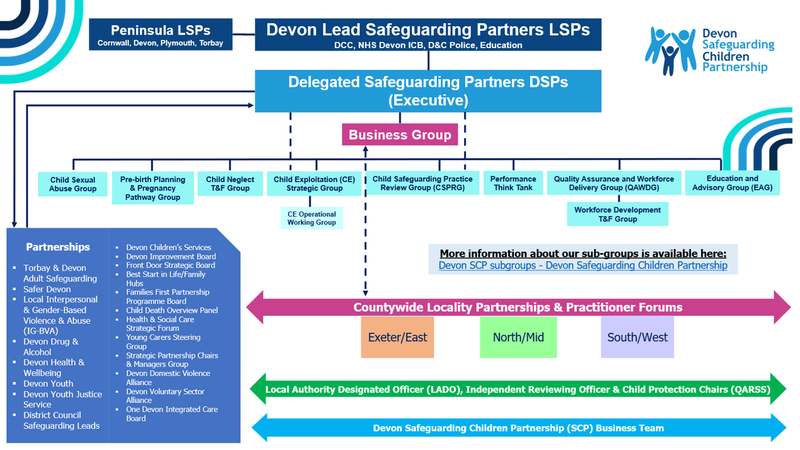
| Devon SCP Sub-Groups These groups focus on specific safeguarding themes and areas of practice: Child Sexual Abuse Group Pre-birth Planning & Pregnancy Pathways Group Child Exploitation Strategic Group Child Safeguarding Practice Review Group (CSPRRG) Quality Assurance and Workforce Delivery Group (QAWDG) Education Advisory Group (EAG) CE Operational Working Group (linked to exploitation work) Performance Think Tank Devon SCP Task and Finish Groups Child Neglect T&F GroupWorkforce Development T&F Group | Connected Partnerships and Forums Torbay & Devon Adult Safeguarding Safer Devon Local Interpersonal & Gender-Based Violence & Abuse (IG-BVA) Devon Drug & Alcohol Devon Health & Wellbeing Devon Youth Devon Youth Justice Service District Council Safeguarding Leads Devon Children’s Services Devon Improvement Board Front Door Strategic Board Best Start in Life/Family Hubs Families First Partnership Programme Board Child Death Overview Panel Health & Social Care Strategic Forum Young Carers Steering Group Strategic Partnership Chairs & Managers Group Devon Domestic Violence Alliance Devon Voluntary Sector Alliance One Devon Integrated Care Board |
Countywide Locality Partnerships and Practitioner Forums
We support and co-ordinate the countywide locality partnership and practitioner forums across Exeter and East, North and Mid, and South and West Devon. These forums bring together safeguarding professionals from across the partnership to share learning, discuss local safeguarding issues, identify emerging risks and promote effective multi-agency working. They also provide an important link between frontline practice and strategic safeguarding priorities, ensuring that practitioner experience, local intelligence and community insight inform partnership learning, quality assurance and improvement activity. They also strengthen professional networks, encourage constructive challenge and support a consistent approach to safeguarding across Devon.
Feedback from these forums has helped the partnership identify emerging themes, understand local safeguarding pressures and shape workforce development, assurance activity and partnership priorities. As a result, they continue to play a key role in strengthening collaboration and supporting a responsive, child-centred safeguarding system across Devon.
Devon SCP Business Team – plays a vital role in supporting the whole partnership and ensuring safeguarding activity is coordinated, effective and focused on improving outcomes for children and young people. They provide the day-to-day coordination of the partnership, supporting governance, meetings, project delivery, performance reporting, communications, learning and development, and quality assurance activity. They work closely with safeguarding partners to organise reviews, audits, training, conferences and learning events, while also ensuring that actions and priorities agreed by the partnership are progressed and monitored.
The Business Team is responsible for gathering and analysing safeguarding information, managing partnership data and performance reporting, supporting Child Safeguarding Practice Reviews and Rapid Reviews, and helping partners identify emerging themes, risks and areas for improvement. They also play a key role in sharing learning across agencies and ensuring that findings from reviews, inspections and audits are translated into practical improvements. Acting as the central point of coordination for the partnership, the Business Team helps connect the work of the Executive Group, sub-groups, locality partnerships and wider safeguarding networks. This ensures that information flows effectively across the system, partnership priorities remain aligned, and safeguarding activity is joined up and focused on making a real difference for children, young people and families across Devon.
During this reporting period, the Devon SCP Business Team were made up as follows:
- Partnership Manager – Jackie Colby (full-time)
- Quality Assurance Lead – Kate Nightingale (full-time)
- Workforce Lead – Chinara Davies (one day per week)
- Commissioning & Policy Officer – Alex Alder-Westlake (full-time)
- Communication & Marketing Officer – Tom Carter (full-time)
- Management Information Officer (Data) – Katie Cranston (part-time)
- Junior Communication & Marketing Officer – Kodey Cooper-O’Donnell (part-time)
- Business Support Officers – Elly Cobbett and Sarah Poat (both part-time)
- Workforce Development Assistant – Sharon Stentiford (full time)